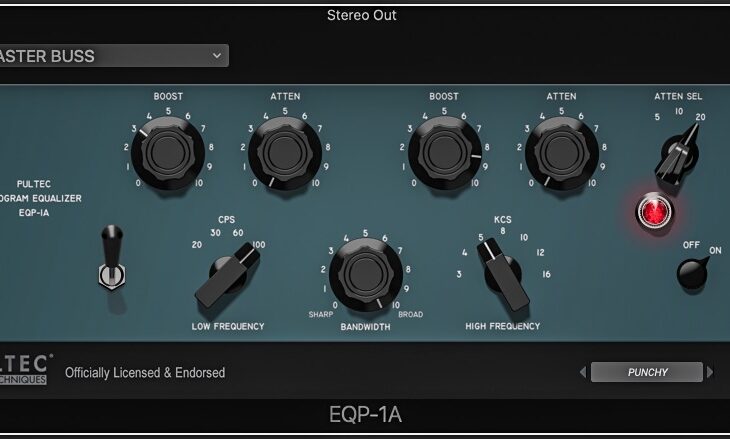
Throughout the history of digital audio workstations, there have been countless Pultec EQP-1A plugin emulations. Apogee developed the only Pultec EQP-1A plugin officially licensed and endorsed by Pulse Techniques. The original Pultec EQP-1A tube analog program equalizer, still a studio staple to this day, was released by Pulse Techniques (Pultec) in 1961, evolving from the earlier EQP-1 model and adding crucial features like a tube-driven gain stage and more frequency options, becoming the iconic version most emulated today. The mystique of the Pultec EQP-1A is never ending and often imitated.
Former Apogee Electronics co-owner and world class mixer Bob Clearmountain explains:
“I’ve used Pultec EQ’s ever since I started in New York at a studio called Media Sound. That studio had crap for consoles and so it was impossible to get a good sound. And so they had these Pultecs in individual racks but they were usually scattered all over the building in the other rooms and so I’d come in before my sessions really early before anybody else got in the building and I’d collect as many as I could lay my hands on and I’m stack them up in the room that I’m working in and patch them all in. That’s just where the sound was. They always sounded great on piano, snare drum, acoustic guitar, a vocal. I always had one on the electric guitar. When Apogee began developing their Pultec plugin, they worked closely with Steve Jackson at Pulse Techniques, the manufacturer of the original hardware. We did some listening tests right here in the studio between the hardware and the plugin and no one could tell the difference. Even Steve. Here’s a secret I may regret giving away, but I’ve used the Pultec on the snare drum for just about every mix I’ve done. Boost 100 Hz in the low frequency to about three and set the high frequency to 5k, set the bandwidth to broad and then crank up the boost to 10. You’re welcome.” This setting is, in fact, the snare preset in the Apogee EQP-1A.
The unique ability to simultaneously boost and cut at the same frequency, commonly known as the “Pultec Trick,” is used to create a complex, resonant EQ curve that adds weight and punch while removing “muddy” frequencies. Although the original hardware manual advised against doing this because they would theoretically cancel each other out, engineers discovered it works for two technical reasons. Mismatched Gains: The Boost control has slightly more gain than the Attenuation control has cut, resulting in a net boost at the selected frequency. Offset Curves: The boost uses a shelf curve, while the cut uses a bell curve (or a shelf with a slightly higher frequency point and broader curve).
Like all Apogee Electronics products, their EQP-1a sets the highest standard for an excellent sounding EQ and Apogee precisely recreates the Pultec EQP-1A’s unique characteristics. Big and powerful on the bottom and clean and sweet on the top, the Apogee EQP-1A is extremely powerful and useful, like any product that Bob Clearmountain has been involved in.
All major DAWs supported. Includes FX and FX Rack versions, and on Apogee hardware DSP in Element Series and Ensemble Thunderbolt audio interfaces and features DualPath Monitoring for near zero latency recording. Plugin formats: VST, VST3, AU, AAX macOS 10.14.6 and higher (including Silicon compatibility) Windows 10 and higher, Pace iLok account required $199. Also available in Pultec FX Bundle including MEQ-5 $299