

The quality of home studio recording has rivaled that of commercial facilities for years. That shift is evident in pop albums like Billie Eilish’s When We All Fall Asleep, Where Do We Go?, SZA’s Ctrl, and Charli xcx’s how i’m feeling now, all of which were recorded largely at home.
A consistent presence in home recording and Native Instruments (NI) has helped define the landscape through ongoing expansion of its creator tools and workflow refinement. One of its recent releases is Producer Strings, a forward-thinking string library developed in collaboration with the world-class London Contemporary Orchestra (LCO). Producer Strings works within NI’s free Kontakt Player which can be used across digital audio workstations.
With credits spanning film (Saltburn, Deadpool & Wolverine), video games (Call of Duty: Modern Warfare III), and collaborations with artists such as Radiohead, Justice, Taylor Swift, among many others, LCO has become the go-to ensemble for traditional compositions and modern productions alike.
Producer Strings is the latest addition to NI’s string library collection, but it stands apart from the others in several key respects. “The string libraries we have so far are primarily aimed at media composers. We wanted to fill a gap with a creative, modern, production-oriented strings library that can fit today’s songwriters and producers,” says NI senior product manager Ilay Bal Arslan.
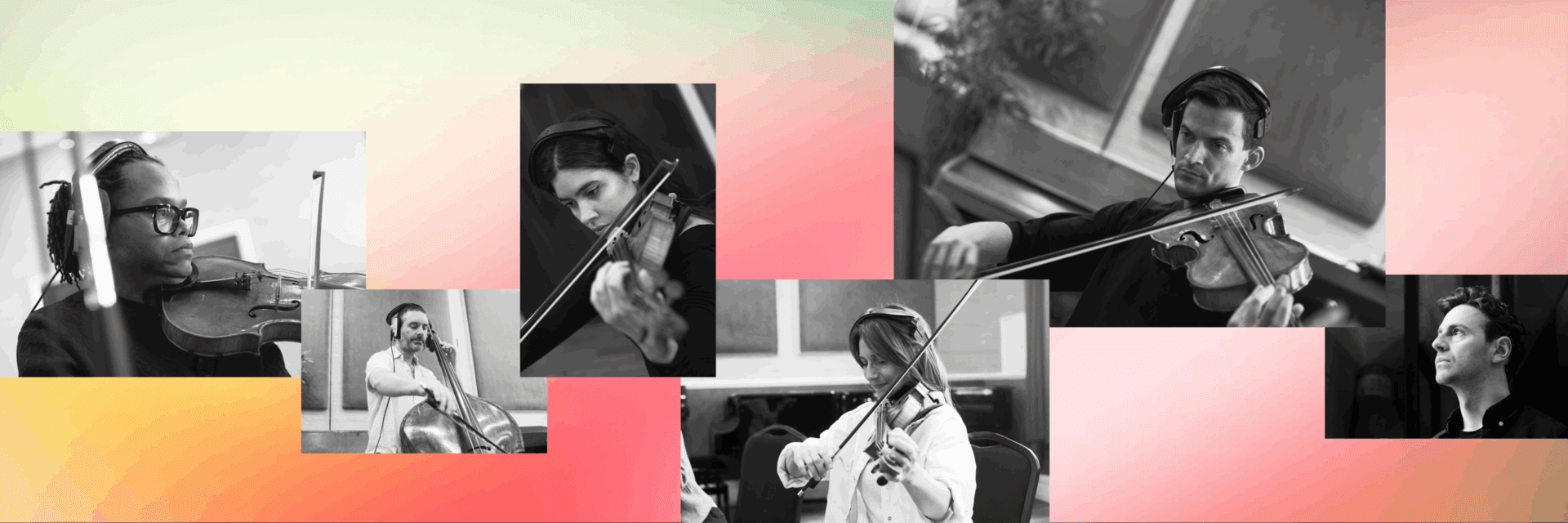
LCO’s accomplished musicians bring years of experience to the distinct performance styles of Producer Strings. Known for their classical training as well as their experimental approach, they offer four articulations: cluster blooms, which are notes packed together that swell outward or “bloom;” harmonic flickers, quick, short, textural gestures; cascading runs, fluid sequences that rise or fall; and percussive pizzicatos, aggressive plucks for sharp motions.
If that terminology is unfamiliar, there’s no need to worry: there is a glossary that explains what each articulation is and how it is created. Producer Strings has a user-friendly, color-coded main interface. Each color corresponds to a different articulation, and building a piece of music is not unlike painting an abstract canvas. There are four easy-to-stack layers for constructing pieces, and you can choose a different instrument for each layer. The colors shift depending on how you combine them.
Each layer features dials to adjust volume, tuning, space, warmth, attack, release, panning, and range, offering a high degree of manipulability. Volume and tuning can be modulated with low-frequency oscillators of different shapes, rates, and amounts, including a tempo-lock option. There is also an “auto-arranger,” which is a voice-distribution tool that distributes notes played across the four layers for a balanced, varied and richer sound. There is also a preset browser with options for instruments, characters, and more. These automatically change color to indicate which instruments are being used to create the preset sound.
“Multisensory,” is how Arslan describes Producer Strings. For first-time users, she suggests trying the “randomizer” on the preset browser which creates “a visual output that you either like, or not. This is curated randomization, meaning we made sure these presets are going to sound great. This is how you start playing with things. It’s inspiring you to easily find things, and it happens without disrupting your creative flow.”
Producer Strings has also integrated synth sounds into the interface. This development stems from LCO’s collaborations with artists and how they have incorporated strings into their productions. LCO’s co-artistic director and co-principal conductor Hugh Brunt explains: “Artists and producers have melded our strings—particularly the cellos and basses on the low end—to create a singular color for those basslines with fizzy analog synths. Having that robustness of the synth combined with the human expression of the strings means there are always subtle variations. That was something we wanted to offer.”
The strings were recorded at London’s legendary RAK Studios with engineer/producer Fiona Cruickshank, who has collaborated with the LCO on numerous occasions. They focused not only on performances but also on microphone choice, placement, and mixing. “She has brilliant ideas on how to layer the strings so that when violins, violas, cellos, and bass are played as an ensemble patch, there’s a rich, expansive sound and spatial interest—just as you would get if you were working with those players in that room for real. It creates the beautiful stereo image the user would want,” says Brunt.
Cruickshank also suggested placing the violas closer to the front, drawing on her experience mixing records and noting that violins are usually too present and bright. Moving them back allows the cello to be featured more prominently, with the double bass in the middle, making the ensemble easier to balance in the mixing process.
“We captured a lot of sounds that haven’t been recorded in any shape or form,” says Brunt. “We wanted to record them in a way that was vivid, charged, and polished. Even out of the box, they’re inspiring, but there’s also space for infinite possibilities and permutations. Hopefully, the four-layer engine of strings and synths—and the blending of the two—creates singular sounds that the user can customize and truly take ownership of.”