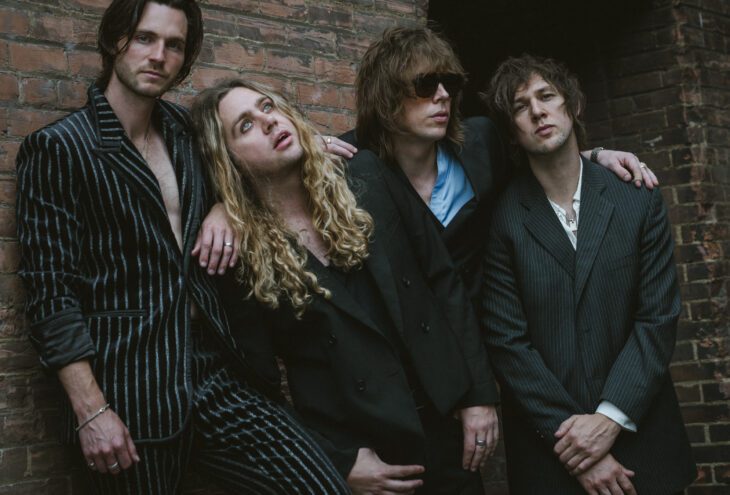
The Band Members: Luke Spiller, lead vocals; Adam Slack, guitar; Jed Elliott, bass; Gethin Davies, drums.
The Storyteller: Luke Spiller
The Song: The honey-smooth baritone voice of Gordon Lightfoot’s “The Circle Is Small” struck a chord with modern-day troubadours, showing how richly detailed, vantage-from-afar storylines can be intertwined with gentle harmonic tension and sweet, piquant phrasing.
The Background: Luke Spiller — the charismatic, swaggering frontman known for his stadium-strength, operatic rock vocal performances with the verbose classic-rock revivalists The Struts — describes how Gordon Lightfoot’s “The Circle Is Small” revealed to him that an artist can “strive to be a wordsmith while also infusing beautiful melodies at the same time.”
While Lightfoot’s California Laurel Canyon-influenced pop meets his Canadian Shield styled folk-rock might seem far removed from The Struts’ braggadocious musical spectrum, the band’s rock-star storytelling is often built with lush harmonic layering in mind. This can be heard on tracks such as “Hands on Me” and “Strange Days,” as well as their intimate acoustic rendition of Queen’s “We Will Rock You.” That intersection —where poetic rock narrative meets rich, dramatic arrangement — becomes even more pronounced on Spiller’s 2025 solo release, Love Will Probably Kill Me Before Cigarettes and Wine.
The Story: Having spent more than 13 years in the industry with The Struts, touring around the world as headliners and as openers — including Foo Fighters, QOTSA, The Rolling Stones, and The Killers — Spiller has charted a considerable amount of alone time on the proverbial tour bus. During these introspective, off-stage hours, he immerses himself in music.
Spiller recalls his initial encounter with the song: “I first heard 'The Circle Is Small' on the back of my tour bus, driving through the middle of America one early summer morning. I played it on repeat for an hour or so. I get obsessed with songs quite easily and will usually play them to death until I’m utterly sick of them. The song really struck a chord with me — I fell in love with the lyrics and production.”
For Spiller, analyzing the stanza of Lightfoot’s “The Circle Is Small” dips into the emotive. “The lyrics — ‘I can see it in your eyes and feel it in the way you kiss my lips, I can hear it in your voice whenever we are talking like this…’ — are a stunning opening few lines for a chorus.” He adds, “It’s equally heartbreaking. The song has a joyful melody that’s met with this devastating story. Genius.”
After hours of examining the song’s structure, Spiller realized that the true strength of Lightfoot lies in his poetic narratives, surfing through waves of harmonic threads. “It taught me that you can strive to be a wordsmith but also[inject beautiful melodies at the same time. I love Leonard Cohen and Bob Dylan, but Gordon is one of the few singer-songwriters who applies poetic lyrics with as much melody as any Beatles or ABBA song. That, in itself, is truly inspiring.”
Lightfoot’s novella-style of storytelling also drew Spiller toward the troubadour stalwarts of the 70’s. “It also led me to dive into more Paul Simon, Cat Stevens, Jim Croce, and Carole King. All of which I’ve been obsessed with since.” These artists, like Lightfoot, taught him how to intertwine lyrics and helped shape his songwriting.
Spiller further reflects on whether Lightfoot’s use of subtle orchestration to create emotion influenced his own music: “Absolutely. I was listening to this song nonstop while writing my debut solo record. Lightfoot’s string section really inspired a lot of my own approaches in using [orchestration] in music.” This influence is particularly evident in his songs recorded with the late Foo Fighters drummer Taylor Hawkins, “Angel Like You” and “Devil in Me,” which feature epic atmospherics crafted with a 007 film consideration in mind.
Lightfoot’s influence has continued on a somewhat unexpected, even deeper level — one that Spiller only recently discovered. “My mum, funny enough, loved this song when she was in her early twenties. She never mentioned how obsessed she was with it [until later]. I find it fascinating how music can sometimes be passed down genetically — at least that’s my belief.”
As with his mother, the long-lasting impact of Lightfoot’s influence on Spiller remains strong and shows no sign of fading. “It still makes my Spotify top five songs each year! That shows my true dedication.” Wanting to give a nod of respect and admiration, Spiller adds, “I owe [Lightfoot] many hours of pure pleasure and inspiration, and for that I sincerely thank you.”
For Spiller, the song is spot-on for musicians in need of a creative spark: “If you’re looking for the perfect driving song while reflecting on a love that didn’t work out —and broke you into a thousand pieces — then this song is for you. It will give you the perfect soundtrack to slow dance with yourself in the kitchen while clutching a stiff drink and a cigarette hanging from your lips.”
Photo by Madeline Northway