By the time a guitar survives years of live performances, price becomes irrelevant. What matters is whether it holds tune, projects reliably through a PA, and delivers a sound that supports the song rather than distracting from it. After decades on the road, one conclusion has become increasingly difficult to ignore: low-cost guitars, properly set up and thoughtfully amplified, can perform at a professional level.
Time off the road—rare as it is—provides an opportunity to reassess long-held assumptions about gear. Revisiting instruments that have endured sustained touring reveals that some of the most dependable tools in my collection were also the least expensive. In practical terms, they have outperformed expectations while demanding very little in return.
An Unplanned Shift
This realization didn’t come from a deliberate search for budget instruments. It happened gradually, beginning in the years following my time with the Atomics. Playing smaller rooms throughout Kentucky, Tennessee, and Georgia meant adapting to intimate spaces where immediacy mattered more than volume or sheen. Berea, KY became a frequent stop, and with downtime between gigs, pawn shops became informal laboratories.
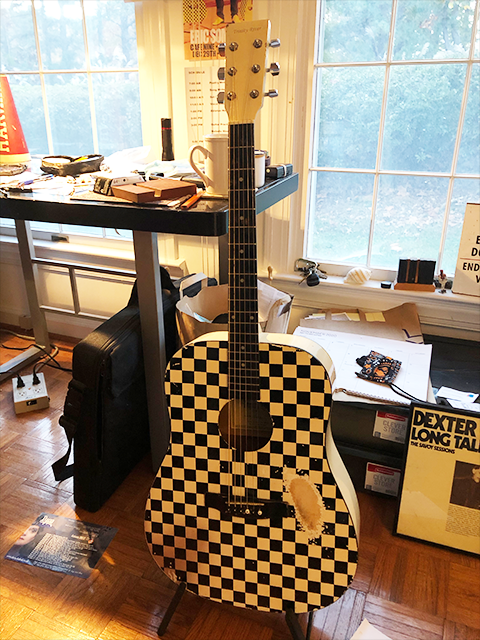
In Richmond, KY, a checkerboard-patterned parlor guitar caught my eye. It was inexpensive, visually distinctive, and clearly not designed with touring musicians in mind. Still, it suggested something different—a break from the assumption that quality tone required a significant financial investment.
Preparing for the Stage
The primary challenge with these guitars was amplification. Most lacked onboard electronics, making them impractical for live use without modification. After researching options and consulting fellow musicians, I installed a Fishman Matrix II undersaddle pickup.
The results were consistent and repeatable. The pickup produced a clear, balanced signal with strong low-end response and articulate highs, while preserving the natural dynamics of the instrument. Onstage, the guitar translated well across different PA systems without introducing unwanted coloration.
Encouraged by the outcome, I acquired additional Trinity River parlor guitars and outfitted them similarly. Each performed reliably, reinforcing the idea that thoughtful electronics can elevate modest instruments into dependable live tools.
Discoveries on the Road
Further validation came in Appleton, WI, where I encountered Jay Turser parlor guitars, often referred to as Jay Juniors. One model—finished in sea-foam green—was fitted with the same Fishman Matrix II pickup and upgraded Schaller M-6 tuning machines.
That guitar quickly became a primary performance instrument. Its tone was earthy and direct, well-suited to small stages and seated rooms. Importantly, the electronics amplified its natural voice rather than reshaping it. The visual impact of the instrument also translated well under stage lighting, an often-overlooked factor in live performance.
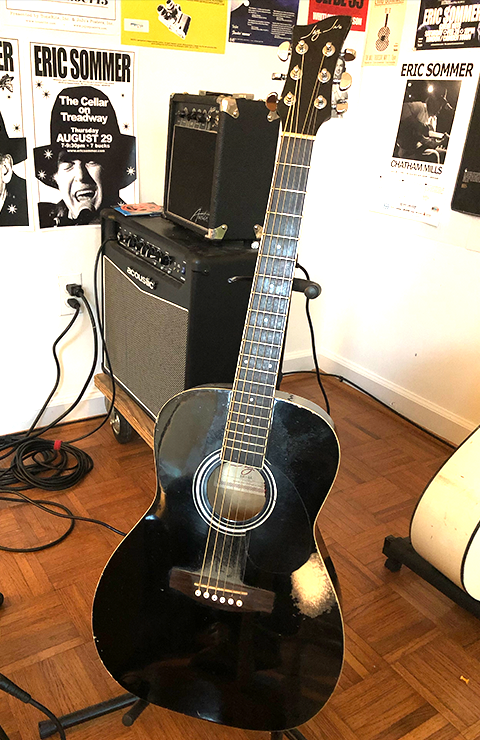
A second Jay Turser, finished in black and modified in the same way, delivered similarly strong results. Over more than a decade of consistent use, it has proven durable and stable, surviving the kind of wear that touring inevitably inflicts.
Tone Is Not a Price Point
One of the persistent myths in the guitar world is that cost correlates directly with tonal quality. In reality, even instruments from the same manufacturer and series can vary significantly in character. Each guitar develops its own voice.
The Trinity River checkerboard guitars exemplify this. Years of aggressive pick use have worn through the finish below the sound hole, exposing material that bears little resemblance to traditional tonewood. Despite this—or perhaps because of it—the guitars continue to sound strong and responsive.
Their imperfections contribute to their identity. They are not precious objects; they are working instruments. And in that role, they excel.
Context and Contrast
This is not an argument against high-end guitars. I own several Taylor instruments whose refined tonal balance and consistency perform exceptionally well in both studio and live environments. Their depth, resonance, and predictability make them valuable tools in controlled settings.
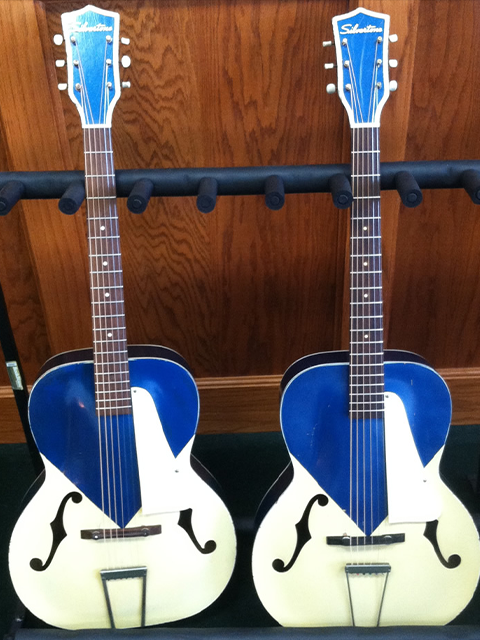
However, they coexist alongside lower-cost guitars that have proven equally effective under real-world conditions. Onstage, reliability and musicality matter more than branding.
A Practical Conclusion
With touring temporarily paused, there is time to engage with these instruments outside the pressure of constant performance. In a quieter environment, their strengths remain evident: playability, consistency, and an ability to support the song without calling attention to themselves.
For working musicians, the takeaway is straightforward. Great sound does not require a large investment. It requires an understanding of how instruments function in live contexts and a willingness to judge them by performance rather than reputation.
In the end, these guitars earned their place not because they were inexpensive, but because they worked—night after night, on real stages, under real conditions.