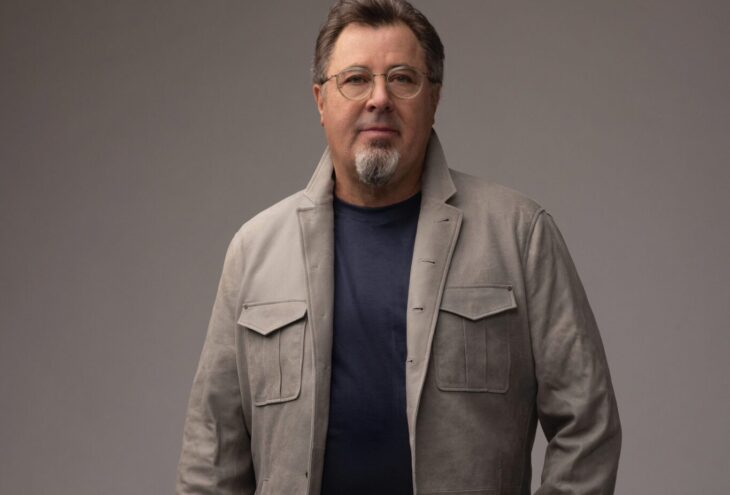
Smiling in front of a few thousand fans at the Fox Theatre in Detroit during the summer, Vince Gill promised to tell some stories and “play for as long as you’ll let me.” He also told fans that if more than three hours of music proved too much, “you won’t hurt my feelings” if they were to leave early.
As if.
At 68, Vince Gill is in the realm of bona fide national treasure. He’s a multi-threat as a performer, singer, songwriter, instrumentalist and producer. He’s been part of notable bands—Pure Prairie League, Rodney Crowell’s Notorious Cherry Bombs, The Time Jumpers and, since 2017, Eagles. Forty years ago, he started releasing his own music, beginning with The Things That Matter with 18 more albums since, including collaborative efforts with pedal steel virtuoso Paul Franklin. Fifteen of those titles landed in the Top 10 of the Billboard Country Albums chart, with nine selling platinum or better.
From those have come more than two dozen Top 10 country hits, including chart-toppers such as “I Still Believe in You,” “Don’t Let Your Love Start Slippin’ Away,” “Tryin’ to Get Over You” and, with Reba McEntire, “The Heart Won’t Lie.” His 1995 hymn “Go Rest High on that Mountain,” meanwhile, has become a memorial staple that Gill himself sang at music legend George Jones’ funeral during May of 2013. Gill’s won 22 GRAMMY Awards—the most for any male solo country artist—18 Country Music Association Awards, and six Academy of Country Music trophies, including a Career Achievement Award. He was inducted into the Grand Ole Opry in 1991.
And that’s the tally as of this year, which also marks 50 since he left his home town of Oklahoma City, OK, to embark on his life in music—and which he’ll be commemorating with a series of monthly EPs drawn from a cache of some 12 dozen songs he’s accumulated but not yet released, part of a new “lifetime record deal” he recently signed with MCA.
“I’m just filled with gratitude, just gratefulness for being able to have had a lifetime of doing what I love more than anything,” Gill tells Music Connection via phone, prior to that Detroit show—part of his An Evening With Vince Gill tour. “That’s a gift in itself. I love getting to play—still do. It feels like it did when I was 18. That hasn’t changed.”
Joe Walsh calls playing alongside Gill in Eagles—which has currently found a residence at Sphere in Las Vegas—"terrifying. He’s that good. He just plugged right into the band, with the vocals and of course his guitar, and he does everything just as right as can be.” Bonnie Raitt, who sang on Gill’s 1987 album The Way Back Home, considers him “one of the most extraordinary voices I’ve ever heard—soulful, heartbreaking—and his guitar playing is fantastic. He’s a great musician all the way around, and just a wonderful, modest person.”
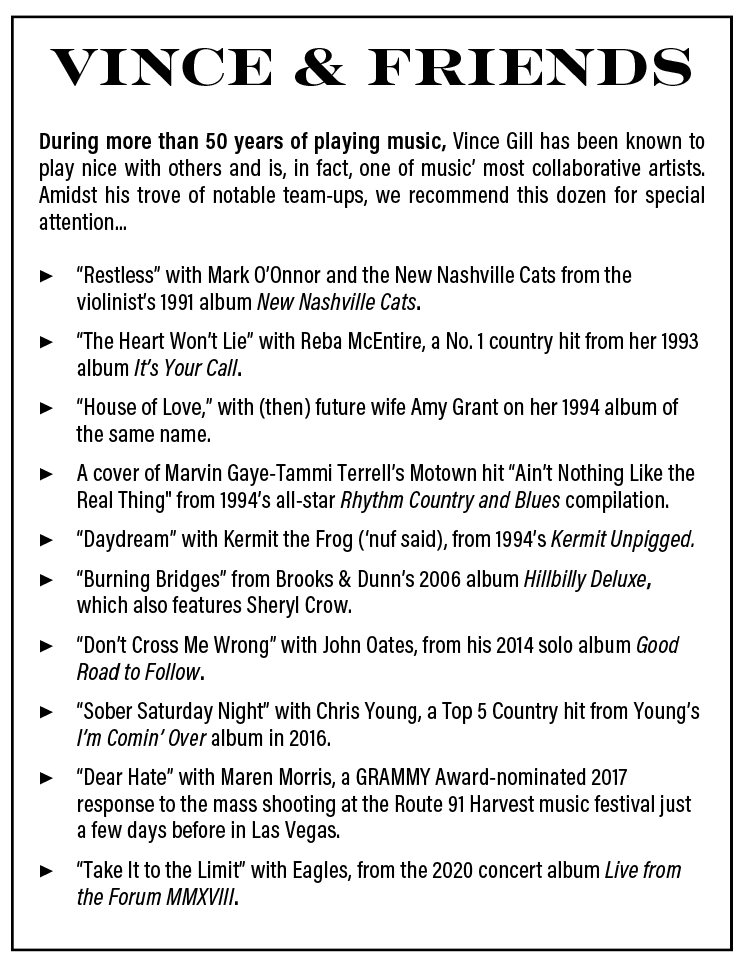
Don Was produced Gill on the 1994 compilation Rhythm Country and Blues—a duet with Gladys Knight on Marvin Gaye and Tammi Terrell’s “Ain’t Nothing Like the Real Thing”—and has worked with him on other occasions. “The thing that makes Vince Gill so great is that he’s got tremendous control over his instruments, both the guitar and his voice,” Was explains. “His technique is beyond reproach, and it never gets in the way of emotion. He’s one of the most soulful singers and most soulful guitar players I’ve ever heard...And he’s versatile; he fits into the Eagles as easy as he could into the Allman Brothers.”
Gill could have gone in a number of different directions, in fact. He was raised in music; father Stan Gill, a judge, played guitar and banjo, while his mother Jerene sang and played harmonica. “Growing up I heard everything, man—rock, country, bluegrass, all of it,” recalls Gill, who was tutored in playing by his father as well as a local guitarist named J. Julian Akins. He’d eventually add banjo, mandolin, bass guitar, dobro, and fiddle to his repertoire.
“We listened to the Grand Ole Opry [radio broadcasts]. I heard...maybe not everything, but I heard a lot.” Bluegrass exerted the greatest pull initially, as Gill led his group, Mountain Smoke—which he remembers was booed off stage when it opened for Kiss during the spring of 1976—and then played in Bluegrass Alliance with Tony Rice and then Boone Creek, whose lineup also included Ricky Skaggs.
“I liked how familiar it felt right off the bat,” Gill recalls. “I love the democracy of a bluegrass band, how they play together and make the sound that it makes. It just really needs everybody to equally come to the table with the gifts they have and the way the music works, minimal instruments and a lot of power when it’s done right.
“What was unique is with bluegrass I felt successful right off the bat. In those first bands I played in there were a lot of great musicians and a lot of good history, so it was a great way to get started. I felt like I was playing with some of the best bluegrass musicians as a young kid, and that’s inspiring. It feels like, ‘Hey, I’m doing something pretty worthwhile here.’”
Gill also learned certain tools of the trade, as it were, that he’s carried throughout his career. “It takes a really great understanding of harmony stuff and how that works,” he explains. “You’ve got the famous kinds of stuff with the Stanley Brothers or (Bill) Monroe, the way Bill would sing the high part and Bobby Osborne was singing lead on top and the two harmonies were below him...So there were all kinds of neat things to learn early on that I’ve been mindful of ever since.”
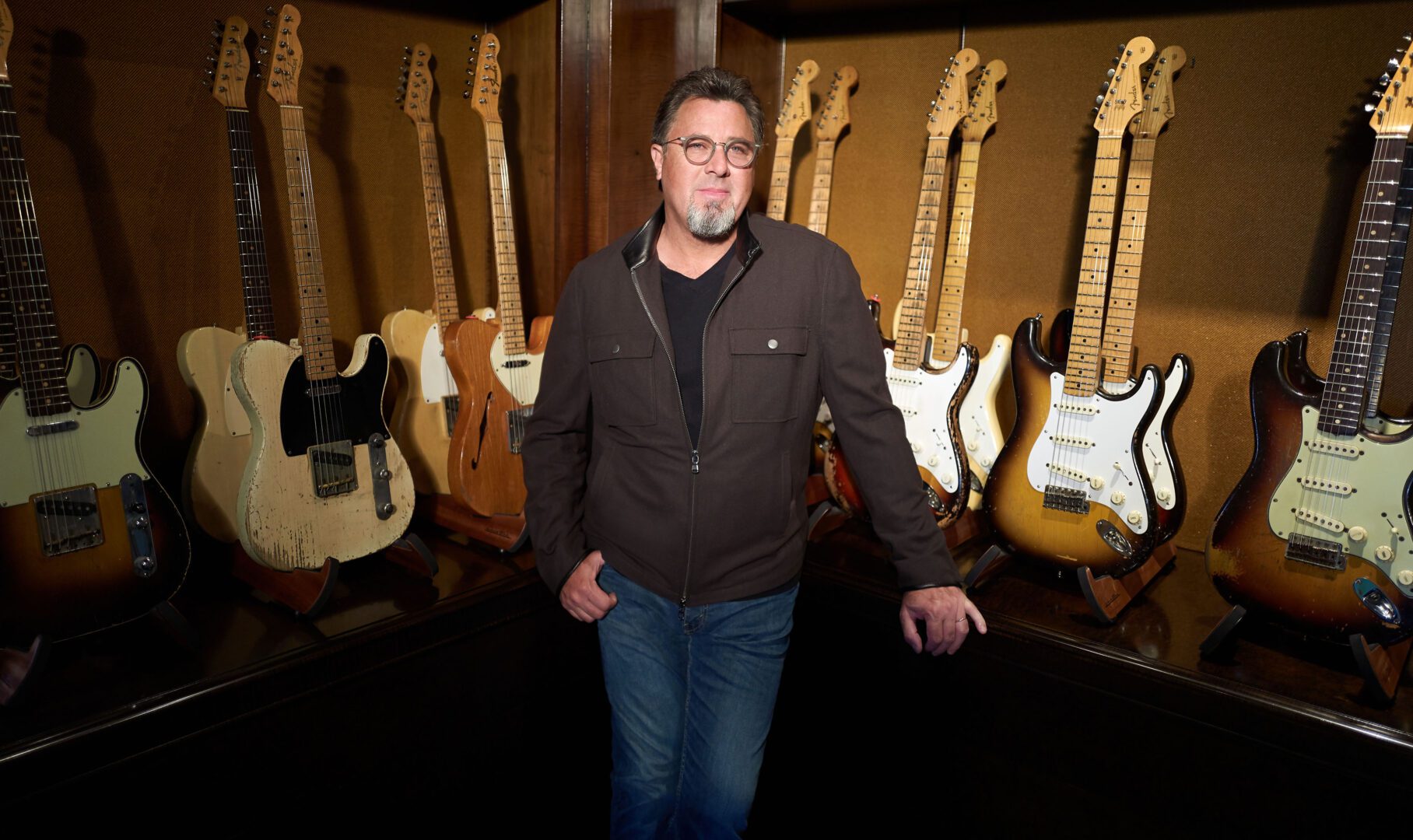
Joining Pure Prairie League in 1978, after moving to Los Angeles a couple years before, gave Gill a berth for his songwriting as well as his playing. He appeared on three studio albums with the group and sang lead on the Billboard Hot 100 Top 10 hit “Let Me Love You Tonight.” He left to back Crowell in the Cherry Bombs and was generally happy being a guitar-slinging band guy more than anything else.
“I played in different bands and did pretty okay with that,” he recalls. “I didn’t have to be the front guy or the focal point; if I got to be in a good band and play great music as the harmony singer, lead guitar, rhythm guitar...just getting to do it was a gift. I had the respect of my peers and other musicians. All those kinds of things mattered more to me than cracking the code of being a big shot smarty pants, as my friend says.”
Nevertheless, Gill began to feel an itch to strike out on his own. “After my first child, Jenny, was born in 1982, I kinda saw the writing on the wall that Pure Prairie League was not my future,” he explains. “And I said, ‘I’ve been writing more and more songs; maybe I could make it as an artist.’” He was further encouraged by Cherry Bombs bandmate Tony Brown, an established hitmaker in Nashville, who recommended him to RCA Records in Nashville (and would go on to produce Gill’s best-selling albums).
“Tony said, ‘You should be a country singer. You talk country, act country. All that other [pop stuff] isn’t in your wheelhouse as much as when you’re doing country music,’” Gill says. “So I made a decision to try it, got a record deal in ‘83, made my first record and struggled for years trying to get a hit, but I didn’t know how to do anything else. I always thought they were not gonna like me coming into [Nashville] ‘cause I’m moving from L.A. and ‘What’s a pop guy from Pure Prairie League doing trying to be a country singer?’”
But focusing on country, he adds, made a great deal of sense, especially with the genre starting to become more welcoming of pop flavors at the time.
“I just think it was more natural, more of my upbringing, to go that way,” Gill explains. “It had more to do with my bluegrass years and my mother and father’s love of country music and the records they had when I was a kid, how drawn I was to Merle Haggard and Buck Owens and Patsy Cline—just as much as I was to the pop stars and singer-songwriters. I just loved it all."
“But I just felt like bluegrass wasn’t enough to hold me, and making country-rock records was probably not enough to hold me. I wanted to make country records. I wanted to make records that felt like [Merle] Haggard. That’s what I love the most. I wanted to crack that code, and I did for a little while.”
“The one thing I wish I hadn’t done so much of is I tried to make records I thought the record company would like because of who they had as artists and what their stance was and what they seemed to gravitate towards. In hindsight I think that was probably an error, but not enough of one to worry me too much.”
Nonetheless, Gill became one of country’s most dominant forces during the ‘90s alongside Garth Brooks, Clint Black, Alan Jackson, Travis Tritt, Tim McGraw and the like, reeling off eight platinum albums and four consecutive multi-platinum efforts. Gill also hosted the CMA Awards starting in 1991 and going through to 2003.
“Then,” he acknowledges, “it was back to not as much interest; they kind of turned the faucet of fad to the younger folks,” he says—without lamenting his fate. “You knew it would happen, so it didn’t bother me. I was pretty consistently okay with that the whole time. I knew I had enough talent I could go back and play guitar in everyone’s band and do sessions and that would’ve been okay, too.”
Gill—who married his second wife, fellow singer and songwriter Amy Grant, in 2000 after meeting during a holiday concert special in 1993—hardly faded away. He continued recording and winning awards, re-grouped the Cherry Bombs during 2004 and two years later released one of the most ambitious albums of his career—These Days, box set whose four albums each explored a different style, with a corps of guest players and vocalists.
It won a GRAMMY Award for Best Country Album and was nominated for the prestigious Album of the Year. He also began releasing albums with the Time Jumpers, a Western swing band he joined during 2010 and stayed with for a decade, and with whom he won another GRAMMY.
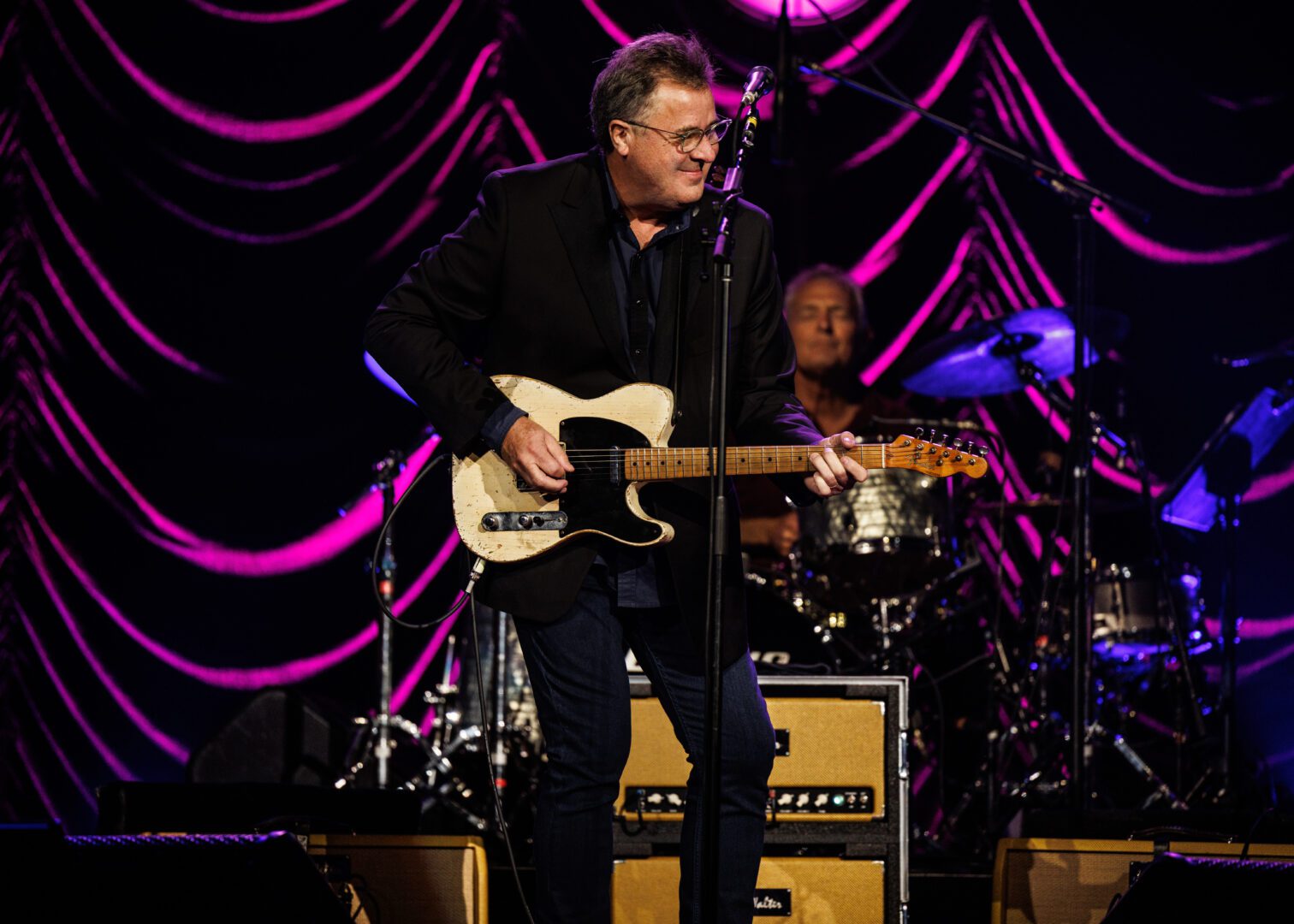
There was one adventure he didn’t expect, however.
“In 2017 I would’ve never thought in a million years that Don Henley would call and say, ‘You want to come finish this ride out with me and come play with Joe [Walsh] and Timothy [B. Schmit]?’” says Gill, who was friendly with all of the Eagles—including the late Glenn Frey, who he was called in to replace (along with Frey’s son Deacon) when the band decided to continue after Frey passed away during January of 2016. “I was just like, ‘God, can you make the question harder? Of course I’ll come. It’ll be perfect.’”
“It’s such a great...I think more than anything, the validation I feel like it gives me, for a lifetime of work and what I’ve tried to accomplish and tried to be good at. For one of the best bands in history to recognize it and ask me to come along for their final ride is really special.”
He does acknowledge some initial reservations, however. “Oh, I think everybody was unsure if it was even doable,” Gill says, “and then it was and it was eerily cool and kind of, ‘okay...’ I mean, the only reason I got to do it was because of something sad and something tragic in the passing of Glenn, so I keep that in the forefront of my mind ‘cause he was an old friend, and I actually knew all those guys fairly well over the years. But I don’t beat on my chest and go, ‘Hey, I’m in the Eagles!’ I never bring it up very often.”
“I remember the first gig I did with those guys, I was really, really scared. I could feel the apprehension in the people sitting in the crowd; it’s a stadium and there’s 50,000 people there or whatever and it’s like, ‘Good luck. You’re gonna be the guy that sings all of Glenn’s songs.’ And the first song, ‘Lyin’ Eyes,’ I remember singing a verse and chorus and I felt like everyone was taking a deep breath and going, ‘It’s gonna be okay.’ It was palpable, and I was grateful for it.”
One thing you won’t hear Gill doing with Eagles, however, is any of his own songs.
“I was singing an old song of mine, ‘Whenever You Come Around,’ at sound check before the first show. Don heard it and came over and said, ‘What is that song?’ I said, ‘It’s an old hit of mine from years ago.’ He said, ‘Man, we should work that up and do it,’ and I said, ‘Don, with all respect, I’d rather not.’ He said, ‘Why?’ I said, ‘Look, what I’m getting ready to do is not gonna be easy, and I really don’t want to give these people one more reason not to like me or not accept me—’I didn’t come here to hear a Vince Gill song!’”
“He said, ‘Man I really respect that.’ It was my way to not only protect myself; it seemed like the right thing to do. Still does. But it meant something to me that Don said that. Somebody asked him, ‘Why did you get a country guy in your rock band?’ and he laughed and said, ‘He knows how to be in a BAND.’”
With Eagles having transitioned from a farewell tour into the Sphere situation—”It’s pretty cool, and I think it’s a great way to keep the band going,” Gill notes—Gill also took the opportunity this year to refocus on his own music. He hit the road with his own band, a nine-member all-star crew that included the likes of Jim “Moose” Brown on keyboards, guitarists Tom Bukovac and Jedd Hughes, pedal steel player Eddie Dunlap, and backing vocalist Wendy Moten.
“I just missed playing my songs,” Gill says. “Y’know, building the career catalog of all that stuff for the last 40 years, it’s just fun to remember these songs and play ‘em.”
More importantly, the shows were also woodsheds for new material—and a lot of it; during the Detroit show he incorporated nine brand new songs into the set list, nearly a third of the overall show, giving fans an early taste of the Mavis Staples-inspired “Some Times,” the guitar love song “Nobody Held Her Like Me,” the moving military tribute “When a Soldier Dies,” the soulfully defiant “March On, March On” and “Benny’s Song,” a bona fide tear-jerker about Gill’s longtime guitar tech and best friend since grade school.
“My audience has always been willing to go with me any way I choose,” Gill says, “and...we always finish up with familiar stuff, so they go home happy.”
Many of those specific songs will be heard on the first couple volumes of 50 Years From Home, the series of monthly EPs that’s slated to commence in October with Vol. 1: I Gave You Everything I Hadand Vol. 2: Secondhand Smoke sits on the runway. “I have this wealth of information and treasure trove of songs, and I started wracking my brain about how I can find a way to really celebrate this music” he explains. He credits a creeping sense of mortality—the subject of more than a few of these songs, in fact—as one impetus for driving this prolific spate.
“Part of it is just how much I love being creative and realizing that I’m 68 years old, and the pages of time has flipped to the other side of the dial,” Gill says. “That puts a burr in your saddle—it has for me, anyway. The more I’ve done it, the more I’ve learned how to do it better—how to be more patient, where not to waste my time, what to do and not to do, to be willing to edit myself and keep digging.”
“Experience is experience; there’s no shortcut. This is what comes from doing this for 50 years.”
Recording at his own Brushwood Studios near Nashville with his corps of musical luminaries, Gill is curating each volume of the series, right down to choosing cover images of specific instruments that seem appropriate to the disc they’re part of. “I try to find six songs that seem cohesive with each other...that sit well together,” he explains. “I love the motion of music; that’s what I got into it for. It stirs something inside me that I can’t describe. I just feel it, and the songs I do and the way I sing ‘em and the way I play ‘em tries to convey those emotions.”
By the time each of the EPs comes out, Gill hopes to “have a little bit of everything,” and in doing so create a microcosm—albeit a lengthy one—of what his career has been about since leaving Oklahoma those 50 years ago.
“I think that what I’ve enjoyed most about my career is the diversity of it,” he says. “As I look at the entirety of all this, there’s some ridiculously traditional country music stuff, there’s some pop stuff that could get played on Yacht Rock Radio, some rockin’ tunes with great swagger, singer-songwriter kind of songs.”
“And at the core of it all is this knucklehead, me, that loves all kinds of things.”
Photos by Dave McClister and John Shearer