
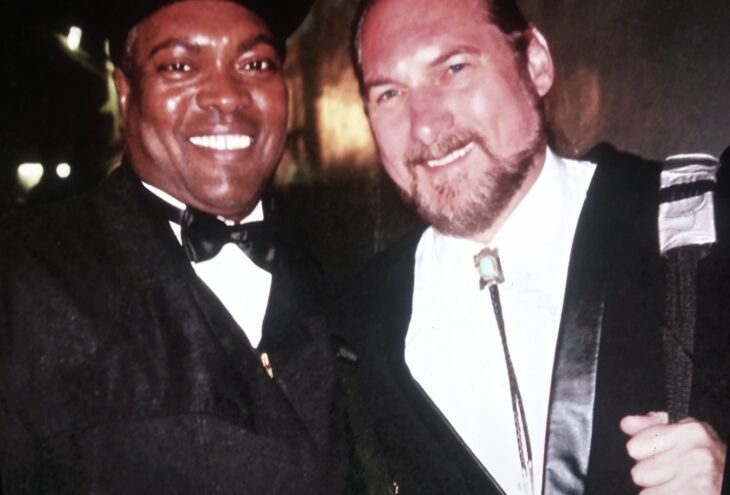
In memory of the great Steve Cropper, who has tragically passed away, we're publishing this interview with Harvey Kubernik (Copyright 2007, 2025).
Photo by Jim Roup
I remember a Hollywood May 1975 visit to Cherokee Studios on Fairfax Avenue during Rod Stewart’s Atlantic Crossing sessions. Steve Cropper, Stewart and engineer Tom Dowd regaled me with anecdotes about Stax Records. I went out to eat with Rod and Cherokee co-owner Con Merton, at the Cock ‘n Bull tavern on Sunset Blvd. Excellent trout.
Steve Cropper: “I don’t think there ever was or ever will be a band that had the magnetism that Booker T. & the M.G.’s had, whether they backed somebody or played on their own. In our high school days and upbringing, we had that band mentality thing, because if some guy wants to go out there and ego stage, he’s gonna blow it for everybody else. We learned to play as a unit in the studio. We were there not for ourselves but for the artist we were playing behind. In the studio, when I was writing songs and starting to record them, I always saw it in my head as a finished product. I knew where to go with it. Booker T. Jones and Steve Cropper. Al Jackson, Booker, Duck, and I grew up playing nightclubs in Memphis. Wayne Jackson grew up that way. You have to play as a unit. Playing live, like at Monterey, if a vocalist is not there, I’m playing vocal parts. When a vocalist is there, I back off and play rhythm and fills.
“The way I recall it, they took us over to the festival in a school bus, we could hear the music, we heard a concert going in that afternoon. Now, we didn’t play until that night but they took us over early, ‘cause some of the guys wanted to hear some of the other artists. And, the Association was on stage as we pulled up, and I will never forget that. And here’s a connection, and I always loved their records on the radio, the influence of the Association in 1966, ’67, that the bridge on ‘Sittin’ On The Dock Of The Bay’ that I wrote with Otis was inspired by my like for their music. Hearing them was a little thing, but that was the inspiration for it, because we knew we had a hit, and we wanted to make it pop.
“To me the Association loved R&B but they were a pop group. You know what I’m saying? So that’s sort of the way I was trying to go with that. Of course, with Otis singing it it became an Otis song. He got the idea when he was staying at a houseboat later when he was workin’ the Fillmore West.
“The Monterey DVD that Pennebaker put together Booker and I did interviews for it. The music leaps off the film. There was an energy. And there’s no need for me to be bragging on myself and I don’t ever do that, and it’s not an ego thing and all that, but I don’t think there ever was or will ever be a band that had the magnetism that Booker T. and the MG’s had. Whether they backed someone or played on their own
“I saw one band that night, a band from Canada. The Paupers. They blew me away. Because they had a style unlike anyone else. We also saw the Electric Flag. I didn’t know who I was seeing. It was like Stax, and I didn’t know until later Michael Bloomfield’s devoted love for Stax and the Staple Singers. I liked the ‘Flag that day.
“And we flew up there from L.A. on the plane with Paul Buttterfield. I saw his set. He was awesome, and years later we worked with him with Levon Helm.
"At Monterey, we didn’t have to do sound check, rehearsal, nothing. Just plug up and go out there and play. Our clothing was different than the flower children. And that was the start of ‘be yourself and do your own thing.’ It was sort of a break away from freedom of teachers, from home, from parents, from society. That’s how that all got started. This freedom that we weren’t allowed. And, I think it was all around the Vietnam time, and we felt very goverened by the government, that they were gonna tell us what to do, when to do, where to do, how to do, because of the (military) draft.
“And I think when music started as more of a religious thing. And, the smell was in the air. (laughs). If you didn’t do anything by then you definitely got a contact high at that concert. (laughs). Earlier when we had the Mar-Keys with the hit song ‘Last Night,’ we were on a show in front of 30,000 people in the Orange Bowl in Jacksonville (Florida), with the Everly Brothers, Tex Ritter and Jerry Lee Lewis.
“Otis had found his audience, and Monterey helped him cross over to a wider white pop market. They already knew how big he was in Europe and Europe was not an ethnic rhythm and blues audience. It was more general. He was big in France and he was big in England. And he was big, and Phil Walden and Atlantic knew that, and they wanted that same kind of recognition over here, and they were finding it very difficult to get pop radio play. No problem getting R&B play whatsoever. So, we knew what we wanted to do. Without question, the Stax Volt tour itself of England and Europe changed everybody’s life. It changed the musicians and the executive end. Most of the guys in the band never played in front of 100 people in a nightclub, except Wayne Jackson and Duck Dunn, because of our success with ‘Last Night.’
“Everybody came home from England with a whole different opinion about themselves. I mean, if I remember, we were treated like the Beatles over there. I mean, when the Beatles came here. We were treated with more like royalty and respect in England. It was amazing. Hundreds of people trying to touch us. They used to have to line bodyguards up so we could get from the stage to the bus. We’d never seen that before. That was something unheard of, especially in the States. It changed everybody’s egos. And things started happening, and all of a sudden, the whole aura around Stax started changing because everybody all of a sudden wanted to be an individual. They didn’t want to work as a team anymore, and I was fighting for the team. I fought for that team big time.
“To me it was like the greatest basketball team that ever came together. When they went into the studio together things magic happen. And they won. And winning was to have a hit record. A hit single on the charts. And then the other thing that happened historically was that in 1968, was the day that Martin Luther King was assassinated, that whole musical aura at Stax the bubble was burst. Never was the same and will never ever be the same.
“You know, I always said it didn’t have to happen in the first place and why did it have to happen in Memphis? A quiet town and everybody got along. You look back, and there were things happening around me that I wasn’t aware of. My buddies didn’t talk to me about it. We never had a problem. We went to each other’s houses, we hung out, we went to restaurants together, we were blood brothers if anything else. We were family. Big time family. So, this sort of changed everybody’s lives without question. So thank God Monterey was before that. And, we had a lot of hit records in San Francisco.
“Al Jackson, Booker, Duck and I grew up playing nightclubs in Memphis. Wayne Jackson grew up that way. So we had that band mentality thing and we worked as a unit. Because some guy who wants to go out and ego on stage is gonna blow it for everybody else. You know what I’m saying? You have to play as a unit. We learned that in the studio, and we were there, not for ourselves but for the artist we were playing behind. Playing live, like at Monterey, if a vocalist is not there, I’m playing vocal parts. When a vocalist is there I back off and play rhythm and fills.
“One of the things that I recall is a very big compliment coming from Phil Walden, ‘cause Phil was about Phil, and Phil was also about Otis Redding. And they told Phil at Monterey, and you know we went on really late that night, and there had been some delays with the equipment because it was drizzling, and stuff. Someone running the festival came backstage back to Phil and said, ‘you know we’re really only going to have time for Otis Redding. Let’s just bring Otis straight on.’ And Phil said, ‘Baloney.’ You’re not touchin’ this show. These guys are gonna go out and do the same thing they always do.’ Which meant we brought out Booker T. and the MG’s, we did one or two songs, and brought out Wayne (Jackson) and them, and did ‘Philly Dog’ and maybe ‘Last Night,’ and then we brought out Otis. And, that’s the way we did it, and Phil stuck to his guns.
“The other thing that happened was that about three or four songs into the set, the (Musicians) Union there came back and said ‘we’re gonna have to shut this show down because we’re over curfew.’ And, Phil went over to them, ‘You ain’t touchin’ this. Them boys are gonna finish this show!’ So we didn’t know what was going on. We heard about this later. Everything Otis touched he made it his own, like Sam Cooke’s ‘Shake.’
“All of those things, you listen to them, and it is sort of like a great actor, like if Gene Hackman takes a part, or if James Stewart takes a part, they become that character. And at the time you watched it you became part of them. You know what I’m saying? You don’t think about somebody else doing it. At Monterey, that audience sat out through the rain to see us, or wait to see Otis Redding, and that’s the first time I ever experienced that. And they were more curious than anything else. Because they heard and heard who Otis was.”