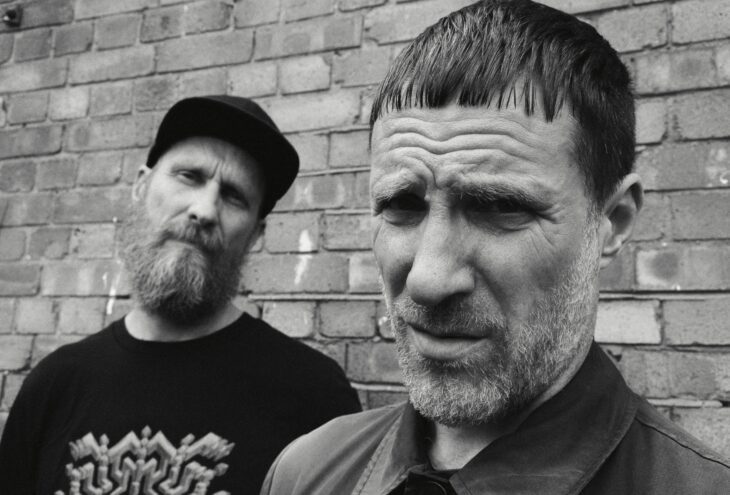
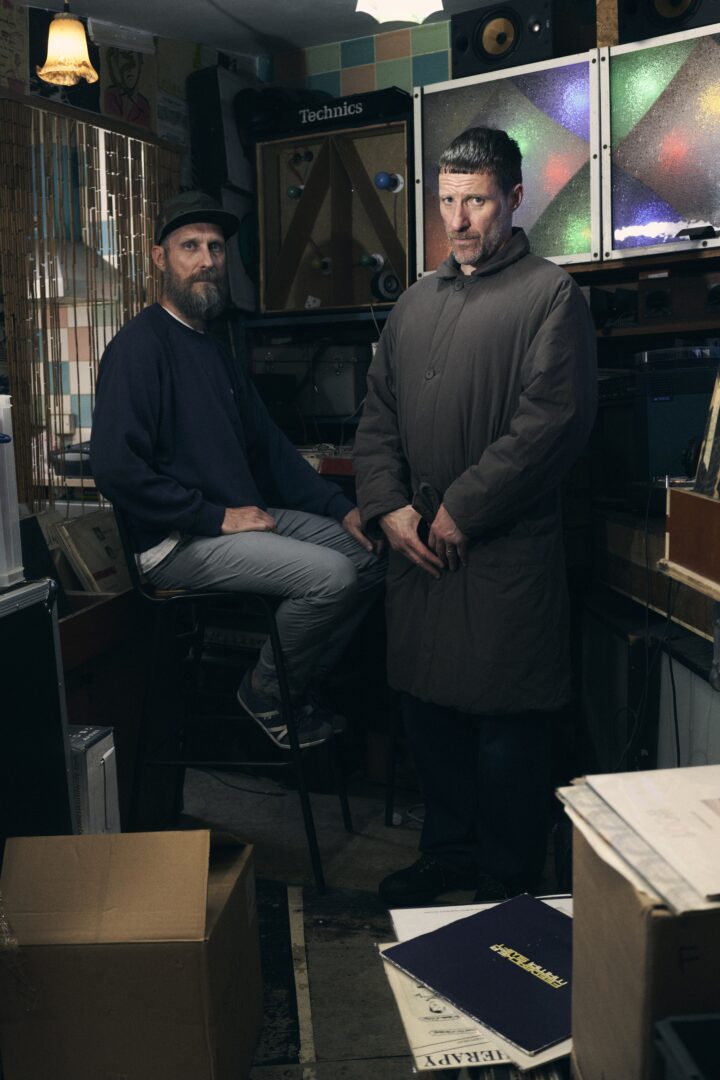
British duo Sleaford Mods are an outlier on the contemporary music landscape. They occupy a space where music meets beat poetry, where art meets spoken word, where biting, satirical comedy meets pub banter. There are other groups out there who stick by their working-class British roots to the benefit of the music, Yard Act being a solid example. But it hits different with this East Midlands outfit, thanks to Jason Williamson’s abrasive vocal delivery and the fact that he retains his regional accent, plus Andrew Fearn’s minimalist yet undeniably infectious musicianship.
MC chatted with both Williamson and Fearn, voices carried across the Atlantic via Zoom in November, early in the morning for us and late afternoon for them. The guys were in great form; we knew in advance that they were razor sharp and super-witty. Williamson’s on-stage delivery is aggressive, and in person he’s passionate when talking about things that he cares about. But that takes nothing away from his warmth and general likability. Fearn, too, is an easy chap to talk to.
Over the course of their 13 studio albums—up to and including The Demise of Planet X, released in mid-January—the subject matter has covered anything and everything that is grinding Williamson’s gears, tackled with the Mods’ trademark caustic wit. There was a gap in the market for hyper-intelligent social commentary set to an ear-wormy melody and beat, and the Sleaford Mods filled it.
“We’re not a rock band, you know,” says Williamson. “Even [2013’s] Austerity Dogs is quite eclectic. There are hip-hop tracks, there’s bangers—even from that point when we got together, it reflected the fact that we like different kinds of music. So, I think that’s something that I’ve tried to hang on to, with my input to the band—to try and keep that variety in there. We don’t have a guitarist; guitarists lead the sound and create a huge part of the sound and the tone of a band, which is great. But we’ve always been a bit more progressive than that.”
Austerity Dogs was Fearn’s second album with the group, his first being 2012’s Wank after he joined in 2011. Simon Parfrement, an original member alongside Williamson, left in 2012 leaving Williamson and Fearn to carry on moving forward. In all, Fearn has now been in the ranks for nine albums. They say that The Demise of Planet X feels different though.
“It’s been different with every album, really,” says Fearn. “I think it’s evolved quite a lot. It’s got more musical from what it was in the beginning. It depends what you’re into and where you’re coming from with your perspective. Everyone talks about it being minimal, but then good music’s always minimal anyway. I think for Jason it’s a different experience, because he was there during the process a lot more than me, just making everything at home and turning up with a load of music.”
“I think with every album, we’ve gone back over things we’ve done before and dragged some of those ideas forward and then been progressive with the album at the same time,” adds Williamson. “Because we don’t want to forget where we’ve come from, and we created our own sound, so we don’t want to forget about that either. I think that’s always been quite important.”
The songwriting process on The Demise of Planet X is much the same as it’s been since the duo started working together on Wank—Williamson writes the lyrics, Fearn the music, and then they come together and it all fits.
“We’ve gone into a few studios this time,” says Fearn. “We got the opportunity to use Abbey Road, so we used it. They set up a guitar and a bit of a drum kit so you can get some ideas down, but it’s the same in the sense that, you know, I’m not a virtuoso musician. I’ll play a bit of something, and then we’ll make samples, basically. So it’s still the same process in that way, but we’re just using all their equipment to make a loop. Jason was getting to loop up other people’s music, you know. So I think that hip-hop aspect is part of what we do. We’ve just embellished that quite a lot. Abbey Road’s, obviously very good. Its reputation precedes it. But it’s just getting away from your normal working space. Just waking up somewhere different can really help.”
While the Sleaford Mods are unashamedly English and they write about what they know, the themes can feel very localized. Throw in Williamson’s broad East Midlands accent, and it all seems very England-specific. But scratch the surface a little, and the Sleaford Mods are singing about themes that many people from all over the globe can relate to: austerity, shitty politicians, working class life, etc. You don’t have to come from New York to enjoy the music of Public Enemy, and the Sleaford Mods’ themes can be similarly relatable. At the same time, you might learn a thing or two.
“It’s cryptic sometimes, but so was the Wu-Tang Clan,” says Williamson. “I think it’d be interesting to see where it goes. In regards to getting any bigger in places like America, I’m not so sure. The more you get into this game, the more you realize that to be able to appeal to the mass, mass market, you’ve got to have that transatlantic type thing. And I don’t think we’ve got that in abundance.”
“America’s like from zero to stadium,” adds Fearn. “You’ve got to go platinum and all that sort of thing. And even if it’s quite good, it’s kind of manufactured, to a point. It’s supply and demand. We’re in a weird time for music. Being English, what was making me think was over the years, the British legacy for songwriters, for lyric writers, you know? And it kind of mixes together. The Beatles sang with American accents. When we play Italy or Spain, they get the working class angle totally. British music’s been a big export for a long time. So we can just tag on to that, and be part of that.”
When it comes to the themes on the new album, Williamson says that there are tons, as the guys seek to air their grievances to their willing public.
“Obviously MAGA, the Middle East, God, nationalism,” he lists. “This sudden acceptance of traditional male masculinity that all the kingpins of modern communication have embraced because of Donald Trump. Just stuff like that, really, and then the ongoing issues with other bands. Just opinions, etc. So, yeah, the kind of usual stuff. And I do say the usual stuff, because we try to take snapshots of whatever’s going on at the time, because it does affect us. Me and Andrew can constantly sit there and discuss what these things mean to us, you know, and that is basically what goes into it.”
For Williamson, the key is to write a song to help you get something off your chest, while also injecting a healthy amount of humor.
“You don’t want to be just moaning and depressing people,” he says. “I mean, you want to have some joy with it all. That’s how it started off, really, just having a, having a go at the right people. So that’s still got to be the order of the day. I think a lot of people are taking it far too seriously in some respects, and it’s becoming quite oppressive. There’s no humor in a lot of people’s music or their message. That just rings alarm bells for me. It’s got to have some of that shit in it. It is a really dark time. People on the left might argue, ‘You’ve got to be vigilant against the rise of fascism.’ You know, kind of true. But you can use humor as a weapon in that way. If it cheers people up, then they’re not so desperate. Why would I want to try and achieve a stay at Utopia if I’m gonna have to still look at a mardy fucking face like yours?”
The Sleaford Mods have been releasing music on Britain’s iconic Rough Trade Records since 2017’s English Tapas album. Rough Trade has, over the years, been home to the likes of Arcade Fire, Super Furry Animals, Islands, The Libertines, and Pulp, among many others. Williamson says that it’s a comfortable relationship because Rough Trade pretty much lets them do what they want.
“They’re nice people,” adds Fearn. “They like what we do, so it’s all quite good. We’re not very good at being told what to do, and sometimes we’re probably not very good at taking suggestions, but they’re really good at handling us a little bit. I think both of us have learned a lot about ourselves as well. Sometimes, a little bit of compromise is needed in the sense of just listening to other people’s opinions, though not so much anything else. I think that’s why it works.”
An early single from the new album was “Megaton,” which came complete with a video directed by celebrated artist and photographer Nick Waplington, filmed at Speaker’s Corner in Hyde Park, London.
“He was great,” says Williamson. “He just turned up in his shorts and orchestrated it. It was as if he had this invisible brush, and he’s just painting each bit. It was very laid back. It was really quite pleasant. There were quite a few people filming it on phones, just quite surprised. So it was quite relaxing compared to something in the studio. He has a lot of faith in knowing that he’s going to be getting what he wants.”
All profits from the tracks went to the War Child organization, a group which states quite plainly, “We believe no child should be part of war. Ever. And we won’t stop until this belief becomes a reality.”
“They work with displaced kids from war zones,” says Williamson. “So what they do is they set up learning centers, or places to try and pull these traumatized children out of themselves, because a lot of them won’t speak for up to six months a year, sometimes more than that. That just fucking knocks your head off, doesn’t it? All of everything about war is absolutely terrible. What are you going to choose, to try and help? And we thought that would be a good place to go with it. We’ve been supporting them on and off for a few years, doing little bits and bobs. But it’s only over the last two years that we fully came into it. I think the past few years, it’s been the most relevant charity to support.”
One of the things that differentiates The Demise of Planet X from the rest of the Mods’ catalog is the sheer volume of guest appearances. They’ve worked with other artists before, notably Perry Farrell and Dave Navarro of Jane’s Addiction on the “So Trendy” track from the UK Grim album. But this time, there are more collabs.
“That’s been quite a new thing,” Fearn says. “Not to get away from the punk thing, but when we have choruses like with Big Special on ‘The Good Life,’ he’s got a beautiful, folky singing voice and that’s quite different to have on a track. In the Aldous Harding track [‘Elitist G.O.A.T.'], she’s quite seductive, and a lot of it is quite gentle. So that’s quite a different thing to have to have there. I think where there’s been a chorus bit, Jason’s usually sang it, and then we’ve kind of embellished it with a synth melody or a keyboard melody to accent that softness. But this time we’ve just got somebody in to sing on it, which just it just makes it sound different. But I think the process involves taking a lot of chances, and it always seems to work out for us. That’s something that we’ve always done—do the wrong thing, and it comes out right. I think we live in a time where there aren’t any wrong things to do. Anyone thinking there is, is missing the point.”
Other guests on the new album include Game of Thrones actress Gwendoline Christie on “The Good Life” alongside Big Special, Life Without Buildings singer Sue Tompkins on “No Touch,” soul singer Liam Bailey on “Flood the Zone,” and Snowy, an MC, on “Kill List.” The collabs, Williamson says, happen organically.
“I’ll run it through my head and I’ll discuss it with Andrew,” he says. “It will be the last minute that we say, ‘right, invite him down,’ until we’re really sure it’s going to work. They come in and they do it. You know, most people that do music are quite professional. They come in and get it done. It’s like, you’re at a level now where, if you’re going to bring someone in to collaborate, they’ve usually got a vast amount of experience, so it’s kind of executed very quickly. So if they agree to do it, it’s going to work.”
“We haven’t had that experience where we’ve picked someone, and it’s just been terrible,” adds Fearn. “That’s because we’re both from a generation, mainly the ‘80s and ‘90s, which is a hugely varied funneling-out time for music. Everything from Throbbing Gristle to fucking ABBA is our generation’s music. I think it’s important to remember that in some ways, to take that forward and try and keep some of something like that in there.”
When you see the two men on stage, you’ll see Williamson holding a mic and Fearn in front of a laptop. When it comes to gear, they keep things simple.
“It’s just an SM 57 mic,” says Williamson. “And I usually just use a mic with a fixed bottom, but I’m thinking about branching out and taking it off the stand. I’m like, ‘Oh, this song really could do with me taking it off.’ And then I’m like, ‘No,’ and this is how delicate the operation is. But yeah, that’s all I use.”
“For me, it’s just Foobar,” adds Fearn. “Because it doesn’t do anything stupid, and it just does what you want it to do, you know? And I’ve just got a T61 [laptop] that I’ve got XP on. They stopped updating it, like, I don’t know, 10 years ago now. So it just works as a glorified WAF player. It’s kind of foolproof.”
2026 will see the Mods on tour, first in the U.K. and then Australia. Plans to come Stateside are afoot, their issues with the current administration aside.
“The shutdown’s finished, hasn’t it? Because a handful of Democrats have folded,” says Williamson. “So the government’s reopening. But who knows what’s going to happen next week.”
Hopefully, we’ll see them here soon. But for now, we get to enjoy The Decline of Planet X while appreciating the fact that there are still musicians out there who can be successful by creating their art on their own terms.