Lutefish Stream is a new hardware and software platform by Wenger America designed to give musicians a way to jam in real time over the internet at distances up to 500 miles with up to five musicians. Consisting of a simple and low-cost hardware interface that plugs directly in to your internet router via an ethernet cable and a browser-based software that enables both the streaming technology and creates a social media platform designed to link and promote subscribers, Lutefish Stream successfully addresses the main issue of real-time musical jamming over the internet: Latency.
Stating a latency time of 30-35 msec within the stated 500-mile limit, Lutefish compares this latency to being “30 feet apart on a big stage or rehearsing in your garage.” MC put this to the test on two remote sessions. Session one was with noted Los Angeles music producer Andy Zuckerman who played electric bass. MC was on electric guitar. We found that Lutefish Stream achieved its main stated goal. The latency was indeed about 30 msec which was noticeable but not an impairment to live jamming. One element of the test was for Zuckerman to call out chord changes during an improvisation, and the timing of chord changes worked out well.
The second session was with Devyn Rush, noted L.A. session singer, songwriter, performer, and Lutefish Artist Collaborator. Rush knows the system quite well and sang in the session with MC playing guitar. Again, the minor latency was not an impediment to performing in sync. The session was technically smooth and very enjoyable. Rush uses the system not only for band rehearsals, including a drummer that lives over 100 miles away, but also extensively for music lessons, songwriting, and is extremely enthusiastic about Lutefish.
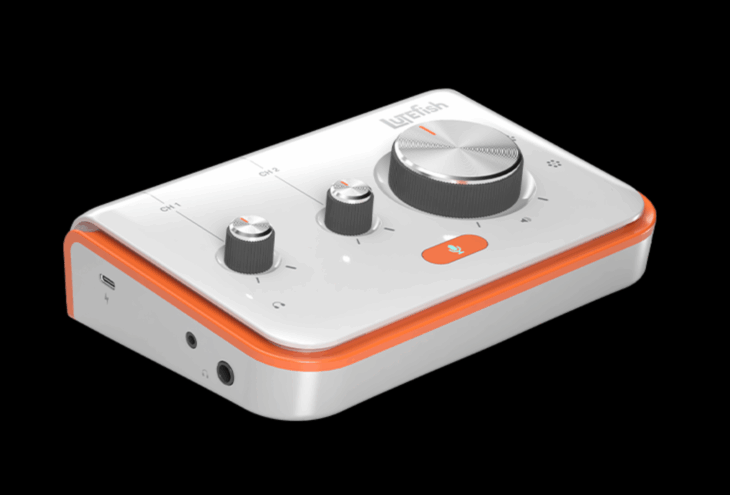
The Lutefish Stream hardware is simple. Two mic/line inputs with level controls accommodate two mono sources, i.e., a guitar and microphone, or a stereo keyboard. There is no +48v phantom power. A stereo source will still sound mono, as is no provision within the stream for stereo. There is a main volume knob, an ethernet port, a USB-C port, a talkback button, and 1/4” and 1/8” headphone jacks. To reduce latency, Lutefish Stream can only function connected to your internet router.
The system is controlled by the Lutefish browser-based software. You make “connections” in their subscriber base, and then can schedule a session. Users are notified by email or when signed into Lutefish. The Lutefish program features an audio mixer for each musician with four sliders: Input 1, Input 2, (talkback) Mic, and overall volume. The metronome cannot be shared, so whoever is “the clock” of the session, can use it. You can use your computer’s camera, record your session, and build a library of your recorded sessions.
The hardware unit would benefit from upgrades. The talkback button was sticky and often created very loud spikes when initiated. The headphone amp created a noticeable broadband hiss. The gain controls must be handled with some finesse to avoid being overloaded. But as an entry into this technology, it seems the main consideration was to keep the price low. It helps to create a good sound coming in as there are no built-in reverbs but that may change by the time this article is published. For many users, the audio quality as is would be workable.
Lutefish Stream shows potential for a great product that can be used not only for jamming, but also for real time musical lessons. Lutefish is in constant development with a strong interest is improving the user experience. Available in yearly or monthly subscriptions. Interface $249. Subscriptions as low as $9.99 a month