January 23 marks the 50th anniversary of the release of David Bowie's tenth studio album, STATION TO STATION.
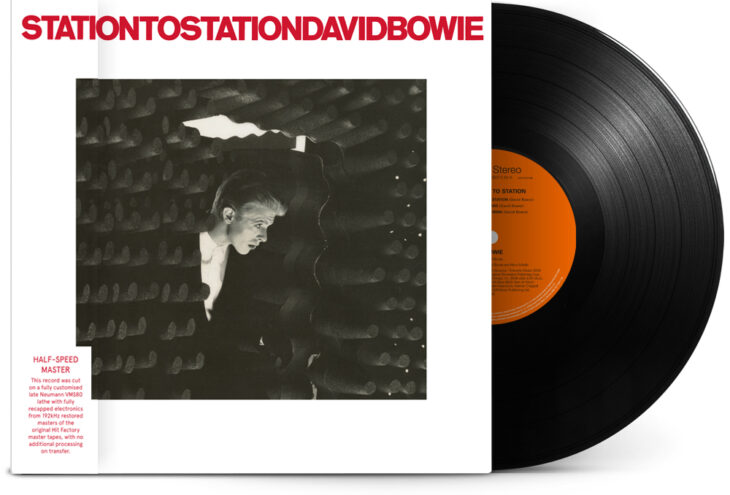
On the exact day of its Golden Jubilee, STATION TO STATION will be issued as a limited edition 50th anniversary half-speed mastered LP and a picture disc LP pressed from the same master with a reproduction of a poster used to advertise the album 50 years ago.
The first single from the album “Golden Years,” was released in November 1975, would give Bowie a top ten single on both sides of the Atlantic. The second single,” TVC 15,” would, a decade later, be heard and seen by almost 2 billion people when Bowie chose it to open his set at Live Aid.
The sound of STATION TO STATION was partly influenced by Bowie’s burgeoning interest in the electronic music and driving rhythms of bands coming out of Germany, such as NEU! and Kraftwerk, most notably on the ten-minute title track, while still embracing dancefloor-friendly grooves in songs such as “Stay” and “Golden Years.”
Harry Maslin, who had worked with Bowie on some of the tracks on his previous album, YOUNG AMERICANS, was chosen as Bowie’s co-producer.
The LP was recorded in Los Angeles at the Bruce, Dee and Joe Robb brothers-owned Cherokee Studios at 751 North Fairfax Ave.
Maslin and Bowie entered the studio in September 1975 with a tight stripped-down band featuring Carlos Alomar and Earl Slick on guitars, George Murray on bass, Dennis Davis on drums, Bowie’s childhood friend Geoffe MacCormack (under the nom de plume Warren Peace) on backing vocals and on Maslin has stated that the vocals on the standout tracks “Wild Is the Wind” and “Golden Years” were both Bowie's first takes.
Ten days after the album’s release, Bowie started the ISOLAR TOUR, which visited over 65 dates in 11 countries and is cited as being hugely influential for its use of banks of fluorescent white light set against black backdrops.
This new pressing of STATION TO STATION was cut on a customized late Neumann VMS80 lathe with fully recapped electronics from 192kHz restored masters of the original Record Plant master tapes, with no additional processing on transfer. The half-speed was cut by John Webber at AIR Studios.
DAVID BOWIE - STATION TO STATION
TRACKLISTING
Side A
- Station To Station
- Golden Years
- Word On a Wing
Side B
- TVC 15
- Stay
- Wild Is the Wind
During 1975-1978 I spent some time at Cherokee writing press releases for the studio, working with their manager, Con Merton and the Robbs. In 1975 I attended a playback of Rod Stewrt’s Atlantic Crossing done with engineer/producer Tom Dowd and guitarist Steve Cropper. At some 1976 sessions for Stewart’s A Night on the Town were at Cherokee. I seem to recall Rod suggested Cherokee to David earlier in 1975, and that Cherokee had Trident Boards. Bowie had worked with engineer Ken Scott in the UK at Trident studios.
Bowie came in one day, walked into studio one, hit the piano, and said to Bruce Robb, “This will do nicely.” I remember another date where Bruce and I were in a hallway where a smiling Bowie personally cleaned up the studio tossing away paper plates and debris, keenly aware there was another client booked.
Until I spoke with Bruce Robb in the eighties, I really didn’t know how technical aspects from a custom-made Trident 40-input A Range mixing console informed the recordings cut at Cherokee. Frank Sinatra, Paul McCartney, Michael Jackson, Harry Nilsson, Ringo Starr, Tom Petty, the Cars, Sir George Martin and Roy Thomas Baker favored the facility. The Robb brothers had the first Trident board in the United States.
In 2026, I talked with record producer/engineer Richard Bosworth, whose credits include Roy Orbison, Don Henley, Steve Perry and Johnny Rivers. He engineered sessions at Cherokee for Van Dyke Parks, Burton Cummings and Dolly Parton.
In our interview Bosworth explained the history of the Trident boards and the influence on the sound of Station to Station.
“Early 1968 in the Soho area of London brothers Norman and Barry Sheffield opened Trident Recording Studios. The studio was equipped with the first eight track audio tape recorder including Dolby Noise Reduction in the city. Even more significantly they commissioned the locally based high end audio manufacturing company Sound Techniques to build the first fully functional eight track recording console in London. Assembled with the highest quality electronic components to the Sheffield brothers and their Chief Technical Engineer Malcolm Toft’s specifications.
“The Trident Recording Studios Sound Techniques desk had twenty mic/line inputs along with a separate eight track tape monitor section enabling use of all twenty inputs for recording microphones while simultaneously monitoring all eight tracks of the audio recorder.
“With this modern state of the art equipped recording facility Trident Recording Studios quickly became along with Olympic Recording Studios a top tier independent London music studio attracting British music artists including the Beatles who recorded and mixed ‘Hey Jude’ their first single release on Apple Records and four songs from their upcoming White Album as well as the Abbey Road track ‘I Want You, She’s So Heavy.’ Along with the Beatles during the next two years British and American music artists such as David Bowie, T-Rex, James Taylor and the Bee Gee’s also recorded at Trident.
“However, by 1970 when sixteen track audio tape recorders had come to England Trident had to face what all studios worldwide had to reckon with. They all needed much larger recording desks to accommodate the higher track count. Discussions between the Sheffields and Toft originally were to have Sound Techniques build a sixteen-track desk to their same original specifications with some additional facilities for echo sends/returns and headphone monitoring.
“Unfortunately, after reaching out to Sound Techniques, they were informed that the company had gone out of business. Upon further discussion Malcolm Toft stated that since their original Sound Techniques console was to their specifications, they use it as a prototype for a new console they would build in house. Hence the infamous Trident A Range recording console was born.
“With the Trident A Range the Sheffields and Toft had the foresight and wisdom and perhaps even had heard that twenty-four track audio tape recorders were coming down the pike so the Trident A Range console would be a fully comprehensive twenty-four track desk. With forty mic/line inputs, associated echo returns, twenty-four recording busses and a twenty-four track tape monitor system. The Trident A Range recording console was destined to be state of the art for over a decade. The sound of the A Range is the mic pre/line amp/EQ module.
“The ‘A’ refers to its Class A discrete transistor electronics. In professional recording audio ‘Class A Electronics’ is the standard. Expensive but sonically superior to all other transistor electronics. The EQ was four band with selectable frequencies. The A Range is renowned for its punch, warmth and clarity and the sound of the critically acclaimed and commercially successful records from the 1970’s recorded at Trident attest to that.”
On September 18, 1975 I interviewed David Bowie in Los Angeles at Television City inside the CBS studios on the corner of Fairfax Ave and Beverly Blvd. Bowie was taping the Cher TV show for a November 9th broadcast. I covered it for the now defunct Melody Maker in their October 25, 1975 issue.
“At age 29, David Bowie has finally conquered the United States. “Fame” has been number one for four weeks on most of the charts, and a grin crossed his lips when told of the song’s progress on the R&B listings. ‘I know!’
Afterwards, I was introduced to Cher. “I adored working with him and was delighted to have him on the show,” she beamed, behind her toothy smile.
In my brief 1975 Melody Maker dialogue with Bowie, he commented on his just completed feature-length movie The Man Who Fell to Earth. Some of the soundtrack was recorded down the street at Cherokee from the CBS TV studio.
It was obvious that David had already departed visually, musically and emotionally from the self-imposed world of Ziggy Stardust character into his current cinematic journey.
“The difference between film acting and stage acting is enormous. On stage you are in total control, whereas in a film the actors are instruments of the director. I think a stage performance is more of a ceremony and one plays the high priest. But in a film, you are evoking a spirit within yourself. You feel a tremendous responsibility of having the power to bring something to life. For example, Major Tom in ‘Space Oddity.’”
I asked Bowie if he entertained any thoughts of an appearance on the Don Cornelius-hosted Soul Train, the syndicated TV black dance show.
“Fame” had been in rotation at several R&B radio stations
“Don’t you think that would be pushing it a bit?” David readily replied.
He was happy at his current single success, but added, “I had a lot of other singles here that didn’t do anything.”
Bowie subsequently was on Soul Train appearing drunk lip syncing to “Fame” and the still-unreleased “Golden Years.”
After hearing the 2026 Station to Station vinyl, I interviewed some friends to reflect on the album.
“Station to Station is one of the greatest LPs of the whole ‘classic rock’ period, and I'm glad there's new interest in it,” volunteered poet and writer Dr. James Cushing.
“I love having the 3CD box-set version that reproduces the 1976 analogue mix and includes 2CDs of an excellent New York concert from the Isolar tour, so I'm not the target audience for a 2026 vinyl upgrade -- but there are plenty of hip people my son Alex's age and younger who would want to drop a needle onto some rotating 12" Bowie plastic, so there you are. I do remember it appearing in early 1976 along with Dylan's Desire, and my feeling that both these albums made very serious statements about the nature of American life at that moment.”
“Station to Station was like the first Velvet Underground album in that its influence just seemed to grow and grow, and create a whole new culture with a whole new sensibility,” suggests novelist and writer Daniel Weizmann.
“Where the Velvets single-handedly created punk realism by bringing post-war NYC and urban grit to rock music, Station to Station explored the dark side of post-war Europe, with shades of Eliot’s The Wasteland, Isherwood's lonely wanderers, Waugh's crumbled empires and fallen aristocracy.
“We don't picture the Thin White Duke on a stadium stage. We picture him alone on a train creaking around the Alps, lost among the ruins. There are no crashing guitar explosions, there's no face paint, no Kabuki get-ups here. This is Bowie insisting on being human-sized, wrestling with the shadow side of his former grandiosity, the loneliness of a cosmopolitan man adrift. The Berlin trilogy doubled down on this new, disarming identity but it was never more bristling than Station to Station, the first pains of shedding a skin.
“Then, for ten solid years and beyond, that sensibility was everywhere -- you can hear it in Joy Division and Magazine and Echo and Human League and Spandau Ballet and on and on. It’s there in New Romance, it's there in New Pop, it’s there in Morrisey and Pulp and on and on. Every serious English songwriter in his wake owes him a debt for the force with which he turned and faced the strain and caught a glimpse of his true self.”
“So, David was in crises, all alone it seems during the years leading up to the rise of the Thin White Duke,” emailed Greg Franco, bandleader of Rough Church and Man’s Body.
“I think he was without Angie, he was in his lost in LA phase, and after this record he started exploring a kind of anonymity of sorts in Berlin.
"The feel from the first pulse of the track of Station to Station comes street vibes, out of place Englishman in a long coat in the LA rain. The bass pulses out like a hungry cat looking for a meal. The vocals are Bowie as a ghost, crossing loud train wheels screeching on the tracks. It's the sound of Bowie's tuned out muted brain on a paranoid cocaine bender. He’s deeply lost in this play where he has cast himself in the lead role again.
“Toward the end of the song Station to Station it picks up and gives us a beat to dance to. Even though this time he admits that he was on his way to wiping himself off the planet, he had dance beats that preceded disco music. He was still into the vibes, the Philly groove of Young Americans, so that didn’t go away on this record. ‘Stay’ is the best example of this.
“When I was a kid, I heard the track ‘TVC15’ on the radio. Growing up in the Los Angeles suburbs in the San Fernando Valley, this was ear catching to me, we were living in the flooded with either rain or sunshine place of Van Nuys CA. I had no clue or idea of Bowie before I heard TVC15. I was just 11 years old, but I hopped on my bike and went down to the JC Penny on Victory and Laurel Cyn. and bought the ‘TVC15’ single for a $1.09
“The B-side was ‘We Are the Dead’ I vibed the hell out of that one too. It was an unfamiliar black and white world that had nothing to do with mine, and it was seductive. It had a devilish vibe, almost forbidden to this catholic kid who was raised on the teeny bob pop of Elton John, Peter Frampton, Rod Stewart, the Carpenters. I had heard the Doors though, so I wasn’t completely in unknown territory. But this was a deep end alien sound to me. ‘Golden Years’ was also on the radio, but I didn’t actually purchase the whole album until later in the decade. I had cut my teeth on Sparks first, T Rex. This record isn’t for untrained ears, I had to sharpen up for it, and it remains a godsend, truly brilliant record for all time.”
(Harvey Kubernik is the author of 20 books, including 2009’s Canyon Of Dreams: The Magic And The Music Of Laurel Canyon, 2014’s Turn Up The Radio! Rock, Pop and Roll In Los Angeles 1956-1972, 2015's Every Body Knows: Leonard Cohen, 2016's Heart of Gold Neil Young and 2017's 1967: A Complete Rock Music History of the Summer of Love. Sterling/Barnes and Noble in 2018 published Harvey and Kenneth Kubernik’s The Story Of The Band: From Big Pink To The Last Waltz. In 2021 the duo wrote Jimi Hendrix: Voodoo Child for Sterling/Barnes and Noble.
Otherworld Cottage Industries in 2020 published Harvey’s Docs That Rock, Music That Matters. His Screen Gems: (Pop Music Documentaries and Rock ‘n’ Roll TV Scenes) is scheduled for January 2026 publication from BearManor Media.
Harvey spoke at the special hearings in 2006 initiated by the Library of Congress held in Hollywood, California, discussing archiving practices and audiotape preservation. In 2017, he appeared at the Rock & Roll Hall of Fame in Cleveland, Ohio, in its heralded Distinguished Speakers Series and also a panelist discussing the forty-fifth anniversary of The Last Waltz at the Grammy Museum in Los Angeles in 2023.
In 2025, Kubernik was spotlighted in the Siobhan Logue-written and -directed documentary The Sound of Protest,currentlyairing on the Apple TVOD TV broadcasting service. The film also features Smokey Robinson, Hozier, Skin (Skunk Anansie), Two-Tone's Jerry Dammers, Angélique Kidjo, Holly Johnson, David McAlmont, Rhiannon Giddens, and more.
Harvey is interviewed in the documentary Elvis, Rocky and Me: The Carol Connors Story that premiered January 3, 2026 at the 37th Palm Springs International Film Festival. The twice Academy Award nominated songwriter’s career is captured by director Alex Rotaru with on-camera interviews from her friends Bill Conti, Talia Shire, Dionne Warwick, Diane Warren, David Shire, Barbi Benton, Mike Tyson and Irwin Winkler.)