During his formative years, Daniel Avery logged a multitude of musical genres, building a massive mental catalogue of all things alt-rock, shoegaze, electro-industrial, and punk. Immersed in his personal auditory archive, he perfected the elusive art of uncovering the intangible connections within musical compositions — linking song structures, moods, and sound textures with precision. His proficiency in weaving harmonies, beats, and melodies, with the misterioso of the unknowns, propelled him to prominence as one of the U.K.’s preeminent beatmakers under the moniker Stopmakingme, before he eventually reclaimed his given name in 2012.
Avery’s meticulous ear and his talent for creating a subterfuge of sounds made his DJ sets legendary, guiding clubgoers into trancelike musical worlds where unfolding sonic narratives took hold. His instinct for shaping sound — building beats and crescendos with sonorous tales that naturally ebb and flow — extends far beyond the floor, resonating through his studio work. Whether in the hypnotic rhythms and distorted caustics of Drone Logic, the synthesized soundscapes of Song for Alpha, the trip-hop-infused breakbeat atmospherics of Ultra Truth, or the dark melancholia of Illusion of Time (with Alessandro Cortini), his productions form a continuum of ever-evolving sonic worlds.
For his 2025 release, Tremor, Daniel Avery threads raw rock with electro grit and cinematic ambience, elevating it further with waves of collaborators, including the voices of Alison Mosshart of The Kills, Walter Schreifels of Quicksand / Rival Schools, and Ellie Rowsell of Wolf Alice, among others. The result is a brilliant exploration of how a smidgen of silence — the blank canvas musicians begin with — can expand into songs that are both “seen and heard” within Avery’s synesthesia-stylized mind, where sounds and stories collide.
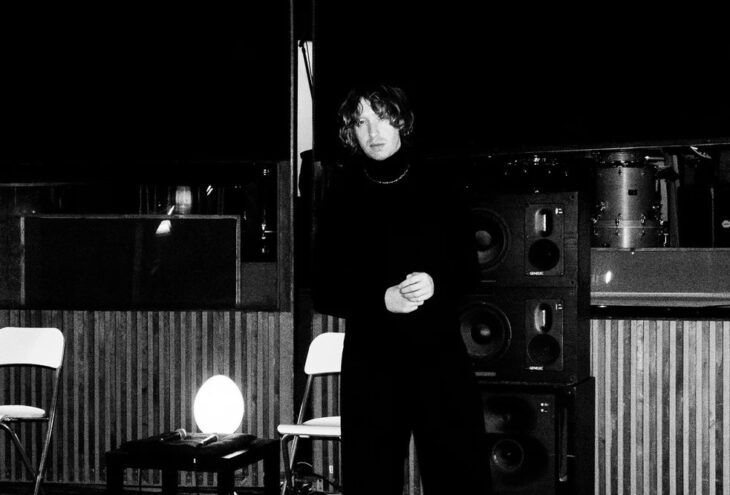
Daniel Avery gives insight into his creative, collaborative world, and how his “admittedly,
very small - studio space,” a converted shipping container on the banks of the River Thames, serves as a source of inspiration.
“Every corner of that place seems to hold that special energy. It must have something to do with its proximity to the Thames, big skies, and the sweeping weather.” Avery notes that the atmospheric views from his space help breathe life into his work. “I personally couldn’t lock myself in a basement space or, if I did, I’d have to get out into the real world as much as possible.” He further underscores how surroundings and movement feed the subconscious by adding: “Take long walks with your music, that’s for certain.”
The Production Process:
This attention to the environment carries over into Avery’s studio work. Though his recording space is built from nuts-and-bolts weathering steel, his production style is guided less by structure and more by instinct.
“I feel that’s been the basis of my entire career: trust only your instincts.” Avery continues, “I have no musical training, nor would I say I am particularly technically-minded; everything revolves around personal taste and feeling. All roads lead back to those musical moments that move your soul. It should be the only barometer.”
This intuitive-driven approach extends to every aspect of his workflow, including guiding collaborators through the visual and emotional world of each track on Tremor. “Each song felt different, but from a writing perspective it was important for me to show every singer around the world of Tremor before we got started.” He clarifies, “At the very beginning of the project, I made a moodboard which explored the visual identity of the album as much as the musical references — David Fincher, David Lynch, Mark Rothko, Silent Hill, Metal Gear Solid, Andrew Wyeth, Chris Cunningham…. it was an invitation into this world we were building together.”
Avery also embraces visceral experimentation with harmonic saturation in audio feedback loops by routing signals into complex reverb chains. He states, “Distortion into reverb into distortion and repeat. That’s been there since the beginning.” He continues by describing how inadvertent glitches often become foundations for entire tracks. “My music is full of these. I love how, by definition, feedback and distortion are unruly. I would encourage every producer to lean into those things [glitches] and see what new ideas they bring.”
This same philosophy carries into how he uses space. Creating massive breathing room — or negative space — with minimal elements or even completely open passages is often key to making songs hit harder. This aligns seamlessly with Avery’s creative ethos. He explains:
“It’s one of the most important parts of the process, to my mind. I believe the world of techno music has taught me a lot here: if a part is there simply because ‘it fits,’ yet it doesn’t add anything to the overall track, then it should go. Space is so important in music; never be afraid of the delete button.”
In the same spirit of experimentation, Avery often tracks sounds with a contact microphone without expectations, letting whatever is captured guide the track. “I’d encourage every producer to buy a contact microphone. They are very cheap but can throw up a whole new world of sound to be manipulated.”
He proceeds, “Even the most subtle layer of static noise can transform a track. It’s an addition that you may not be able to hear sonically, but you’ll hugely miss it once it’s been taken away.” This hands-on approach extends naturally to effects and pedals. “I’ve used a Space Echo pedal from the very beginning. There’s something about the physicality of hammering the pedals to create new and interesting delays. Many happy accidents have come from that thing.”
Avery’s synesthesia-stylized mind continues churning out ideas, carrying the spontaneity from the studio into reinterpretations of Tremor, including Midnight Versions Part 1, slated for Jan. 2026, with hints of additional concepts in development. Beyond the studio, Avery is leaning into a live-band tour alongside his always-dynamic DJ sets. For those who love sweeping thrums and sonic narratives, go forth and step into Avery’s museum of the mind, where sound and imagination collide.
Photo courtesy of Keffer