
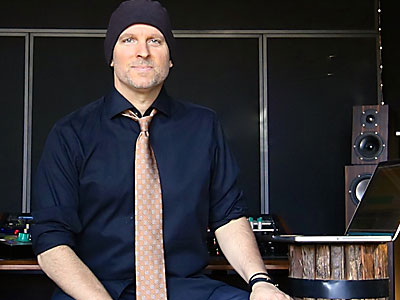
 Brian Lucey
Company: Magic Garden Mastering
Clientele: The Black Keys, Beck, The Shins
Contact: magicgardenmastering.com
Brian Lucey came to mastering on the tail of a 25-year career as a musician––he’d picked up the guitar at 11––and recording engineer in New York. Early on, he couldn’t afford mastering superstars for his own music and he didn’t like how the lower-priced ones sounded, because he didn’t hear the flow or harmonic content that he craved. But mastering represented an opportunity to bring all of his skills and passions together. So, in 2000, Lucey struck out to do it on his own––he’s self-taught––and established Magic Garden Mastering in Los Angeles.
What are some of the biggest challenges facing emerging mastering engineers, aside from budgets?
Today it’s an oversaturated market, especially with automated services that use algorithms instead of emotions. Those of us that are good at mastering make it look easy, so a lot of people have gotten into it in the last year or so.
What have been your favorite technical developments over the past few years?
I’ve used the same chain, more or less, for the last 12 or 13 years. I upgraded my playback D to A recently and am using the Bricasti M1 Special Edition. I have a pair of those for pre-chain and post-chain. But my process, D to A, is the same. I’ve also upgraded my amplifiers recently to Cary Audio’s 211 Founders Edition. That’s new gear to me, but it’s an old design.
What are common problems you see in mixes?
The main thing people need to focus on is skill and monitoring. Mixing rooms, generally speaking, could all be upgraded [because] the first things you hear are mixing room issues. In terms of advice, three things: One, the loudness war is definitely past its peak. There’s still a fear element some people have with compression, thinking it’s the way to have a loud/competitive record. Two, section-to-section levels. Master fader automation is your friend. Three, placement of speakers in the room, in terms of the width and how that relates to panning and low end. If they’re too wide, people will under-pan. If they’re too narrow, people will over-pan and lose the power down the center.
What are the best ways for artists to save money when it comes time to master?
With the monitor volume up, be sure that you love what you’re sending without fearing the level issue. Listen to it in the car, listen to it in the studio. Everyone involved should hear it. If you feel good about it, that’s the one to send. People get into trouble when they become caught up in theories about what makes a good mix. I’m interested in the one that’s been produced with a sense of adventure where there’s a clear vision that comes across.
How is mastering for vinyl different from mastering for CD or iTunes?
More and more people hire me to make what I call vinyl pre-masters, which are the digital files that go to the cutter. The limiting goes away or comes way down––square waves and cutter heads don’t get along. We make sure the low end, high end and sibilance aren’t too big. Vinyl pre-mastering is conservative. You can’t get away with as much as you can in the digital world. I mastered Dr. John’s 2012 record Locked Down and it’s interesting because the vinyl sounds like it was made in 1968. It’s really only [a difference of] two dB. It’s a question of what dynamic range does to perception.
Final thoughts?
People used to think mastering was a dark art or a secret. With automation, they now think the opposite. It went from being a mystery to DIY. The simplest things in life are the hardest, whether that’s writing a good song or mastering a record with musical juiciness that respects the mix. Mastering is about connecting the artist with the audience. That takes things that newbies, bad rooms and plug-ins can’t do. •