

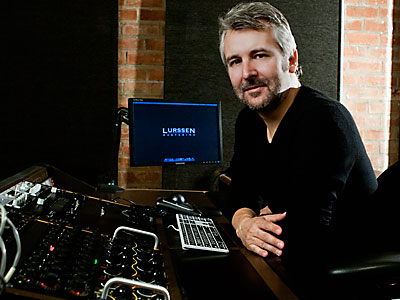
 Gavin Lurssen
Company: Lurssen Mastering, Inc.
Clientele: Steven Tyler, Miranda Lambert, multiple film soundtracks
Contact: lurssenmastering.com
A three-time Grammy winner and an engineer on multiple Platinum records, Lurssen graduated from Boston’s Berklee College of Music in 1991. After a brief return to Washington, D.C., he commandeered his mother’s car and set out for the coast. Once in L.A., he landed a runner gig with legendary mastering engineer Doug Sax. In 2005 he branched out on his own and launched Lurssen Mastering. In addition to an array of artists, his company has mastered soundtracks including The Martian and Pitch Perfect 2. His company also makes a mastering plug-in. This year marks Lurssen’s second appearance in MC’s Mastering Roundtable.
What are some of the biggest challenges facing emerging mastering engineers, aside from budgets?
Getting a seat at the table. It’s a different world now and many more people are mastering. The tools are far more affordable. The biggest challenge is that there are no mentors anymore. When I started, there were mentor-protégé relationships. That was the system and it made sense. The mentor had the equipment and an established career. Today there are precious few unless you’re exceptionally proactive. A lot of the work now gets discovered by accident.
What have been your favorite technical developments over the past few years?
There’s no excuse to give consumers a 44,1, 16-bit file anymore, because if you look at the video that’s being piped through wireless networks, a 96k, 24-bit audio stream is even smaller than that. I’m pleased that high-resolution audio is getting the attention it deserves. Consumers are starting to understand that you don’t have to have compressed files with a low sample and bit rate. And some of the digital plug-ins have gotten exciting in the last five years. We make one called the Lurssen Mastering Console.
What are common problems you see in mixes?
People listen to mixes in their compromised environment. The studios have fallen away and everyone’s working with their near-field monitors. By the time I get a mix, I’ll do a tweak and send it back to the client. They’ll hear what I’ve done to bring out the goodness, but then they’ll hear their mix in a new light. So they’ll make an adjustment, return it and ask me to run it again with the same settings. On the one hand, artists have exhausted their budget, so it’s not like I can hit them for more. On the other, I still have to pay my crew, so there’s an awkwardness around that. We still work all analog. To do a recall [for us] is a whole procedure.
What are the best ways for artists to save money when it comes time to master?
Have confidence that your mix is ready to be mastered. That’s always been true. There’s so much gray area between mixing and mastering now with stems and the ability to recall your mix in the mastering room and make adjustments. Reduce that gray area and create a boundary between mixing and mastering and then let the mastering engineers do their job.
How is mastering for vinyl different from mastering for CD or iTunes?
There’s a vinyl component to most of what we work on. We create a high-resolution cutting master and we don’t EQ any differently for vinyl. Some people do. We’ve got a system with Ron McMaster at Capitol. He’s got a special way that he runs our high-res master onto the lacquer. We’ve worked it out over years. The challenge in vinyl cutting is: did the person who cut the lacquer do it right? There are only so many people that can do it and it has to be done on vintage gear. The bigger challenge is the pressing plant. Be sure to get a good test pressing. Otherwise it just looks cool. But it has to sound cool, too.
What are the unique challenges of mastering for television?
We do the soundtrack component so it’s no different from any other work. In many cases, composers hear what we do, like it and want to submit it to their TV editor. We don’t approach it differently from anything else.
Final thoughts?
It’s wonderful that [mastering] is considered a necessary element of the process of music creation. In the late ‘90s, I began to see trends that people would combine all of the processes into one. I was concerned that the art of it would get diluted. It’s become even more emphasized. •