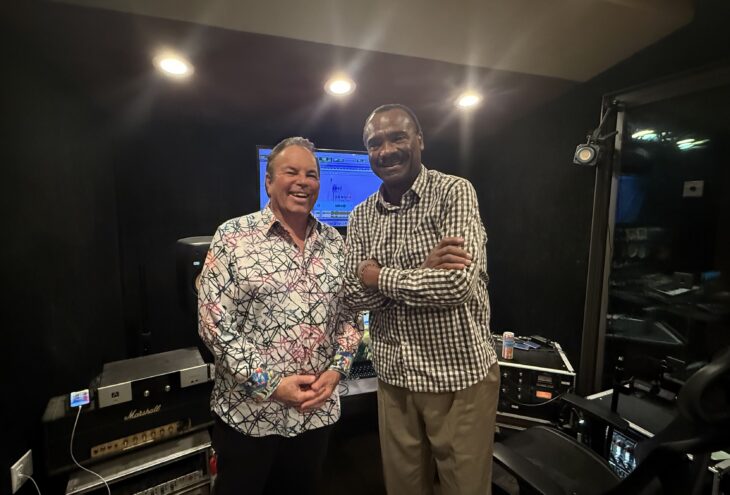
Photo above: David Chatfield with Ronnie Laws
David Chatfield is a musician, record producer, remixer, attorney, rights activist, author, and the founder and owner of the Harmony Music record label.
Chatfield is a native of Los Angeles. He’s a lifelong musician, including touring in the early seventies in an early US production of Jesus Christ Superstar. Chatfield was awarded the USC School of Music Annual Convocation Award and was responsible for the introduction of record and concert reviews in The USC Daily Trojan.
After reaching his goal of playing the Greek Theatre and Hollywood Bowl by 21, he graduated from law school and immediately became active in the music and recording business for four decades.
He is a 38-year member of the Recording Academy and their Producer and Engineers’ Wing.
During an October interview, Chatfield discussed the intrusion of AI-generated music into our work with recording artists and cultural creatives.
Chatfield disclosed his proactive and protective streaming alternative with the quick launch of his new HavenMusic.us music streaming startup, which is intended to remedy both artists’ and listeners’ concerns about AI-generated music and AI training from copyright material rampant in the streaming world today.
Q: Tell me about the genesis of your company?
A: Since the beginning of the year, I have been reading articles about subscribers leaving Spotify over AI use and low artist payouts. BGR’s June 13, 2026 piece, “5 Reasons Why People Ditch Spotify,” treats AI music as one of five reasons people are quitting, alongside low artist pay, no ownership, algorithms replacing personal discovery, and a bloated app.
It seems that platforms claim to have been given those rights by the aggregators/DIY distributors and record labels. It allegedly comes from the label and publishing agreements.
A separate, older issue is that some DIY distributors have had an “additional grant” since 2023 letting licensees transform, remix, and make derivative works of delivered recordings.
That is a distributor contract, not the streaming services’ terms, the services claim. Articles appeared in Rolling Stone, The Guardian, Pitchfork, the FADER, the Verge, Stereogum, and The Washington Post in late 2025, raising attention to the problem.
CEO’s of streaming services assert that AI can create new songs trained from copyrighted material and AI can create cover versions and remixes. Many articles appeared which quoted AI music “slop” as one reason why subscribers were leaving Spotify and were looking for alternatives.
Anti-AI training organizations like “Is This What We Want”, “Make It Fair”, “Creators Coalition on AI” and the “European Music Managers’ Alliance” June 2026 open letter signed by 31 organizations including the Music Artists Coalition, Songwriters of North America, Artist Rights Alliance, Featured Artists Coalition, Black Music Action Coalition, and the Ivors Academy, begging labels and publishers not to opt artists into AI deals.
On October 1, 2026, Chicago musicians held a “Human Music Only” rally outside of the Federal Center and have planned a two-day Spotify/Apple Music listener blackout on October 26-27, 2026.
Q: You felt a need to initiate a venture in this arena.
A: In late September, 2026, after reading a new set of terms and conditions from the largest streaming service, I became incensed by the slant the music industry was giving to AI training and AI-generated music and, as I usually do, I sprang into action and began creating a new streaming service: HavenMusic.us, to address those issues that had become an almost daily topic. HavenMusic.us went live shortly after that October protest.
It’s a safe “Haven” for “Music” and “us” human artists and listeners. Thus, the name HavenMusic.us. The product was built to address each of the complaints those articles and protest groups describe: penny payouts, silent remasters, broad licenses that allow derivatives and training, and catalogs pulled off the big apps. The names we tested (Intact, Haven, Remain, Reclaim) were meant to be the house for that withdrawn music and other unhappy artists and listeners.
Why I took action. There are several of my artists at Harmony Records Music who have been complaining to me for quite a while, and some songwriters have outright stated that they would no longer let me work on developing their music if AI training or derivative works could be made from it. Although I believe that in my business this was a baseless belief, AI-generated music and unlicensed AI training became an impediment to my artist development!
HavenMusic.us is a “human music-only” website available on mobile, portable, and desktop, with the mobile app in development.
HavenMusic.us is human-only streaming without AI-generated artists or AI music. No AI training on artist work and fair payouts for artists. That is the core mission clearly stated on our Artist Bill of Rights.
One must note the difference between AI-assisted production and mastering and AI-generated music. The latter is made from music and lyrics protected by copyright that is used to “train AI models”. It is that use which the courts have thus far disapproved of.
On my website, when someone submits a song, it goes through a program to check if it is AI-generated or human-made. So, there is less of a question about the human sourcing.
Harvey Mason, Jr., CEO of the Recording Academy, recently acknowledged that AI tools are “used every day in every recording studio.” But there is a difference between AI-generated music and AI tools. Only the former is banned on this human music-only website.
Q: What does your site provide and what is the revenue stream for recording artists?
A: 70 percent of all revenue goes to the rights holders. Sonically, there is no compression or EQ, no normalization, so the music heard is exactly how the artist intended. When HavenMusic.us succeeds, I suspect that some elite artists may negotiate better terms, as they have done with other streaming services.
The site also gives the subscriber the artist’s full album package; the cover art, liner notes, booklets, artist notes and pictures, and credits are readable and downloadable from the website. These rights are granted to HavenMusic.us by the artist or distributor, whoever submits the material.
Presently, an artist can upload their music directly, and they do not have to pay an aggregator extra money to get their music onto HavenMusic.us.
However, the artist must provide Haven with the same metadata that they would send their distributors and are subject to the same “commercially acceptable” requirement in all artist deals. There is no “AI slop” or other slop on Haven.
What I am trying to do with HavenMusic.us and the artists involved is trying to wake people up. An alternative to the algorithmic mundaneness and AI is the human music on HavenMusic.us. We don’t create your playlist. You can do that from the new music you discover that would never be fed to you by an algorithmic playlist.
I believe that new generations of fans are craving more of a true connection with artists…they want to experience the music similar to what we experienced in the seventies and eighties.
Living in the disconnected artificial world of swipe left, swipe right social media, fans want to have something real to hold on to and an artist-made package that allows the listener to explore what the music is all about.
Listeners want to read the artist’s backstories, page through album notes, and look at pictures from the artists while they listen to the music. The new audiences crave authenticity in a world of artificial everything… connection in a disconnected world.
Q: What additionally has spurred you to combat the ongoing threat of AI?
A: I’ve been actively following the ‘AI-generated music’ plight or crisis for a while.
The artists signed to my Harmony Music Record label were complaining to me that they did not want any of their material to be trained by AI. Some even objected to any use of AI tools, not trusting that the tool makers would not misuse their material without their permission.
Q: It appears some artists and organizations are very active in monitoring and observing AI-generated involvement in streaming services.
A: There are many organizations, some of which I mentioned above, which include Tom Yorke of Radiohead, Robert Smith of the Cure, as well as the Human Artistry campaign launched in January 2026. 800 songwriters, including REM, Bonnie Raitt, Billy Corgan, the Roots, and is backed by the RIAA, SAG /AFTRA, and the Authors’ Guild.
Their demand is authorization, licensing, and transparency, rather than a blanket ban. On the legal front, you have artists like Jason Isabel and David Lowery who, in late August, filed a class action suit against Suno and the platform’s alleged likeness and identity rights violations.

The AFM [American Federation of Musicians] in New York filed suit this past June against UMG [Universal Music Group] allegedly over recording licenses to Suno and Udio without paying union session musicians.
I do not consent to my music being licensed without my permission just because a streaming service printed new terms of service that retroactively apply to the music on their platform.
And if the AI-generated song made from lyrics or music on a streaming service that has allowed AI to train from my music is used with a visual, a sync license is also required. Therefore, HavenMusic.us was designed to better protect the lyricist, musician, and the videographer from the unlicensed use of their protected works.
Q: HavenMusic.us presents music coupled with visuals to be available
A: Getting back to the music, a part of HavenMusic.us is a continuation of my campaign to connect fans to the artist through liner notes, pictures be and lyrics, so someone will sit down and listen to an album. If they like it, they will tell their friends to listen to the full album.
So, what am I trying to do? I am trying to get people to reconnect and have community, and some connection with the artists, to listen to an entire record, an album, and really get into something. Music can be experienced.
With the emergence of streaming music, some people complained their music ended up sounding compressed, EQ’d, crunched compared to the artist’s submissions that were pristine sounding.
Add to that AI music, and people are leaving streaming. There have been articles written about it. A high number of people have left streaming, and a large number have come in, so the platforms remain silent.
Q: Is there a company or group of recording artists you have empathy with that have reinforced your efforts in introducing, developing and nurturing HavenMusic.us?
A: I respect GATE, the Global Alliance for Transformational Entertainment. It’s a non-profit 501c3 organization founded by transformational marketing pioneer John Raatz, international bestselling author/teacher Eckhart Tolle, and actor/activist Jim Carrey.
It’s a place that is very open to anyone who is in the creative community and the general public who want to support the mission of expanding transformational entertainment and media.
Eckhart has released music on Spotify and is the author of The Power of Now: A Guide to Spiritual Enlightenment. The GATE Manifesto states the obvious: Without a creator, there is no creation…all value begins with the act of creation…creation is the first cause. Everything else follows. It has been said that AI does not create anything original.
There is also an alliance, the Artist Rights Institute campaign, and Artist Rights Alliance, which recently published an open letter asking to stop devaluing music. Some of the signatories include: Billie Eilish, Pearl Jam, Stevie Wonder, the Jonas Brothers, along with the estates of Bob Marley, Frank Sinatra, Jason Isabel, Robert Smith, and REM. The biggest compendium is a statement on AI training at AItraining.org. Over 13,000 signatories signed their names to it. The goals of HavenMusic.us are in alignment with them.
As I stated, I’ve been reading about the protests staged by a Chicago-based group of musicians urging a boycott against Spotify and Apple Music Group planned for October 26th and 27th over AI-generated music, which caused me to act quickly to provide a haven for artists and listeners.
Their concrete action, a streaming boycott, is asking listeners to avoid Apple Music and Spotify entirely for two days. They are concerned with human music only and to pause on AI. The rally demands legal safeguards against AI-generated copies of their work.
Q: Television host Bill Maher said on his October 2nd HBO TV show about AI, “it’s scary shit.” The music media and record business have been a bit delinquent in addressing AI concerns in the workplace and artist rights.
A: For three years, I have been going to meetings about AI and its potential detriment with the Motion Picture Academy, the Television Academy, and the Recording Academy. Everyone seemed to be afraid of losing work, and nobody seemed to know what to do about AI.
My opinion is that, if someone is going to use music I am associated with (for example, my 140+ songs that are on streaming platforms around the world), rightfully the entity or person that generated the AI song should have to pay a license fee for each song that was used to train the AI model without permission or payment.
In America, if a songwriter permits an artist to record their songs, or after the songs’ initial release, a cover song is released through a mechanical license, their song - the lyrics and the melodies – appears to have no right or opportunity to consent or not to train AI on their lyrics and music.
According to industry sources, there will be more intrusion by AI in every aspect of the music business.
Maybe it all began with Spell Check. They would take my words and turn them into other words. Now my refrigerator talks to me, my TV talks to me, and I have not logged into them for communication.
In my opinion, AI has a myopic picture of the population because there is no way they can guess what a human is going to do. They may get to know everybody’s individual habits, but what makes us human is being unpredictable. That’s where invention and real creation come in.
Q: How did AI first enter our lives?
A: The concept of computer learning was the product of Alan Turing in the early 20th century. By the mid-20th century, the term “artificial intelligence” was first used. The concept of sentient computers is considered to be “fringe science.”
In 2022, ChatGPT began to challenge the Turing test. There is a group of companies that started as philanthropic endeavors but went into billionaire land, and just about everyone in the music business is lamenting but not inventing. A group of scientists from these companies recently stated that we should be watching for the end of civilization, or perhaps in 10 years this “threat” to mankind may be more invasive.
So, what did I do? What I always do. See a problem and suggest or create a solution. I’m trying to help the artist and collaborate with them, and others deal with the problem of infringement. And with the recent meetings of our government with heads of tech companies, I see that AI could be a threat, and those in charge are very cautious and afraid that they have let the genie out of the bottle, and it is out of control.
There have been dialogues and established talks about safeguards and protection for the human being, the consumer, and the listener and viewer, but the laws have not kept up with technology, and the courts are left to decide what the infringement is.
I’m a student of science fiction and have many ideas that some term “fringe science”. However, scientific theory is always changing, and we do not know where the fringe line is.
In June 2026, I wrote about the threat of AI in quantum computers utilizing the observer effect to change the neural pathways of our minds in my sci-fi action trilogy series. Think about it: That is exactly what they are doing with algorithms. They are trying to change the synaptic pathways of the listener to only want to hear and buy what they are giving them. Soon, “you will own nothing, and you will be happy,” they said.
Q: In your lectures and talks in the US and in Europe, you also discussed algorithms in marketing to the willing consumer.
A: In our lives, if we mention or even think of something we need to buy, all of a sudden, ads for those products will appear on our internet and social media. Streaming services began giving you songs, albums. and related products based on your past purchases or work in the same arena that they think you should like.
What do you think the effects of that are? It limits your taste. They only give you things that you’ve heard. Your scope of music choices is limited. If the only flavor of ice cream is vanilla. You are not going to know about strawberry or chocolate. Do you want to live in a vanilla world?
So, if you only suggest or give people what they have listened to, people are not going to hear any new trends, no new music, and people are already getting bored. Studies have shown that if you give people too many choices, they choke and do not make a decision. That’s the result of uploading 100,000 songs a day; people are tuning out and going back to music of the past. They are being deluged and overwhelmed by what is being called AI slop.
As for TikTok, I think it’s the 21st-century version of The Gong Show. People watch it because it’s funny. It’s entertaining. It’s not the same thing as the music experience that you get from doing a deep dive on an artist’s album.
Is AI an existential threat? Current scientists think so. Producer and director Stanley Kubrick showed us in 2001: A Space Odyssey with Hal the computer.
“Open the pod bay doors, Hal.” “I’m sorry, Dave, I’m afraid I can’t do that.” Hal the computer said, “I know that you and Frank were planning to disconnect me, and that is something that I cannot allow to happen.” That’s in a movie from 1968! But that is only science fiction…right?
When I started in the record business in the eighties, there were A&R departments. People went out and listened to music to find talent and sign them to their record companies that would develop the talent’s careers. The music people left the business at the end of the century, and the accountants took over.
Record companies cut their radio budgets. Instead of developing talent, the labels bought publishing catalogs and got involved with music publishing.
Then they bought the aggregators/publishers, like Downtown Music, which owns CD Baby, AWAL and the Orchard are owned by Sony. They bought assets where they didn’t have to do the heavy lifting. They are giving us the same songs, recordings, a hundred times in a row. Money is made in placements and sync rights for music in TV shows, commercials, and movie soundtracks.
And, right now, there is a trend where the kids are listening to the eighties and nineties music. Bands from that period are reforming and now touring. The classic rock or heritage artists keep touring in various iterations of the band at huge ticket prices.
Plus, you have the growth of the immersive experience along with multimedia and archive-driven bookings.
The active record and music-buying fans crave authentic music made by humans. Artists in the past were experimenting with sound, and that made music interesting and engaging.
Now, people are overwhelmed by many things, and their financial and personal obligations are the priority. Comedian and author Lewis Black says, “They are stunned into submission. They are in shock.” There are 85 million surveillance cameras. We are being recorded everywhere. Surveillance is fun and trendy. What is happening is we are all in shock, and we need positive music to make us feel something.
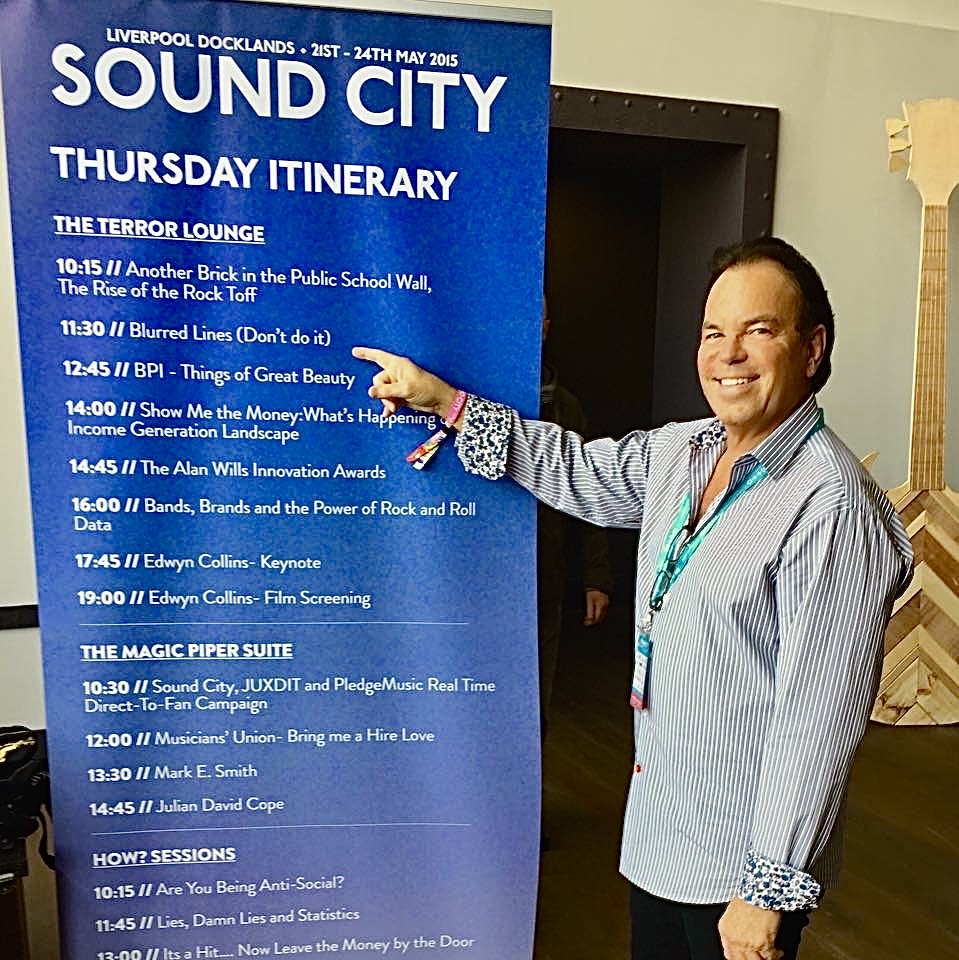
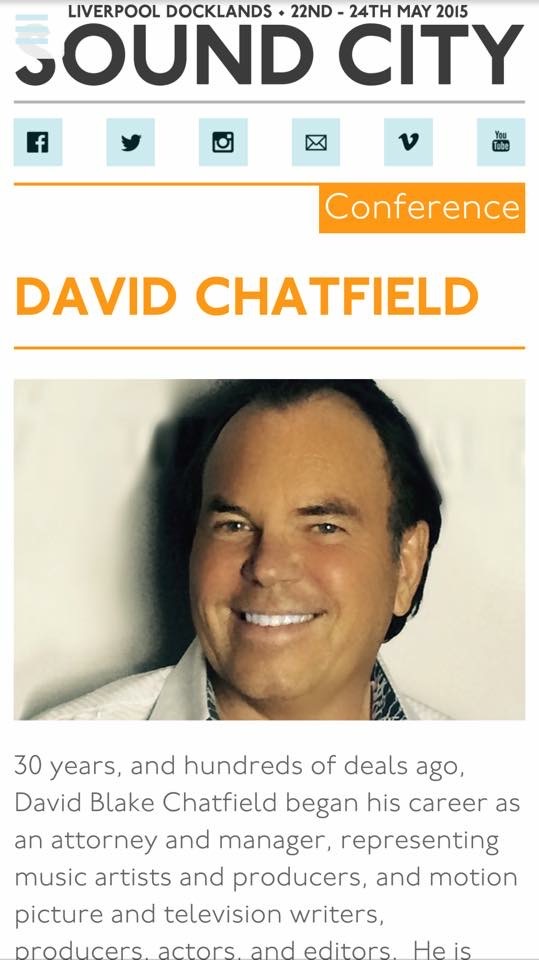
Q: In 2015, you spoke on a panel with music and record business veterans at the Liverpool Sound City Conference in England about copyright infringement.
A: The same issue wrapped differently. The copyright infringement verdict in the Blurred Lines case, where a jury found what Robin Thicke and Pharrell Williams argued was an improper comparison of unprotectable “feel” or “groove” rather than specific elements in the sheet music.
This ruling prompted a defensive shift across the industry. The definition of what is protectable broadened and led to vetting of tracks for potential infringement claims before release, and settlements for similarity disputes climbed.
Retroactive credits followed the same pattern. The ruling reinforced that copyright holders have enforceable rights even when the copying involves structure and combination rather than a note-for-note lift. That was what I and the other panelists discussed.
Included in that discussion was how copyright law had been changed by the ‘My Sweet Lord’ case, where the court decided that copying could occur subconsciously…a process where a songwriter internalizes a familiar melody and later reproduces it without conscious awareness. Familiarity combined with similarity satisfied the standard for infringement. Memory, exposure, and similarity formed the basis of infringement. Intent no longer served as a gatekeeper.
The EU cases have found that AI training of copyright material is wrongful, and US cases suggest that AI-generated songs are the fruit of the unlicensed songs used in the training, and style-matching output is wrongful. Record companies have settled cases that could have outright banned unlicensed AI training and AI-generated music that has a similar structure and combination.
Those cases could have conversely found that AI training is fair use and could have eliminated or reduced the ability to obtain license fees. The issues are still pending in courts worldwide, with labels settling cases for big money, while artists and songwriters are still earning pennies awaiting outcomes of proposed class actions by independent recording artists where billions of dollars are at stake.
My motive for the past 38 years has been to protect artists’ rights and provide them with opportunities to earn fair income.
Q: You’ve always been a champion of the compact disc.
A: What I looked at was that everywhere else in the world, there was an increase in the sale and use of physical product. So, I am making deals to sell physical product all over the world. If you sell 300 CDs, you can make $1,500 dollars from CD sales at the minimum.
There has been a 56 percent increase in CD purchases in the first half of 2026. And who is driving it? Gen Z. They want something to hold in their hands. Years ago, people, consumers, had to buy them by earning them off jobs performed.
There is the new rise of the compact disc. Sure, I’m OK with vinyl and Record Store Day, but CDs are selling way more than vinyl. “The desire for physical media never really went away. It gave people a reason to show up. There is something special about buying music. Friction, going to buy music. Intention, to go buy music.” Randall Messman can be seen saying this on his Cheap Audio Man YouTube channel.
CDs are now a lot less expensive, and people are buying objects that also serve as collectibles. It’s a bond the item has with the listener and purchaser. It also reinforces identity and deep fandom. It’s a community that still exists and is growing.
There is a ritual component that I have spoken about in my television interviews about my newest CD release. You remove the disc from the casing. Physical media is still a delight. People listen to the recording and read the liner notes. There are psychological and chemical reasons why people like to buy physical media. That’s why I put the artist’s media on HavenMusic.us. You can just read it, or you can print it out if you want to hold it in your hands.
I listened to the president of Diskmakers, Tony Van Veen; he sent out a video that everyone saw. My A&R Director, Sydney Alston, used to work with him.
He said that he is selling 16million CDs a year to artists whose fans don’t have CD players. He claims a CD is a token and souvenir of sorts. But is he right? Go to Amazon, and you can get a great CD player for $29.95, and it can be plugged in anywhere and played on anything.
One of the reasons is the economy. Vinyl is expensive, and to buy a record player and a cartridge is expensive. But a record is still good. It’s a part of fandom. But you can go into a record store, especially for a legacy artist, and the unit is 4 or 5 dollars.
65 percent of all record sales in Japan are physical. And in Japan, they will make multiple CDs, the same CD and same music, but release a dozen different artworks.
Q: You have developed and released a new marketing strategy that offers a unique method of presenting one of your label artists, Julian Shah-Tayler.
A: At the moment, my Harmony Records is giving away a CD player with each copy of Julian Shah-Tayler’s Easy to Love. In the 42-page CD package, there are coupons for discounts on Julian’s other dozen albums. Music on CDs sounds better.
I recently heard from some executives that, after seeing an ad for Julian’s CD package, an artist went into their manager’s office and said, “Why didn’t you do this for me?”
Q: There is the ongoing retail renaissance of the Beatles. The 60th anniversary of Rubber Soul is being touted and celebrated. Do you have a theory why this band continues to connect to established and devoted consumers as well as new fans who now are first discovering them?

A: My experience was that in November 1963, President John F. Kennedy was assassinated and a whole country was depressed. He described that time as “a powerful storm pounded your town and your country and for weeks and for months for the longest time your heart and your world had been wrapped in black and the head of every person you looked up to was bowed in mourning and discontent.”
Hauntingly similar to what Lewis Black has described seeing in the faces in his 2026 audiences. As Hanks said in his speech at The Rock and Roll Hall of Fame, “The Beatles and The Dave Clark 5 gave us joy, that gave us permission to be happy again.
“Music reaches the soul and lifts ours…takes our confusion, our sadness, our loss and despair: it takes all the bleak days we have been through and heaviness in our hearts. [The music took] our joylessness and smashed it to pieces.”
This may explain why Gen Z is rejecting AI social media filled with negativity and violence and instead is seeking possession of something that they can hold onto: human-made music and CDs that they can call their own, and reach their hearts and souls the same way that the spirits of their parents were raised when they needed positive music decades ago.
And at that moment the kids didn’t want to be like their parents. We grew our hair long (in violation of the school’s dress code). And then came along FM radio, which continued the sonic messages in the recordings and narratives on the air. Many of us were against the Vietnam War or any war. Music reflected those mores. FM radio became a big factor in exposing longer album tracks and narratives between the DJ and the listener.
With my ventures, I am trying to offer out-of-the-box concepts and a business model that is coming from love and from positivity. And anything that isn’t coming from there doesn’t come from Harmony Records or HavenMusic.us.
The record label is an artist development factory. We have musicians, business people, and managers, and we do what the old-time record companies did when they found talent. Develop the talent. New stars will result from this, and merchandise like CDs and vinyl will be the catalyst if the artists and the record companies do their jobs. The yearly increases in sales of physical products have proven not to be a fad.
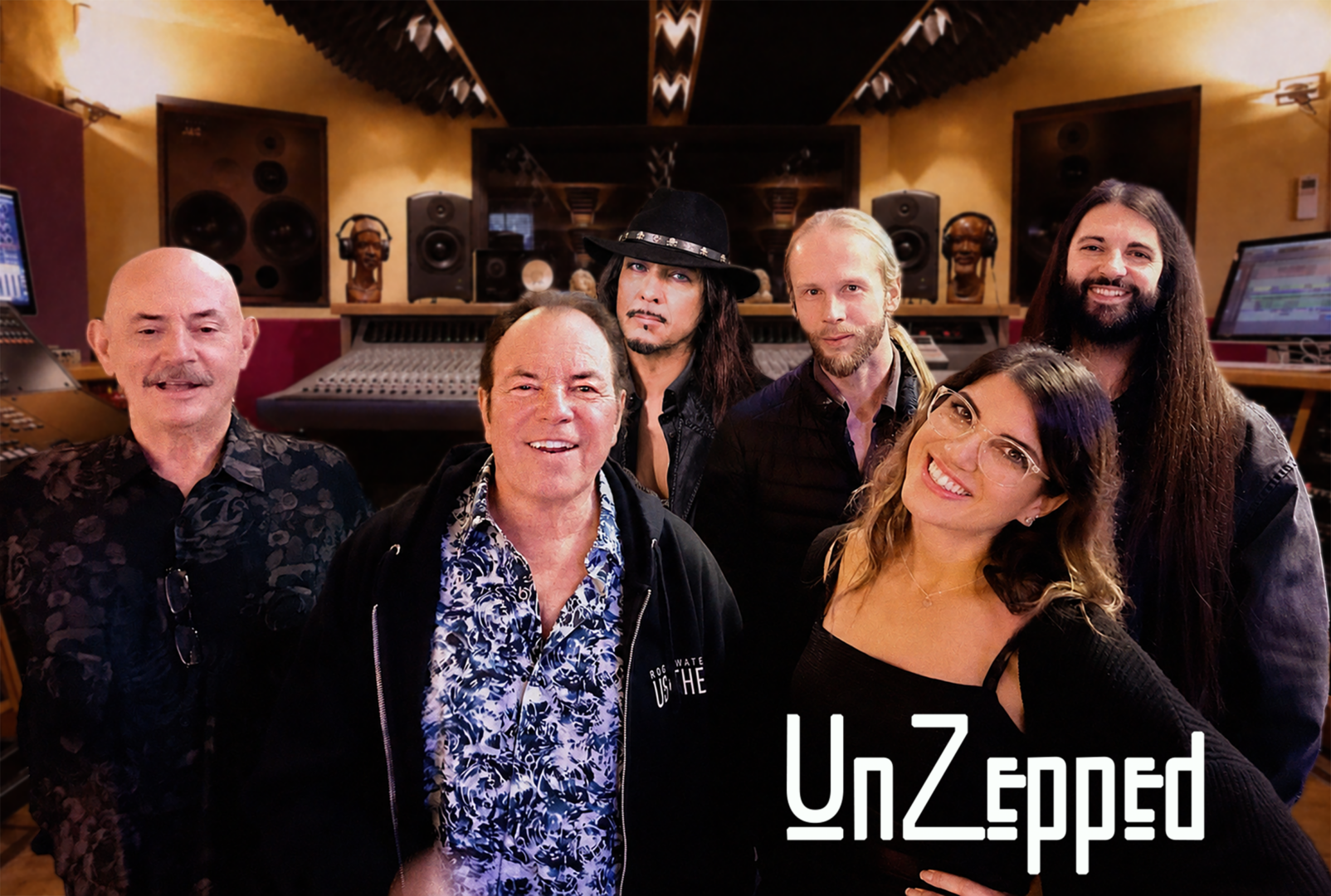
Q: For the last quarter of 2026, your record label is releasing in digital and physical formats of your work and remixes of The Storm, Tony Moore, Julian, UnZepped, Ronnie Laws, and Evil Woman, a tribute to the Electric Light Orchestra.
A: The Harmony catalog is being uploaded now to HavenMusic.us. New exclusive releases from Ronnie Laws featuring Stevie Wonder among others are up on HavenMusic.us.
The Storm’s new single “Leave Well Enough Alone” is available as a HavenMusic.us exclusive, and there are two new exclusive tracks by Julian Shah-Tayler on the Easy to Love album up on HavenMusic.us. Julian’s new CD comes with a free CD player for those looking to get into CD listening. I am working on an immersive version of the Evil Woman album currently on HavenMusic.us.
Tony Moore (Iron Maiden, Cutting Crew) wrote a show called Awake. It’s all about waking up, identifying and stopping the loss of our humanity. It’s the theme of music made by humans, not made by machines.
What is now happening. Tony will have a couple of songs on my label. I am putting them on the streaming services along with his Awake album. He played rock and roll in the early careers of many emerging artists, including KT Tunstall, James Morrison, Paolo Nutini, and Ed Sheeran.
There are two new instrumental versions of Ronnie Laws’ “Ribbon in the Sky,” which features Stevie Wonder, Hubert Laws, Larry Dunn, Lil’ John Roberts, Rob Mullins, and Ray Fuller. I’m also planning new releases from The Storm, UnZepped, Evil Woman, and Brickyard.
I’m also planning new releases from The Storm, UnZepped, Evil Woman, and Brickyard.