
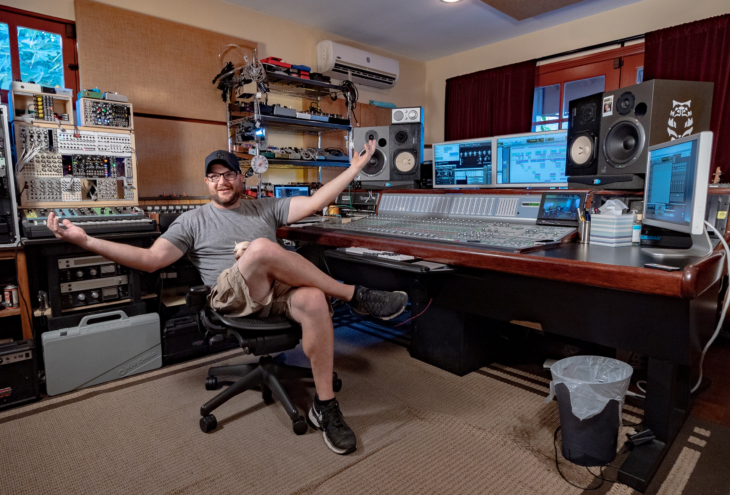
Mixer, recording engineer and producer Keith Armstrong launched his career as an undergraduate at Los Angeles’ University of Southern California. He majored in music recording and, through the able assistance of Candace Stewart, longtime manager of EastWest Studios (manager of Silver Lake’s Soundcastle Studios at the time), landed his first gig as an assistant engineer at The Mix Room in Burbank. He went on to work at several studios but most notably for fifteen years alongside legendary mix engineer Chris Lord-Alge and even followed him to various audio abodes. Artists he’s worked with include Green Day, Shinedown and Halestorm.
With several decades in the business, Armstrong has engineered on countless projects. His experience has led him to a simple yet poignant conclusion about what puts a song on the path to success. “You need to believe the singer and feel that they’re telling you something that has to be told,” he observes. “It feels like they’re literally talking to you; that the song needed to be written. I once worked on a record where we’d recorded all of the tracks but the singer hadn’t written a single lyric. I asked him what he liked to write about and he said, ‘Stuff that we think sounds cool. Our fans tell us what the songs are about later.’ It occurred to me that once you release a song, it’s not yours anymore or at least it’s no more yours than it is anyone’s else’s. We all have a deep attachment and connection to our art but that doesn’t invalidate the listener’s experience. The strength of a song has to do with the listener’s connection. For example, maybe it’s a song they listen to when they have to do something brave.”
Any engineer must possess at least a basic command of his or her craft, of course. But interpersonal skills also play an important and sometimes underestimated role. “Soft skills are a big part of the job,” Armstrong asserts. “Everyone has their own way into this. I’m not a particularly talented person in terms of hearing the music, seeing chartreuse in my mind and then creating a chartreuse track that somebody thinks is amazing. The hard skills are what attracted me to the job but the soft skills are what kept me in it. The hard skills are the means to the end and the soft skills are the hard part because then you have to become every client’s best friend for five minutes. The way that you get to that point is different for everybody.”
Armstrong’s favorite gear includes a blend of standard and bespoke pieces. “I need to mix with my hands so I love my faders,” he observes. “At my main studio I run an old 24-channel Digidesign / Avid D-Command ICON series and I just got into the Avid Pro Tools Dock. Hardware-wise, I have an 1176 limiter, which was built for me by my friend Dim-E (Dmitar Krnjaic). He also made me a monitor switcher known as the Switchitar, as well as something called The Booger that has a little Frankenstein switch in it for fast attack/slow attack. Those are the ones that I’d take in a fire; the things that can’t be replaced.”
Armstrong works largely from his space in North Hollywood, which was a home studio built originally by Mike Melvoin of The Wrecking Crew fame. His recent and upcoming projects include the soundtrack to Green Day’s comedy film Nimrods, and a live record for Durand Jones & The Indications.
The three most important lessons he’s learned as a mixer, recording engineer and producer are:
- Your perspective isn’t as important as you think it is.
- Don’t give up the chance to learn something. This industry is always changing, and you can’t dig in your heels. Even if you think a client is wrong, take the time to engage in their vision.
- Don’t forget that ninety percent of us do this on weekends because we love it. It’s fun.
Contact pietownsound.com, Instagram @properkeith