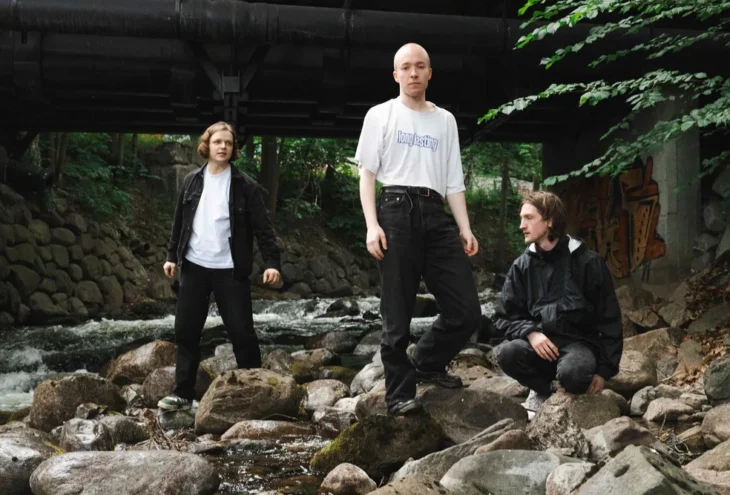
The Members: Tobias Osland, vocals, guitars; Ferdinand Aasheim, drums; Ole Benjamin, bass
Additional Vocals: Haley Shea from Sløtface & Nikki Brumen from Blood Command
Producer: Tobias Osland
Additional Engineering & Bass Re-amping: Benjamin Bosse Krogh Kiønig
Mixing: Derek Coburn
Mastering: Alan Douches
The Origin: Evolving from within Oslo’s contemporary post-hardcore circuit, Hammok stand out by blending aggressive energy with heavily textured production. Defying the traditional logic of real-time guitar chords hitting first, they treat in-the-box studio experimentation as an elastic canvas. The result is a soundscape of electronic fragments and sonics that strike the mind before they are physically felt outside.
The band initially began taking shape through the longtime friendship between vocalist/guitarist Tobias Osland and drummer Ferdinand Aasheim. Bonded by a shared affinity for skate culture, fast pop-punk, and the jagged intensity of aggressive melodic mathcore, the duo eventually converged with bassist Ole Benjamin. Yet, before the trio’s flourishing collaborative identity could fully unfurl, they found themselves abruptly trapped in the enforced stillness and isolation of the 2020 pandemic.
While many bands might have crumbled or dismantled without the vital physical architecture of a live stage and immediate audience feedback — a severe pressure point for many up-and-coming hardcore groups — Hammok chose to adapt. Dropped into a paralyzed musical atmosphere, they used the confinement to fuel their creative fire. The trio moved into a shared space together, turning restrictions on their head and peeling the skin back to build their identity from the inside out.
Hammok thus consciously rerouted their mosh-focused instincts into the digital domain, utilizing it as a personal sonic foundry to engineer a distinct style of norsk støypunk (noise punk). Initially centered around digital audio workstations like Fender Studio Pro (formerly PreSonus Studio One), this unconventional, studio-first punk process allowed the band to prove that methodically crafted in-the-box creations could carry the same volatility and confrontational energy as a sweat-soaked wall-to-wall venue. This foundational philosophy shaped Hammok’s 2022 debut, JUMPING/DANCING/FIGHTING, establishing a core principle that would carry their trajectory forward: highly experimental digital signal processing and virtual re-amping could still produce music that felt intensely physical, pulling just as violently through to the listener.
After showcasing on tour that these heavily layered studio creations could translate flawlessly into explosive live sets, their hyper-pressurized sound caught the attention of the alternative music vanguard and premier noise-rock pillar, Sargent House. Now, as the band is set to release their highly anticipated sophomore album, When Does This Place Become Our Scene (June 5, 2026), Hammok is pulling back the curtain on how they reverse-engineer their tracks — proving that their digital-first landscape might just be the new shape of punk to come.
The Production: Creating and assembling the ideas for new songs has become a beautifully hyper-focused process of discovering the exact sonics Hammok hears and feels. For their follow-up, the trio already had the proof of concept from their digital-friendly, in-the-box debut. This time, however, they were ready to fine-tune this language, finding both the sound and soul to anchor complete chaos within the box.
The band pushed this logic further outward, capturing ideas, song snippets, and audio fragments accumulated while on the road and across personal environs — bedrooms, living rooms, rehearsal spaces. They utilized any mobile setup where in-the-moment ideas could be captured almost as soon as they materialized. The trick for Hammok was piecing them together so they hit as hard in the head as they did in the stomach, and ultimately, on the pavement.
Their tracking process, in its most essential form, leans into reverse engineering. They turn traditional songwriting on its head by building tracks in fragmented layers.
“I love tweaking,” Tobias Osland explains, emphasizing how their DAW-based production workflow shapes their songwriting. By building songs inside the box, the band shifts away from standard hardcore formulas, where thinking in sonic layers will ultimately translate live. Through this system, the emotional core is discovered through sound first, written second, and tweaked third. At the heart of that structure is the search for what Osland describes as a singular point of recognition: a tone that feels both imagined and intensely physical at the same time. “I always want to hear it,” Osland says. “When will it appear, when will I feel it, and where is that exact tone?”
Once that sound is chased down, everything else begins to orbit. It becomes a sonic and structural pillar, with song ideas reverse-built around that moment of recognition. For the new record, those pillars revealed themselves most clearly in “Blast Off” and “BANG” — two tracks that function as opposite expressions of the same method.
As Osland describes, “Blast Off” operates through separation. “The guitar is stripped into high-frequency, short repeating patterns — almost percussive in its restraint — leaving space for the bass to fully define harmonic movement and emotional direction. The track revolves around the distribution of responsibility — each frequency range carrying its own structural role.”
By contrast, “BANG” folds everything into a single object. Guitar and bass cease to exist as separate instruments and instead form one unified wall of sound. The discovery was almost accidental in its final form, achieved by muting most of the original guitar layers and leaving only overdubs that suddenly became the identity of the track. What was meant to support the song became the song itself.
Once those tonal pillars were established, Hammok shifted into translation — taking these internal sonic ideas and forcing them into physical existence through recording. The guitar setup reflects that tension directly. Osland describes how a Gibson Melody Maker and a ‘no-name Stratocaster copy’ are split between a Laney VH100R head feeding a Marshall 4x12 cabinet and a Vox AC30. In short, the two amplification systems interact until the tone becomes unstable in the right way.
Vocals follow this architectural setup. Using tools like the FreeClip plugin across all tracks, along with stock Studio One compression and EQ, and additional distortion via Ruina, the voice is layered, saturated, and pushed into the mix as another physical object. Something that sits inside the sound rather than above it.
If the guitars and vocals define the upper pressure system of Hammok’s sound, the drums are the steadfast grounding force that locks everything into place. That grounding arrived during a focused week at Artilleriverkstedet Studio in Horten, where the band tested multiple kits to ensure their scratch drum takes would work as a cohesive sonic whole.
The moment landed on a vintage Ludwig Blue Sparkle kick drum: the impact was immediate.
“We hit on it, and it was like, ‘Wow, that’s the sound!’” Osland recalls. The sonic recognition was instant for Ferdinand Aasheim and Ole Benjamin as well; Ludwig’s incredible dynamic range and sharp attack were perfect for both live shows and studio settings.
Osland provides more of a breakdown of the specific engineering behind it as they tracked. “We used a Neumann U47 outside and a Shure Beta 91A inside. It was then heavily compressed in parallel through a DBX 560A, so each hit carries direct impact.” In addition, a Tama Piccolo snare appears only in specific sections, used for contrast — sharp interruptions inside an otherwise dense system. The entire kit was then pushed through an API 1608-A console and further shaped with a JHS Colour Box and Meris Ottobit, adding layers of controlled degradation that blur the line between acoustic performance and engineered texture.
Ultimately, what Hammok has captured on When Does This Place Become Our Scene is a masterclass in controlled instability. By bridging the gap between bedroom-laptop ingenuity and raw, room-shaking studio air, they’ve realized the ultimate evolution of their custom-built norsk støypunk. They have proven that punk in 2026 doesn't have to choose between the digital box and the sweatbox of choice. By mastering both, Hammok has created a sound that behaves like something entirely alive—beautifully fractured, deeply unstable, and violently real.
Photo Credit: Fabian Fjekdvik