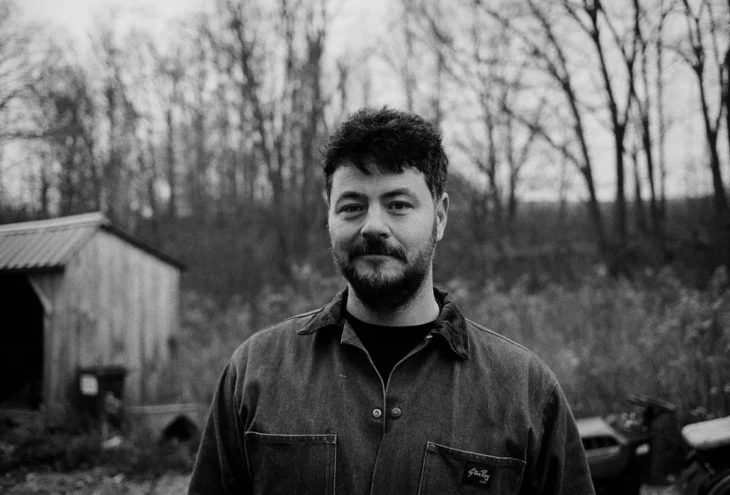
The Artist: James Felice
The Storyteller: James Felice
The Song: Swelling with muted processional horns, sweeping strings, and a rolling piano that sways along a syncopated, blues-based rhythm, the arrangement for “Sail Away” sets a stage where legendary songwriter and film scorer Randy Newman’s voice suddenly arrives with its unpolished resonance. Against this musical backdrop, he delivers deceptive lyrics channeled through the eyes of an allure-spinning huckster. This sardonic sonic monologue develops into a melodic historical annotation, delivering a bitter sarcasm central to Newman’s solo artistic ventures.
Through the years, Newman’s deployment of harmonic irony welded within Americana-infused orchestral compositions set him apart, eventually making him a highly sought-after film composer. His stylistic spectrum spans his most extreme artistic poles, stretching between the love-hate sunshine sound of his lovable 1983 single “I Love L.A.” and the quintessential warmth of his scores for the Toy Story franchise. This fusion of tragicomic storytelling and symphonic craft has influenced a generation of lyrical subversives ranging from Elvis Costello to Father John Misty, galvanizing his place as an iconoclast of American songwriting.
The Background: Hailing from the mountain hamlet of Palenville, New York, The Felice Brothers personify the sound of the storied Catskill Foothills— a place where the faded pastoral harmonics of Bob Dylan and The Band, and their legendary Big Pink sessions for The Basement Tapes, can still be heard echoing throughout the artistic valley with its historic Woodstock grounds.
The Felice Brothers’ twenty-plus-year career earned them widespread respect, highlighted by stints at the fabled Midnight Ramble shows hosted by Levon Helm — the revered drummer and vocalist for The Band — along with extensive work with peers like Bright Eyes and The Lumineers. After decades of James Felice manning the accordion bellows, moving them to-and-fro and breathing life into The Felice Brothers’ timber-toned folk melodies, he stepped away for snippets of time in the early 2020s to work on a collection of newfound Americana frettings — a creative workflow that eventually led to his debut solo outing, 2025’s The Little Ones.
By setting aside a few of his grandest concepts from that time, Felice splintered his output, ultimately expanding his multi-instrumental toolkit to create another round of material. These newer arrangements found their final form in the cinematic, roots-rock rush under the direction of Bright Eyes’ Nate Walcott. With the resulting sophomore album Homeworld Blue, set to hit the shelves via Conor Oberst’s Million Stars Records, James Felice details how the sweeping sounds and eccentric character studies of Randy Newman pulled this new sonic world together.
The Story: Intent on hearing the subtle sonic shifts being signaled across the Catskill peaks from early on, the accordion-to-keys maven kept his internal dial turned up — his young mind always scanning, ever seeking the latent melodies of his surroundings. For Felice, this musical awakening was a twofold event: a cool older brother’s album recommendation paired with an eclectic aunt’s hand-me-down mixtape. The familial pairing inevitably primed him to appreciate the prettiness of sweeping arrangements while simultaneously introducing a smidge of wry, idiosyncratic songwriting.
“It all started when I was around 13. I was hanging out with my brother, Ian, who is a few years older. We had just returned from a hike, and no one else was home, so I started going through a CD collection,” he explains. “I saw a Randy Newman CD called Sail Away, and pulled it out. Before seeing that, I only knew of him because of Toy Story. I loved that movie and the music as a kid when I was around ten, but did not realize that he also wrote songs that were not for little kids.”
Intrigued, he asked his brother about it and popped the disc into the player. From the moment the title track began, Felice felt his entire musical world enter a new reality.
“I remember from the first few bars, when the strings and his voice come in for ‘Sail Away,’ that just changed my life forever. I didn't know that you could write music like that — feeling overwhelmed and beautiful.”
In a surreal flash of clarity, Felice’s mind instantly connected the dots back to an even earlier childhood obsession, one with silver-screen scores circulating through his imagination. In a strange twist of subconscious circumstance, he had picked out the exact artist who straddled both the cinematic and songwriting worlds his developing mind was being drawn toward.
“At the time, I remembered my aunt also had made me a mixtape of film scores when I was about six or seven years old with themes from Star Wars and Chariots of Fire. Basically, big scores from the 70s, 80s, and early 90s. I used to pop that cassette into the car stereo whenever we went anywhere. I would listen to that and just feel these emotions of these sounds; the sounds just really talked to me.”
Sitting there in the still house with his brother, Felice found that hearing the title track "Sail Away" unlocked another door. Though the songs were brief vignettes spanning around three minutes, Newman managed to pack an entire world into every single track.
“I didn't realize that you could use those orchestral, almost classical music-influenced elements in songwriting until I heard ‘Sail Away’,” says Felice. “The marriage of those two worlds. He created these little, tiny films inside of each song.”
That initial realization eventually expanded past the orchestral opulence and into Newman’s unconventional approach to lyrics.
“The first time I listened to the record, I didn't really get what he was going for,” Felice explains. “But on subsequent listenings — and it has been hundreds for me — his technique of adopting a new voice and perspective for every song was mind-blowing.”
That childhood love for massive movie scores colliding with Newman’s style of mordant, miniature storytelling was a huge influencing factor — proof that a vast sound built on strings and small snippets of stories could be achieved. As Felice explains:
“Randy’s lyrics are challenging and surprising. He can easily enter the mind space of another person and tell their stories. It is a little unbalanced, but I find that to be so invigorating.”
That same desire to capture Newman's grand arrangements is what also pushed him to scale up his soundscapes.
“Homeworld Blue is riddled with strings and orchestra,” Felice says. “Much of the music I’ve made over my life has been very small by necessity — just a couple of people in a room. That is the best, but I also wanted to try something different. The idea was to make these songs feel as big as possible.”
This delicate balancing act between massive symphonics and quirky, at times cynical character studies is what makes Newman unclassifiable for many musicians.
“He’s an unusual person in that way. Most of his music that he’s known for is children’s music, scores for Disney films and such. That’s a very unusual path for what I consider a serious songwriter and artist to take. Great songwriters are usually very much like their own little thing. Newman is versatile, and commercial in a way that is just brilliant.”
Felice summarizes Newman’s magic this way:
“I consider him to be on his own little island because a great song makes its way through all your defenses, gets right into your heart, and changes you. That is the most incredible thing art can do. And Newman does that.”
Photo Credit: Michael Koshkin