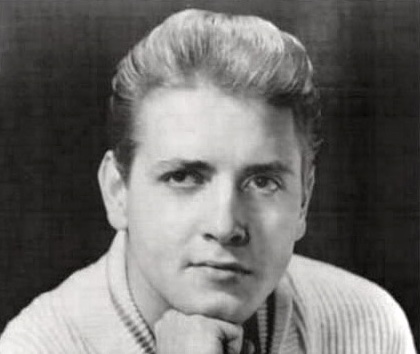
Musicians, Record Producers, Engineers and Deejays Remember Eddie Cochran
Eddie Cochran, guitarist, singer, and songwriter was a pioneering rock and roll icon who left an indelible mark on countless musicians. Dying and just age 21 in 1960, his unique rebellious spirit and influence still resonate with recording artists, fans and rock music historians.
The first official documentary about the charismatic West Coast rocker Eddie Cochran, Don’t Forget Me, is due later this year.
Director Kirsty Bell has lensed on-camera interviews withKeith Richards, Rod Stewart, Ronnie Wood, Roger Daltrey, Peter Frampton, Linda Perry, Alan Jackson, Alice Cooper, Sting, Billy Idol, Suzi Quatro, Brian Setzer, Yungblud, Kiefer Sutherland, members of Cochran’s family and additional talking heads.
Production on the documentary started in 2022. A release date will be announced in the upcoming months.
Kirsty Bell is a UK based filmmaker, producer and executive producer of well over 90 feature films in her career including Executive Producing the 2023 Best Short Film Oscar and BAFTA winner An Irish Goodbye. The Cochran Estate has partnered with Goldfinch Entertainment, Universal Music Enterprises and the Rock & Roll Hall of Fame.
Blue Cheer, Rod Stewart, Humble Pie, the Move, Joan Jett & the Blackhearts, Sheiks of Shake, the Rolling Stones, Stray Cats, the Who, Van Halen, Shakin Stevens, the Beach Boys, Mike Love, Alex Chilton, Bruce Springsteen & the E Street Band, T-Rex, Ritchie Valens, Dion, Terry Reid, the Flaming Lips, Sex Pistols, Buck Owens, Levon Helm, Bobby Vee, Blow Up, Jimmy Barnes, the Flying Lizards, Olivia Newton-John and Tom Petty & the Heartbreakers have recorded or performed versions of Cochran’s “Cut Across Shorty,” “Sittin’ In The Balcony,” “Summertime Blues,” “Twenty Flight Rock,” “Somethin’ Else” and “C’Mon Everybody.”
Many movies and commercials have also licensed Cochran’s master recordings.
Paul McCartney, as a 15-year-old performed a rendition of Cochran’s “Twenty Flight Rock” as the first song when he auditioned for John Lennon’s skiffle group The Quarrymen on July 6, 1957 in Liverpool.
Bob Dylan’s The Philosophy of Modern Song publishedin 2022 has a 1957 photo of Cochran, Little Richard, and Alis Lesley in Australia as the front cover image.
In 1987 Eddie Cochran was inducted into the Rock and Roll Hall of Fame by Mick Jones.
Born Ray Edward Cochran on October 3 1938 in Albert Lea, Minnesota, his family relocated to Bell Gardens, California in 1952 and he began playing guitar in 1954. He subsequently joined with songwriter Hank Cochran forming the Cochran Brothers, but weren’t related.
It was then when Cochran started working a session musician and began writing songs which led to making a demonstration recording with Jerry Capehart. Eddie’s first solo single was released in 1956 on the Crest Record label, owned by a music publisher Sylvester Cross.
In 1956, Eddie made his screen debut in director Frank Tashlin’s The Girl Can’t Help It, singing his rockabilly-inspired “Twenty Flight Rock.”
Cochran then co-starred in the 1957 teensploitation flick Untamed Youth alongside Mamie Van Doren directed by Howard W. Koch.
Eddie played guitar and occasionally contributed vocals and arrangements for Van Doren, rockabilly giant Johnny Burnette, country music singer and songwriter, Wynn Stewart, and friend, songwriter Baker Knight.
During 1958, Cochran did television appearances on the Philadelphia-based American Bandstand and Dick Clark’s Saturday Night Beech-Nut show.
Eddie had a seismic February 7, 1959 live booking on the Los Angeles (Compton-based) and Hadley’s Furniture sponsored Town Hall Party program in 1960 that was broadcast on KTTV-TV with Dick D’Agostin and the Swingers.
In 1959, Cochran, Ritchie Valens, Jimmy Clanton, the Cadillacs, Harvey Fuqua, the Moonglows, Sandy Stewart, Jackie Wilson, Jo Ann Campbell, DJ Alan Freed and other acts starred in Go, Johnny, Go! directed by Paul Landres.
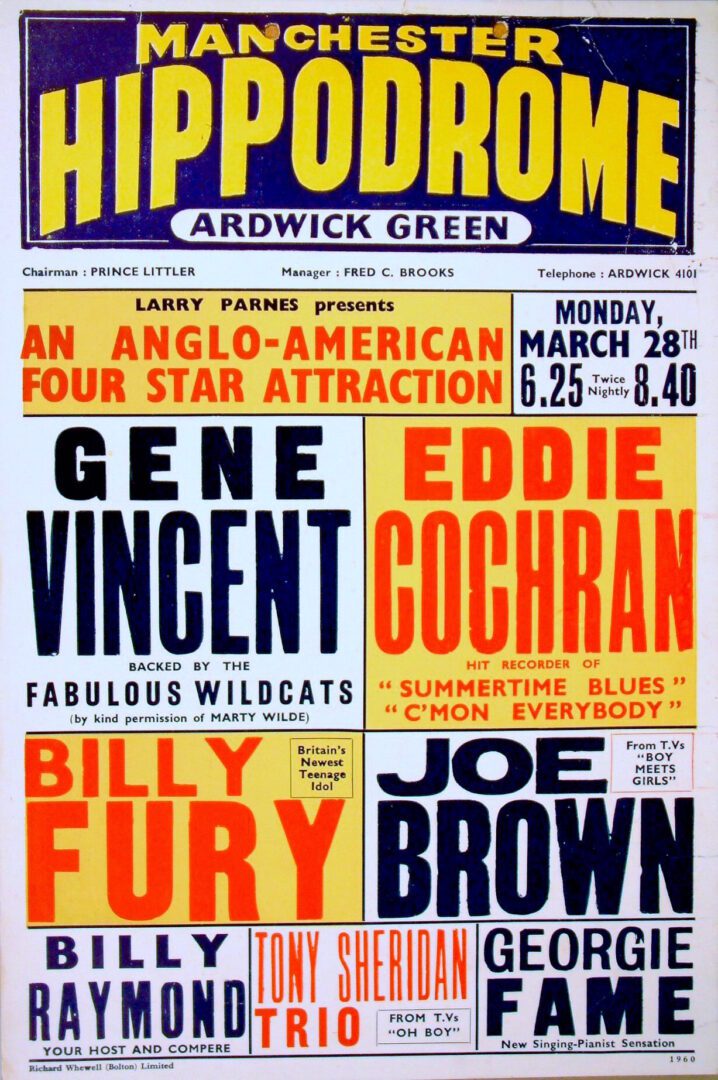
On January 24, 1960 Eddie and rockabilly star Gene Vincent embarked on nearly two-month British tour.
After a show at the Bristol Hippodrome on April 16th, a hired cab driven by George Martin carrying agent Patrick Tompkins, Vincent, Cochran and his fiancée songwriter Sharon Sheeley was involved in a horrific car accident at the end of their trek in Chippenham, Wiltshire.
Vincent and Sheeley were seriously injured and Cochran died the following day in Bath, Somerset at St Martin’s Hospital.
Eddie Cochran was buried April 25th at Forest Lawn Memorial Park in Cypress, Ca.
Sheely had co-written “Somethin’ Else” with Eddie’s brother Bill Cochran and “Love Again” and “Cherished Memories” for Cochran. She penned “Poor Little Fool,” recorded by Ricky Nelson, and “Hurry Up” for Ritchie Valens. Following the tragic 1960 accident, Sheely wrote Brenda Lee’s “Dum Dum” with singer and songwriter Jackie DeShannon.
Eddie was booked for The Ed Sullivan Show before his death.
Two previous England-produced documentaries before Don’t Forget Me were made on Cochran’s life by the BBC: Three Steps to Heaven in 1982, and 2001’s Cherished Memories.
In his memoir Life, Keith Richards crafted a playlist of the most influential songs in his life. “Summertime Blues,” recorded in Hollywood at Gold Star recording studio was in it.
On their 1981 US tour the Rolling Stones included “20 Flight Rock” in their repertoire. On his 1993 Main Offender tour, Keith Richards and the X-Pensive Winos, opened their set nightly with “Somethin’ Else.”
Over the last half century, I’ve asked friends and associates about Eddie Cochran and his legacy. Some worked and recorded with Eddie, others knew him, caught Cochran on stage, and inspired by his catalog.
Multi-instrumentalist, record producer, deejay David Kessel is CEO of CaveHollywood.com and an avid fan of Eddie Cochran.
David is the son of guitarist and jazz legend, Barney Kessel, and step-son of background singer and vocal contractor B.J. Baker, who were both on dozens of record dates at Gold Star.
As a child in the sixties, and as a musician and record producer in the seventies and eighties, David logged more hours at Gold Star than anyone I know.
“Eddie Cochran was a powerhouse. He was completely rock and roll. As a teen himself, he delivered the passion and angst of the teenagers of that era. His swagger and pounding rhythm helped create ROCK AND ROLL. With him you get a guy who put together the multi-musical genres happening at that 1956-1960 time period.
“Eddie was a great musician. He played drums and guitar, overdubbed sounds and had a great songwriter music producer understanding of what he wanted.
“I grew up at Gold Star starting at age 6. My father and step-mom always took us to the studio if we weren’t in school. There was no such thing as day care centers 60 years ago in Hollywood. You sat on a couch, watched the cats set up their equipment, play and smoke cigarettes.
“My brother Dan and I produced recordings at Gold Star and did all kinds of sessions with the American Federation of Musicians Local 47 union members. They were never called the Wrecking Crew.
“I worked there all the time with Phil Spector, recording with Leonard Cohen, Dion and the Ramones, played on their album End of the Century, and more.
“You can explore Gold Star and Eddie’s history in the room, but you need to really take note: The guitar we hear on Eddie’s records is a Gretsch 6120 hollow body electric guitar. It had some punch power and was a very versatile guitar with F holes, huge pickups and added more depth to the sound.
“It’s the F holes. When you have a hollow body electric guitar with F holes, it makes the guitar breathe. When you’re putting it through an amplifier, it breathes extra. It’s the F holes that allow it to get air in there and breathe.
“Gretsch instrument company was founded in 1883 and had a major renaissance in the 1950’s and 1960’s.
“Many artists grooved to Gretsch, and there are many: Duane Eddy, Malcolm from ACDC, Pete Townsend from the Who, and the Stray Cats’ Brian Setzer. George Harrison used a Gretch Chet Atkins Country Gentlemen in the height of Beatlemania.”
In 2012’s Kindle edition of British author and broadcaster Spencer Leigh’s THINGS DO GO WRONG which tells the story of the ill-fated Gene Vincent and Eddie Cochran UK 1960 tour,English musician, singer and guitarist Joe Brown further illuminated Cochran’s unique guitar prowess.
“Eddie had a great trick, it had probably been used in America for years, but we didn’t know about it over here. He used to put a second string instead of a third string on his guitar, so that he had an unwound string and he could bend it and get those bluesy sounds that you never heard in England.”
Russ Titelman is a record producer and songwriter. He’s won three Grammy Awards producing Steve Winwood and Eric Clapton.
In the early sixties Titelman spent hours at Gold Star around Spector sessions. In 1965 he was the rhythm guitarist on the Shindig! television show. He became a staff producer for Warner Bros. Records for 20 years and brought the band Little Feet to the label.
“In 1959 or ’60 Lou Adler and Herb Alpert produced a TV pilot for a dance TV show that they shot at the Renaissance Club on Sunset,” reminisced Russ in a 2014 interview we conducted.
“Eddie Cochran was the guest and I was on as one of the dancers. He had magic. Man, I’ll tell you. ‘Summertime Blues.’ ‘C’Mon, Everybody.’ The sound that he got with his guitar and bass was so completely compelling.”
Music man Robert Marchese won a Grammy for producing in 1968 the live Richard Pryor album at The Troubadour.
Robert witnessed Elvis Presley in 1957 and Eddie Cochran during 1959 in Pittsburgh, Pennsylvania.
“I saw Eddie at the Syria Mosque,” emphasized Marchese by telephone. “Buddy Holly played there 4 times in 1957 and ’58. Elvis blew the roof off the house.
“Believe me, Eddie Cochran was the only person I ever saw who could ever give Elvis a run for his money.
“He sang about girls, cars, had moves and nervous energy we all had. Cochran actually wrote a lot of his stuff. Good lookin’ boy. The chicks were swooning. Eddie was on a bill with Chuck Berry and Huey “Piano” Smith and His Clowns, who were terrific. Mickey & Sylvia were on the show. Her dress was so tight she couldn’t walk! The brothers were going crazy.”
Malcolm Leo is a film director who with Andrew Solt wrote and directed the documentaries This Is Elvis, The Beach Boys: An American Band and in 1979 the groundbreaking television movie Heroes of Rock and Roll.
“I saw Elvis at the Pan-Pacific Auditorium in October 1957,” proclaimed Leo. “The appearance of Elvis in Los Angeles not only changed the culture, but he catalyzed the whole record industry.
“The world before Elvis was the 5/4 Ballroom at Fifty-Fourth and Broadway in downtown L.A. “I had an older friend, Leland States, who could drive and he took me to see Eddie Cochran. Leeland and I were classmates at North Hollywood High School.
“It was Eddie’s hair, shiny shirts, cool slacks that packed the punch when we caught him doing ‘Somethin’ Else.’”
“I heard the Spector and Cochran records in the UK,” volunteered author, and 1964-1967 record producer of the Rolling Stones, Andrew Loog Oldham in a 2000 interview with me.
“It made an impact because of the use of room. The usage of tape delay. You knew something was going on, even if you didn’t know what it was. Later, after, I’d recorded the Rolling Stones’ ‘Not Fade Away’—or let’s say ‘Little Red Rooster.’ You realized, by recording in similar mono circumstances, in London’s Regent Sound as opposed to Gold Star, or where Phil did ‘To Know Him Is to Love Him,’ what the room brought to the game.
“There is a lot of magic to that record. Maybe one of the things that drew me to it was that there was a subliminal audio text from Eddie Cochran records. Eddie had already done ‘Summertime Blues’ at Gold Star. So, we didn’t know, but you do know, man. That’s my memory of it.
“After we were at the Monterey International Pop Festival [in June 1967], emailed Pete Townsend of the Who in a 2007 correspondence, “a side issue was that we played at the Fillmore [in San Francisco] on this trip, and that was probably more important to us, because Bill Graham insisted that we play a longer set than we were used to. It was around this time we began to include songs like ‘Young Man Blues’ and ‘Summertime Blues.’”
Ian Whitcomb was anEnglish piano player, singer-songwriter, record producer, historian, author and broadcaster.
I spoke with him in 2013.
“I’m rooted in Eddie Cochran, Jerry Lee Lewis and George Formby. I also love rock ‘n’ roll. Elvis Presley, Gene Vincent, and Fats Domino. Cochran is sort of overlooked in history. He didn’t make that many records and got killed too early,” lamented Whitcomb.
A deejay on Little Steven’s Underground Garage with Rockabilly Rave-Up is Slim Jim Phatom, drummer of the Stray Cats.
In 2022 I bumped into him in Sherman Oaks, Ca. We chatted briefly about Eddie Cochran. Slim Jim praised the sonic aspects of the Cochran/Capeheart discs and Eddie’s threads.
The Stray Cats have a tune called “Gene and Eddie,” and at every concert you can hear them play “Twenty Flight Rock,” “Summertime Blues” and “C’Mon, Everybody.”
“Eddie Cochran. A great one for sure,” Slim Jim emailed.“We always say Eddie is the greatest rock star ever!”
(Harvey Kubernik is the author of 20 books, including 2009’s Canyon Of Dreams: The Magic And The Music Of Laurel Canyon, 2014’s Turn Up The Radio! Rock, Pop and Roll In Los Angeles 1956-1972, 2015's Every Body Knows: Leonard Cohen, 2016's Heart of Gold Neil Young and 2017's 1967: A Complete Rock Music History of the Summer of Love.
Sterling/Barnes and Noble in 2018 published Harvey and Kenneth Kubernik’s The Story Of The Band: From Big Pink To The Last Waltz. In 2021 they wrote Jimi Hendrix: Voodoo Child for Sterling/Barnes and Noble.
Otherworld Cottage Industries in 2020 published Harvey’s Docs That Rock, Music That Matters. His Screen Gems: (Pop Music Documentaries and Rock ‘n’ Roll TV Scenes) will be published in February 2026 by BearManor Media.
Harvey spoke at the special hearings in 2006 initiated by the Library of Congress held in Hollywood, California, discussing archiving practices and audiotape preservation.
In 2017, he appeared at the Rock & Roll Hall of Fame in Cleveland, Ohio, in its Distinguished Speakers Series and as a panelist discussing the forty-fifth anniversary of The Last Waltz at the Grammy Museum in L.A. during 2023).
Photo courtesy of Liberty Records