Robert Burden fuses a labor-intensive Renaissance-level figurative technique with the obsessive-collector deep end of the pop culture canon in large-scale oil paintings whose Gen X-coded hyper-decorative motifs have only become more complex and dense with contemporary and historical references over the past 20 years.
Often incorporating toys—which he considers as talismans from the liminal space between fantasy and reality—as Proustian narrative prompts, Burden is aware of the “obvious irony in spending thousands of hours to create a single painting that glorifies a cheap, mass-produced toy.” At the same time, this fusion of highly honed technique and pop culture sensibility can offer viewers a transportive experience that is both sweeping and deeply personal. “The work is thematic in nature, but it’s akin to historical icon painting. With icon painting, there’s an emphasis on beauty through symmetry and decoration,” says Burden. “As pretentious as this sounds, I believe the paintings are a distillation of our collective imagination.”
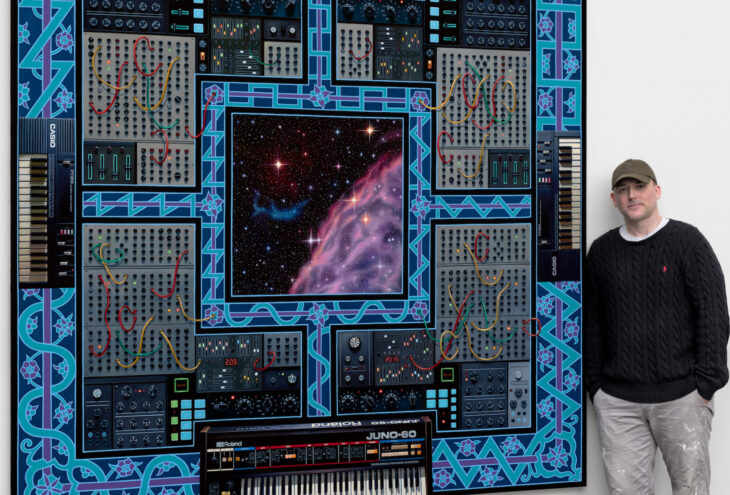
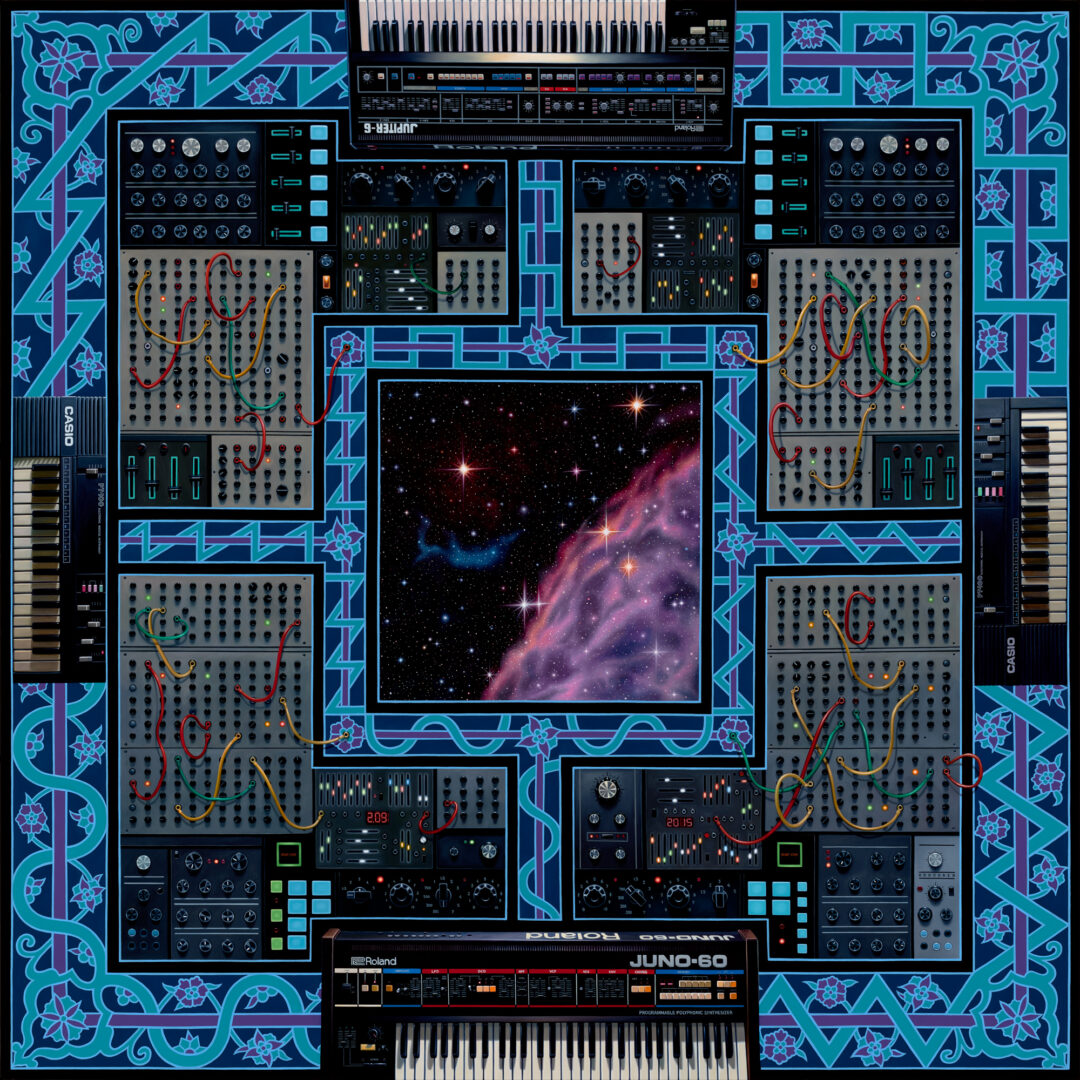
With any one of his paintings taking years to complete, and fresh sources of inspiration arriving all the time, it’s rare that Burden takes commissions. But in the case of Sine Language, he found both. With its elaborate network of cables and wires and circuit boards resembling the borders of illuminated manuscripts, and the center representing the fractal harmony of the cosmos, the work is radiant with mystery and musicality.
“Art has brought me a lot of joy at times,” he says, in spite of the hard, lonely work it demands. “I believe in the work. I believe it has an interesting and weighty social commentary. Twenty years ago, I had a vision for an epic body of work that would take me a lifetime,” he says. And that tune is definitely still playing.
The massive work took roughly 1,700 hours to complete—yes, by hand; yes, by himself—and was commissioned by a music producer named Louis Bell. “Brainstorming this painting with Lou was a lot of fun,” says Burden. “I hung out in his studio, [and] we talked about many different topics, but primarily things that influenced him as a musician—his favorite instruments (Juno 60 and Jupiter 6 keyboards), his first (a Casio PT-100 keyboard), and waveforms and musical elements” that became the architecture of the painting.
Photos by John Janca