Composed by Georges Bizet and premiering in 1875, Carmen is a widely adored opera that's performed in French and set in 1820's Southern Spain. Even casual fans of the art form know the aria "L’amour est un Oiseau Rebelle" (aka "The Habanera"--you'd know it if you heard it), and "Votre Toast, Je Peux Bous le Rendre" (aka "Toreador Song"). These are tunes that have become ingrained in popular culture; they're uplifting, joyous and, in the case of the former, sensual.
But, as is often the case with operas, the arias are infinitely more satisfying when placed in the context of the full show. This latest LA Opera production of Carmen, the first show of the new season, is directed by Thaddeus Strassberger. The conductor is Domingo Hindoyan, while costumes and choreography (both of which are vital and beautiful here) are by Mattie Ullrich and Antonio Najarro respectively.


Tenor Joshua Guerrero is the spurned Don José, bass-baritone Liam James Karai is valiant toreador Escamillo, and soprano Kathleen O'Mara is the unfairly-ignored (by Don José) Micaëla. All are magnificent, as is the entire cast. Special mention to the village children.
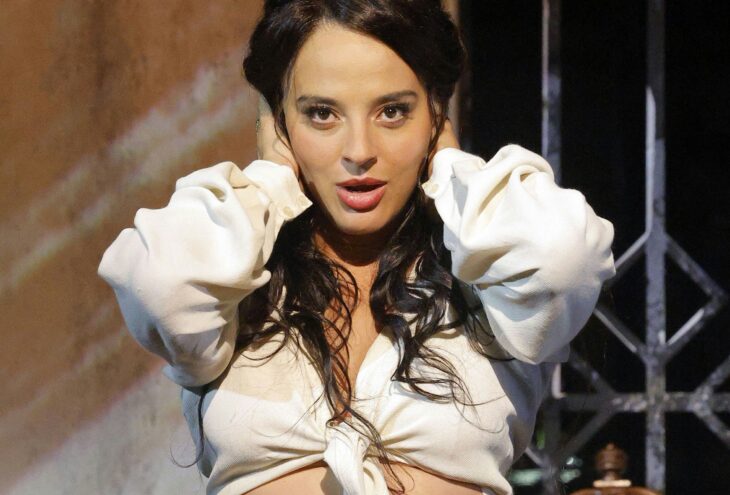
But the star is mezzo-soprano Rihab Chaieb in the title role. First of all, Carmen is an iconic character; determined to remain free of patriarchal bindings, there's a punk rock energy about her from the very start. We first meet her during an argument involving donkey-based name calling, that quickly escalates into a knife fight. Carmen is eventually jailed for slashing a woman's face. It's a proper street brawl, a gutter war, and Carmen swaggers through it all with the slightest hint of a smile on her face.


The character of Carmen is also intoxicating. The men that cross her path are apparently hypnotized into acting like fools and throwing their lives away. While imprisoned, she convinces Don José to release her which results in him getting jailed himself! A buffoon-like officer, Zuniga, keeps showing up to woo her (badly), while super-masculine Escamillo swoops in (his teeth practically twinkling like a cartoon hero). Carmen has her pick, and she knows it. But more important than love, certainly than any man, is her freedom.
"Her freedom is more important than anything else--any person, religion or society," Chaieb said in an interview printed in the event program. "And she says it in the opera: 'Libre elle est nee et libre elle mourra'--free she was born, free she will die. And she will see it through."


"At the time the opera was written, a woman was as good as the man she married," Chaieb continued. "Carmen makes her own decisions. She has power over her body, her sexual life, whether she works or not--everything."
Ultimately, she does die. After 150 years, the word is probably out on that spoiler, and it is an opera after all. The main character usually kicks the bucket. In this case, Don José can't handle the fact that she chose to be with Escamillo, and he runs her through with a sword. But the key is, she knows that death is near and she still chooses freedom over an abusive, imprisoning relationship.
Dear lord, we love the character of Carmen so much. Fans of Deborah Harry, Siouxsie Sioux, Alice Bag, Patti Smith, L7 and any other punk rock and/or riot grrl icon will love her too if they give themselves the chance to. Chaieb is perfect in the role; her voice soars and you simply can't take your eyes off of her.
Get out to see Carmen at the first available opportunity.
Photos by Cory Weaver