Four decades in, with a global team of over 1,000 (20 percent of them in R&D), L-Acoustics has components incorporated into one-of-a-kind venues and events around the world—including Adele’s Las Vegas residency, the Philharmonie de Paris, the Guangzhou Opera House, and more. We spoke with CEO of the L-Acoustics Group, Hervé Guillaume and CEO of L-Acoustics Americas, Bryan Bradley, to get more insight on the impactful brand.
“I would frame the last forty years as a single defining principle—the physics of a coherent wavefront—that we’ve successfully applied to more and more aspects of live sound, with the goal of making live experiences better for everyone.” - Hervé Guillaume, L-Acoustics Group CEO
Founded in Europe by physician Dr. Christian Heil, with a mission to give every audience member the same high-quality sound experience, L-Acoustics continues to push the envelope on spatial audio, prioritizing consistency of sound over pure volume. “With offices and production facilities in France, the US, the UK, Germany and Singapore, the scale is different,” Guillaume says, “but the criteria for launching a product have not changed. If it does not measurably improve what an audience hears, we don’t release it.”
With innovation leaning on neuroscience and psychoacoustics (not trends), the key to L-Acoustics’ success has been the right kind of growth: starting with the right team, continually asking the right questions, taking the time to build quality products, and not being afraid to iterate.
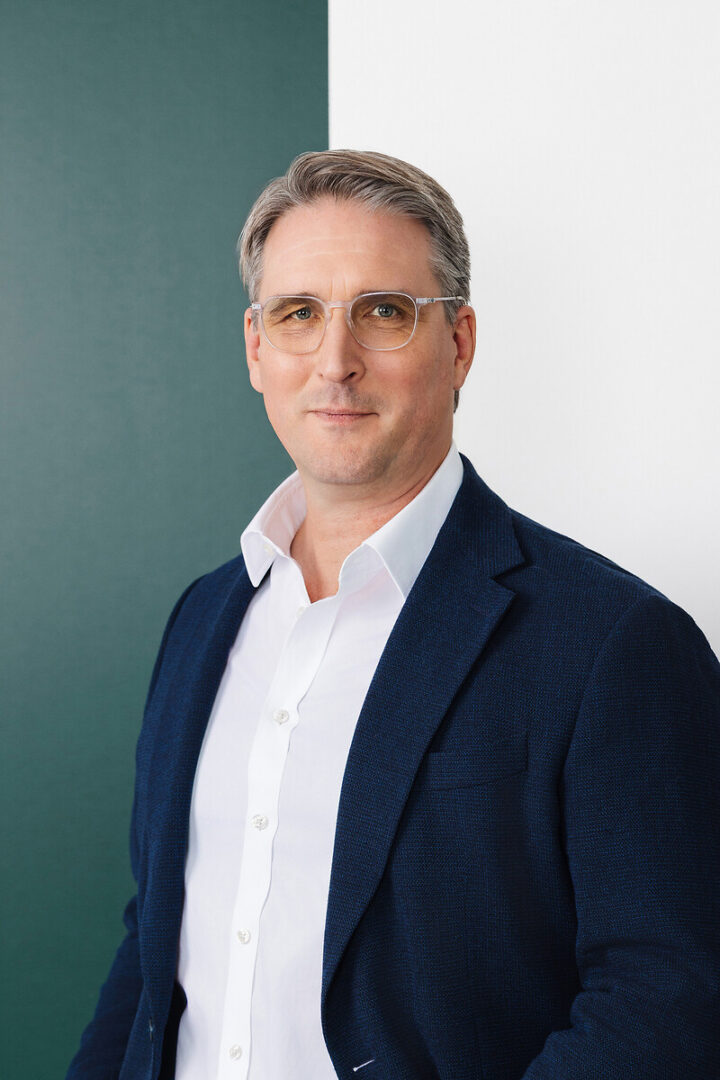
Raising the bar for live sound with modern line array setups and developing WST (Wavefront Sculpture Technology) with 1992’s V-DOSC system, they have become the gold standard in premium touring sound (with products including V-DOSC/ K1 / K2/ Kara/ A Series). Says Guillaume, “V-DOSC was the first proof that Wavefront Sculpture Technology worked outside the lab. Before WST, stacking cabinets meant interference. Christian [Heil] and Marcel Urban published five criteria for coupling drivers so an array behaves as one coherent wavefront, and V-DOSC turned that theory into a product that tour crews could actually rig. Everything L-Acoustics has done since starts from that principle.”
In 2015, L-Acoustics added the L-ISA (L-Acoustics Immersive Sound Art) sound system, treating each sound source as an independent object in any physical space across the stage (rather than traditional left and right channels). “Engineers can mix for where the audience’s attention actually is, not just where the speakers happen to sit,” Guillaume explains. The technology has since been expanded for loudspeakers, amplifiers, predictive modeling software, networked audio, immersive processors, acoustic simulation, room design, and spatial mixing workflows.
Moving from a hardware company to becoming a full experience platform, L-Acoustics’ HYRISS (Hyperreal Immersive Sound Space) technology landed in 2024, expanding on tech developed from stadium performances and applying it to corporate environments, luxury homes, museums, wellness, hospitality and collaborative spaces, with the sound itself becoming part of the architectural design buildout.
2026 saw the introduction of the L1 large-format line array system, CS1 subwoofer, and the launch of Source Intelligence. The latter uses machine learning to bring real-time voice separation technology that runs through the L-ISA Processor, giving front-of-house engineers the ability to clean vocals in real time, adding clarity and eliminating PA bleed, stage and crowd noise, reverb, and feedback risk—with no loss in quality—while giving artists the freedom to perform anywhere.
The team also launched L-Acoustics DJ. “DJs have been mixing in stereo for fifty years,” says Guillaume. “Mostly because the rooms they play are equipped for stereo, so there has been little reason to prepare an immersive mix. More rooms and festivals are adopting immersive systems, because they want to give their audience a better shared experience. DJs can quickly adapt using the real time, machine-learning-based separation to pull a stereo track into its stems and spatialize them automatically.”
Starting as an L-Acoustics intern in 1994, Guillaume continues to be impressed. “Christian [Heil] started the company in a farm outside of Paris, and we were fewer than ten people at the time,” he says. “Sound was not what pulled me in, the company was. What I found here, what still keeps me here, is a small group of physicists, engineers and craftspeople who believe there is always a better way to move air. That belief is contagious.”
Adds Bradley, "The people-first framing is not marketing here. It shows up in how long people stay, the size of the education and training investment, the way regional teams get authority to serve their markets, and the fact that every product decision has been made against the same question: does this measurably improve the connection between the artist and the audience?"
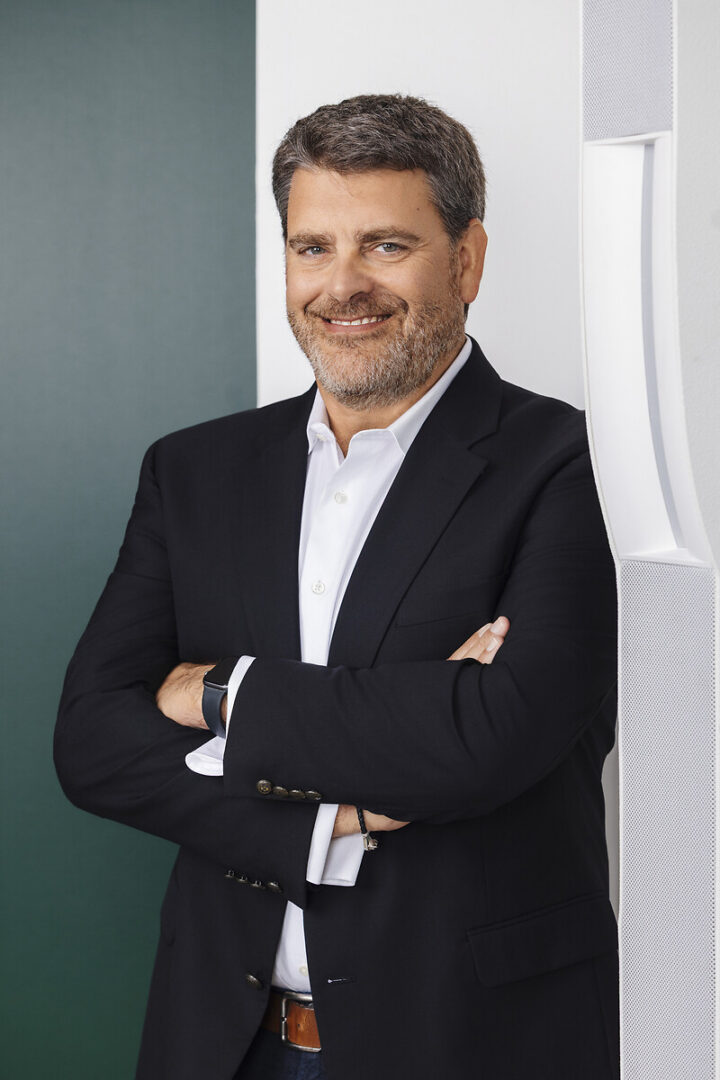
Bradley’s career has always been tied to music—first a songwriter and television music director, then working with Guitar Center, Alfred Music Publishing, Harman Professional, and Group One before L-Acoustics. For him, L-Acoustics stands apart with their balance of continuity and renewal, alongside their discipline. “The company is renewing itself while it holds onto what made it work in the first place,” he says. ”That kind of continuity is unusual in this industry. L-Acoustics [also] really commits to long-term development in technology, building for where the industry is going rather than chasing a fiscal quarter. That has earned the company its leader position in the industry.”
Respected as world class front-of-house, touring production, and acoustic consultants, with systems that behave as a coherent source with smoother frequency response, L-Acoustic products provide improved intelligibility, predictable coverage, less destructive interference, and easier (and lighter) design. They’re used regularly for stadium touring, Broadway, symphony, performing arts centers, churches, festivals, and luxury hospitality spaces and they were the first manufacturer to create a certified partner network and education program to support it (leveraging standardized quality design and internationally available deployment). Artists frequently request L-Acoustics components as part of their rider agreements for good reason.
Now integrating amplification, software, acoustic modeling, immersive processing and networking into a well-oiled, stable ecosystem, L-Acoustics engineers can model a full venue before installation to ensure optimum performance.
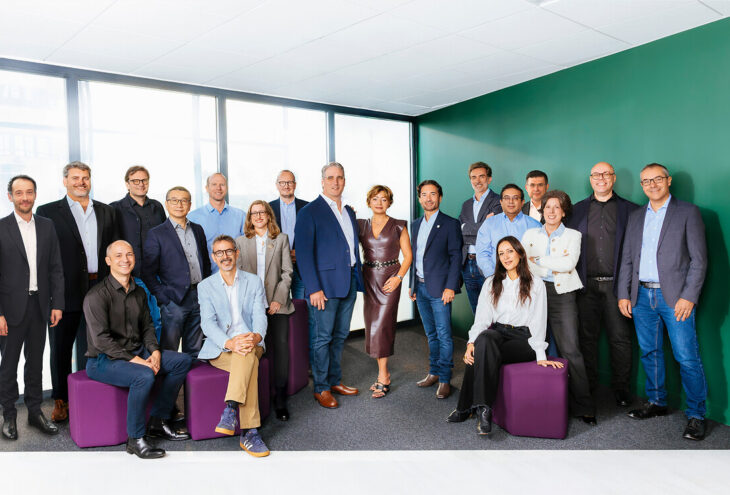
[L to R, standing: Olivier Maynard, Bryan Bradley, Cedric Montrézor, Tim Zhou, Thibaut Jouanin, Céline Mutz, Jaboc Barfoed, Hervé Guillaume, Anne Hamlett, Laurent Vaissié, Marc Furstoss, Ayoub Mounaddam, Louis-Manoël K/Vella, Françoise Cardoso, Genio Kronauer, Etienne Corteel / Seated, L to R: Christophe Combet, Guillaume LeNost, Audrey Neustadter]