MC: We have to ask about “Sun Don’t Let Me Down” featuring Nile Rodgers. Where did this concept come from to work with this legendary guitarist, songwriter and producer?
Urban: He’s always been one of my favorite guitar players. The man is a phenomenal musical entity, a walking vibe, Mr. Mojo. I’ve never worked with anyone like him in the studio. It’s hard to say what he does specifically, other than create an environment and an atmosphere that is so conducive to creativity. His rhythmic sense and his general energy as a person is so intoxicating to be around, and playing with him is a dream come true.
MC: How did you write the lyrics to “Sun Don’t Let Me Down?”
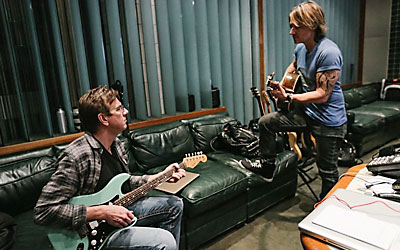
Urban: I like to write by sound. As the track was playing I was singing loudly over it, just gibberish. I actually have an old Sony shoebox recorder I take with me. Everybody I write with knows this. And I have an Armageddon supply of cassette tapes. I love the little condenser mic and the way it compresses. It sounds like AM radio. You can tell if you’re on to something commercial and special if it’s vibing. This song had that.
 MC: There is an interesting turn of phrase in the title. It’s like, what can you say about the sun that hasn’t been said before? How did you develop the concept?
Urban: I was listening to playback, and the vowels sounded like “Sun Don’t Let Me Down.” So what does that mean? You just need a few more hours of the night to seal the deal. I love the play on words. It’s saying, “Don’t let me down and come up.”
MC: On “Sun Don’t Let Me Down” you and busbee are co-writers along with Nile Rodgers, and you also have an additional contributor, Armando Christian Perez, who we know better as Pitbull. How did Mr. Worldwide from the 305 wind up on a country record?
Urban: I was at home working out one day, listening to Globalization by Pitbull, and I kept hearing his voice. Nile knew him and sent him the track. Thankfully he loved it and he made his piece twice the length of what we originally had. That’s how that collaboration happened––it was very organic.
MC: What did the label say when you came in with a banjo-intensive project featuring Nile Rodgers and Pitbull?
Urban: (Laughs) Why not, right? Royce Risser and everyone at Capitol A&R is good at knowing if something works by listening to the end results and not reading the credits if it feels honest and real and authentic. I didn’t meet any resistance from the label.
MC: This is your eighth album for Capitol. Did the execs check in during the recordings?
Urban: Mike Dungan and Cindy Mabe, two of the main people, were good about coming by the studio. They would hang out for ages. Mike wouldn’t say anything, but his presence in the studio made me hear things differently. He wouldn’t say a word, but it was like having a coach in there. I feel really lucky to have a label that gives me that kind of support.
MC: Was radio equally receptive?
Urban: Early on, I was meeting with radio people and playing them different things and the label had been talking to them as well. They were getting hip as it was being made and I think that helped in getting their support.
MC: Your vocal on “That Could Still Be Us” is astoundingly emotional. Where do you have to go mentally to connect like that with a lyric?
Urban: First of all, that song really spoke to me. I didn’t write it, but I felt like, “I know that place like the back of my hand. Let’s go in the studio and keep it simple.”
Jonny Price, one of the writers, had done this great demo. I asked him to come track it out, just the two of us and an engineer. I think having minimal people in the studio is key. I sat down at the control desk, turned the lights down, put on the headphones and shut my eyes and just sang.
MC: Your use of the six-string Deering banjo, or “Ganjo,” is the very first sound that is heard on the song “’Gone Tomorrow (Here Today)” on Ripcord. It is a very distinctive signature––how did you discover this instrument?
Urban: The short version of this story is, I was making The Ranch record in 1995 and I needed a banjo. So a banjo player came in, but I could not articulate my idea. I was thinking, “Man I wish they made a six-string banjo,” because I could hear the part that I wanted in my head. I went to this music store and found this thing, and I took it back to the studio and played the part myself. It ended up on three-fourths of the record and it became part of my sound. Now 21 years later it’s all over Nashville.