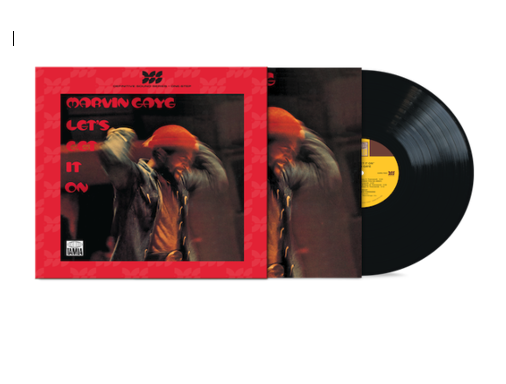
Marvin Gaye’s epic Let’s Get It On is the next release in the Definitive Sound Series (DDS), an acclaimed premium audiophile vinyl collection. Arriving July 17, it’s a limited-edition AAA 180g high-definition vinyl One Step pressing.
“Mr. Gaye created music that was deeply personal, yet universally understood,” says The Estate of Marvin Gaye. “Let’s Get It On remains one of his most celebrated works, and we are honored to see this album presented in a way that respects its legacy while introducing its extraordinary sound to new audiences.”
Mastered by Chris Bellman at Bernie Grundman Mastering, the Definitive Sound Series edition of Let’s Get It On was cut from the original analog master tapes and pressed on Neotech VR900 D2 180g high-definition vinyl by Dorin Sauerbier at Record Technology, Inc.
Utilizing the state-of-the-art One Step process, which eliminates multiple plating stages, the release presents the album’s intricate arrangements, rich instrumentation, and vocal harmonies with exceptional clarity and depth.
This edition is limited to 3,000 numbered copies in a custom-designed slipcase featuring original album artwork, a heavyweight tip-on gatefold jacket, and a certificate of authenticity detailing the mastering, plating, and pressing chain.
Originally released in August 1973 on Motown Records, Let’s Get It On marked a pivotal moment in Marvin Gaye’s career and the evolution of soul music. Released two years after the socially conscious masterpiece What’s Going On, the album revealed a new dimension of Gaye’s artistry, expanded the boundaries of R&B, and became one of the defining albums of the decade.
The title track emerged as one of Gaye’s signature recordings, reaching No.1 on the Billboard Hot 100, while the album climbed to No. 2 on the Billboard 200 and became the best-selling soul album of 1973. Alongside the iconic title song, Let’s Get It On features enduring favorites including “Come Get to This,” “Distant Lover,” and “Just to Keep You Satisfied,” showcasing Gaye’s remarkable range and emotional nuance.
Fusing sensuality, vulnerability, spirituality, and masterful musicianship, Let’s Get It On remains a touchstone of American popular music more than five decades after its release. As Rolling Stone observed, the record explores “the gap between sex and love and how to reconcile them,” while American Songwriter recently noted that its music remains “as vibrant, sultry, and sexy as when it was recorded.”
Let’s Get It On Track Listing:
Side A:
Let’s Get It On
Please Don’t Say (Once You Go Away)
If I Should Die Tonight
Keep Getting’ it On
Side B:
Come Get to This
Distant Lover
You Sure Love to Ball
Just To Keep You Satisfied
“The Definitive Sound Series was created to honor the artistry and enduring impact of these albums through the highest standards of vinyl craftsmanship,” says Xavier Ramos, EVP D2C and eCommerce Strategy at Interscope/Capitol. “Let’s Get It On is one of the most beloved and influential recordings ever made. Presenting it in this format allows listeners to experience the warmth, intimacy, and sonic depth of Marvin Gaye’s landmark album in an entirely new way.”
All DSS releases are initially exclusive to shop.capitolmusic.com and Interscope.com.
A 2023 media announcement from UMe provided background information on Marvin Gaye.
“After the success of What's Going On and the following album, the proto-acid-jazz soundtrack to Trouble Man, Gaye had won Motown's trust. The freedom was liberating, but also fueled a heightened uncertainty about where to take his career. At a personal crossroads involving relocation to Los Angeles, a fraying marriage, a budding romance with Janis Hunter, who attended the initial sessions, and a driving need to experiment, Gaye found a steam valve in creating a suite of erotically charged yet emotionally vulnerable songs. But the final album lineup was drawn from a series of different sessions, resulting in a wealth of vaulted material.
“Marvin's first step in early '73 was to seek out Ed Townsend, the artist, songwriter, and producer best known for his 1950s ballad hit, "For Your Love." He initially had Townsend guide him through ballad arrangements created especially for Marvin by arranger/pianist Bobby Scott in 1966, tracks he obsessed over for years. But these versions of the ballads, like ones Marvin recorded earlier, were left behind; the revealing, previously unreleased '73 versions are included on the new Let's Get It On: Deluxe Edition. (Later vocals were included on the posthumous release, Vulnerable.)
“Simultaneously, sharing their mutual vulnerability, Marvin and Ed wrote new material that eventually became Side 1 of the Let's Get It On album.
“‘I'd just come out of rehab, where I'd beaten a monstrous addiction to alcohol," the late Townsend said. ‘I was looking to move ahead with my life - to 'get it on.' Marvin grasped this completely. But he didn't stop learning the lyrics. He bypassed superficiality, questioning where you were coming from when you composed the song. He couldn't just sing it; he had to connect with it as deeply as he'd written it himself.
"I witnessed the pain he was going through in his life; I was also blessed to witness the joy of an artist fully engaging with his work.’
“With Townsend and veteran arranger Rene Hall, and a slew of stellar session musicians, including veteran saxophonist Plas Johnson, guitarists Don Peake, Arthur Wright and Melvin "Wah Wah" Ragin, drummer Paul Humphrey and the Crusaders' Wilton Felder on bass, Gaye recorded six songs, completing three, transforming the hopeful theme of what became the album's title song into a call for spiritual sex.
“Nothing hung together until Motown, watching months fly by without a new Marvin Gaye record, selected "Let's Get It On" from the tapes and rushed-released it as a single before an album was finished. Alongside new hits from Motown's own Stevie Wonder, Smokey Robinson (in his solo debut), Eddie Kendricks, and Diana Ross, "Let's Get It On" shot to No. 1 Pop (2 weeks) and R&B (6 weeks). The company's first full year on the West Coast was proving a resounding success.
“During the song's climb to the top, Let's Get It On, the album began taking shape. Gaye built upon tracks that originated in Detroit in the fall of 1970 - the Side 2 gems "Come Get to This," "Distant Lover" (the album's second single) and "Just to Keep You Satisfied" - while also finalizing additional selections from the Townsend sessions and his own, provocative "You Sure Love To Ball," which was eventually the third single from the album. Let's Get It On stayed No. 1 on the Soul Albums chart for 11 weeks in the fall of 1973 while peaking at No. 2 Pop.”
“Let’s Get It On” was inducted into the GRAMMY Hall of Fame in 2004 and represents a pivotal moment not only in the career of Marvin Gaye but in the evolution of soul music. Gaye gave voice to intimate desire in a way that was lightning-charged. At the time, he claimed it was spiritually guided. Half a century later, it's never been more apparent that he was telling the truth.”
“The title of David Ritz’s Marvin Gaye biography, Divided Soul, is highly and sadly accurate,” theorized poet and deejay Dr. James Cushing.
“From What’s Going On (1971) through Here, My Dear (1978), that divided soul was fully displayed on record. Gaye showed great courage in 1971 by insisting that his political opus be released intact, but then followed that up with one unsuccessful “message” single and an album’s worth of tuneless cuts that went unreleased until decades later (You’re The Man, 2019). He retreated from politics with his next three albums, Trouble Man (1972),Let’s Get It On (1973), and I Want You (1976), which constitute an irresistibly atmospheric bedroom trilogy — and of these three, I pick the Trouble Man soundtrack as Gaye’s most overlooked, underrated (and sexy!) album. Its lack of recognition must be tied to the nonstarter that was Ivan Dixon’s violent blaxploitation film.
“My favorite element of Let’s Get It On is also relevant to the ‘division’ theme: the album, which celebrates the lascivious joys of sexual congress, ends with one of the saddest, most mournful break-up songs of the 20th century, ‘Just to Keep You Satisfied.’ This adagio to a lost love would not be out of place on Sinatra Sings for Only the Lonely, and has, for me, the effect of emotionally dissolving the title cut’s enthusiasm in the acid of its consequences.”
I witnessed a handful of mid-1960s Motown Revue live road shows in Los Angeles and Hollywood, and danced on a couple of music TV shows when Motown acts would be booked on the Sam Riddle-hosted 9th Street Weston Melrose Avenue and Dick Clark’s American Bandstand Vine Street location.
My brother Kenny and I went to the KHJ Second Annual Appreciation Concert at the Hollywood Bowl on April 29, 1967, for the United Negro College Fund and the UCLA School of Music, headlined by the Supremes with Buffalo Springfield, the Seeds, Brenda Holloway, Johnny Rivers, and the Fifth Dimension.
I once talked to Marvin Gaye in the very early seventies, standing on the corner of 3rd Street and La Cienega in Los Angeles. He was leaving the Record Plant recording studio. We were both on our way to a Motown Records party across the intersection at The Climax Club. Gaye was clad in iridescent green slacks and a dark turtle neck sweater. His hair was perfect.
Marvin and I talked about a Muhammad Ali boxing match he was going to the following night at The Wiltern Theater on Wilshire Boulevard and Western Avenue.
Jack Nitzsche, years later, told me he bumped into Marvin that evening in the Wiltern lobby after the fight. Gaye complimented him on the music charts Jack arranged for him when Marvin appeared at The T.A.M.I. Show 1964filming in Santa Monica, where Jack was the Musical Director.
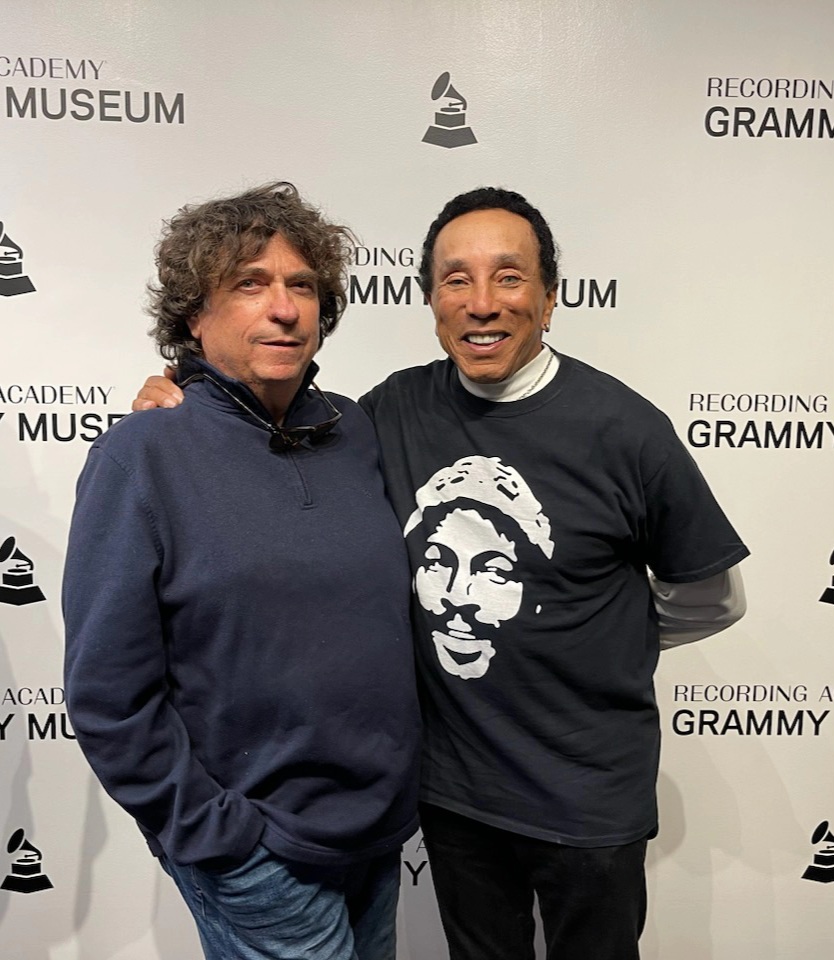
On Wednesday, August 23, 2023 the Grammy Museum in Los Angeles hosted LET’S GET IT ON: Celebrating Motown &1973. Smokey Robinson, Jimmy Jam, and Marvin Gaye biographer David Ritz discussed Motown Records' first full year in LA, including the 50th anniversary of Let's Get It On, moderated by UMe's Harry Weinger.
At the event, I asked Smokey Robinson about one of my favorite recordings he cut with the Miracles, “The Tears of a Clown.”
“Harvey, it's our biggest-selling record. I heard a circus noise in my head when the tune came to me. You know, Barnum and Bailey. Joyous. But I wanted to make sure beneath all the happiness I had a clown who was sad, and knew Pagliacci had tears he hid when he went to the dressing room alone..."
I reminded Smokey that in 2012, I attended the premiere of his spoken piece, Words at the El Portal Theatre in North Hollywood. I even bought a poster that he autographed.
You have no idea, unless you were in that Lankershim Boulevard room that memorable night, what it was like to hear Robinson telling stories and anecdotes about his life. He wasn’t reciting song lyrics, but prepared a program culled from diary entries and observations read from a notebook.
This wasn’t Smokey booked at an awards show, a ceremonial bash, an artist tribute intro spot, or a eulogy. He was standing alone at a microphone, talking to an adoring throng. It was like hearing Robinson’s isolated narrative passage on “Baby, Baby, Don’t Cry,” a hit single for the Miracles in January 1969.
For Melody Maker in November of 1974, I interviewed Bobby Rogers, a member of the Miracles, since their inception in 1958, when he joined his sister Claudette, Ronnie White, Pete Moore, and William “Smokey” Robinson.
Rogers shares the February 19, 1940, date of birth as Smokey Robinson in the same Detroit hospital and co-wrote compositions with Robinson: "The Way You Do the Things You Do" for the Temptations, "First I Look at the Purse" cut by the Contours, and the Miracles’ "Going to a Go-Go."
“The Miracles have always, to this point, been a singles-oriented group. Smokey was writing for the group and everybody else. Smokey never really had the opportunity to do a concept thing.
“The best thing that ever happened to music has got to be the What's Going On album by Marvin Gaye. Marvin was listening to everything that was around. Beatles, Stones, pop, and jazz.
“You know that Sgt. Pepper LP? It was always on Marvin's turntable. Marvin took some time off and really looked at what was happening. Society has changed. A long time ago, black people were smoking dope, and if they got caught, they would go to jail. Now, white people are doing it, and they bring the penalty down. Also, we had some racial hassles years ago in the South, and it's getting better now,” suggested Bobby.
“I really loved touring with the English groups, back in 1963 and 1964. We used to tour with the Rolling Stones and people like Georgie Fame. During the breaks from touring, a lot of the groups would ask questions about certain songs on our albums. I remember when we filmed The TAMI Show, Mick Jagger asked me about what I'd thought of the album James Brown Live at the Apollo, which was his favorite LP.
“One time, he mentioned that he'd like to record a Marvin Gaye song for the next Stones album. A month later, their version of Hitch Hike was being played all over the radio in Detroit.
“I have picked up as many hints on guitar playing as I can from Don Peake, who is the Everly Brothers guitarist,” Keith Richards proudly confessed in a 1963 issue of New Musical Express.
“He really is a fantastic guitarist, and the great thing about him is that he is always ready to show me a few tricks.”
Guitarist Don Peake met Smokey Robinson in December 1964 when he was in the stage band Jack Nitzsche assembled for The T.A.M. I. Show. In addition, Don reconnected with Keith Richards at the landmark taping. At the time, Peake was in Ray Charles’ band and a member of the American Federation of Musicians Local 47, later and incorrectly referred to as the Wrecking Crew. He’s heard on “You’ve Lost That Loving Feelin’” and “River Deep, Mountain High.” Peake was in the Ray Charles band from 1964 to 1974, and with Ray in the nineties.
Don is on the Temptations’ In a Mellow Mood 1967 LP. The music tracks were done in 1966 in Los Angeles and Hollywood. The original vocal lineup of the Temptations then overdubbed their vocals at Hitsville in Detroit. Rene Hall, HB Barnum, and Don Costa arranged and produced the West Coast instrumental sessions.
“I was in a core session group that, in a sense, replaced the Funk Brothers, who did the Motown sessions in Detroit,” stressed Peake in a 2023 interview with me. “We didn’t want to replace them, but Berry Gordy moved out here.
“Benjamin Barrett was a very powerful contractor. He worked with Gene Page a lot, and that’s how he knew me, ’cause Gene always used me on Phil Spector dates. Benjamin called me on the telephone. ‘Hey Don, Motown is moving to Los Angeles. I’m forming a staff band and want you to be one of the guitarists in the orchestra.’
“I went into the room, and there was David T. Walker playing guitar, Louie Shelton on guitar, and drummer Gene Pellow. Some of the records have Paul Humphrey. He wasn’t like Hal Blaine or Earl Palmer. Paul was very understated. He was chill. The pianist was Joe Sample, and the bass player was Wilton Felder, sax player for the Crusaders, but he played the bass for Motown. Ben Barrett told me to go over to the mom-and-pop studio on Ventura and Colfax—Freddie Perren’s studio.
“These were different sessions from those with Spector and Brian Wilson. Freddie had us in a compact core group. It wasn’t the five guitars, two pianos, two drummers, two bassists. This was more like Detroit combos, where the bass was featured. It was a whole different kind of music.
“Playing with the Jackson 5 was just exciting. I had played with the Everly Brothers from 1961 to 1964, so I was into the harmony thing. I’m on a lot of the Jackson 5 records cut in Hollywood: 'I Want You Back,' 'ABC,' 'The Love You Save.’
“I made all those Monkees records, like Mary, Mary. I did the chart. I played on some and arranged some. So, I was on Monkees, Jackson 5, and then the Partridge Family,” confirmed Peake.
“In 1969, Diana Ross came into Freddie Perrin’s studio on Ventura and Colfax and said, ‘I’d like you to meet Michael Jackson.’ The Jackson 5’s debut LP was Diana Ross Presents The Jackson 5.
“The kids were all there. I watched them do their vocals. Michael was magic. All of us looked at Michael and said, ‘Oh my God. This guy is amazing.’ We knew, like with 'ABC,' we were making a great record. Sometimes you can just tell,” Peake emphasized.
“When I played on the Righteous Brothers’ 'You’ve Lost That Lovin’ Feelin,’ everybody in the room knew it was going to be a monster. I played on so many songs by the Jackson 5, including a wonderful record, 'Maybe Tomorrow,' which has an electric sitar. That’s me on the Danelectro.
“We started recording down on Romaine Street, just south of Santa Monica Boulevard, near La Brea Avenue, the Motown studio, the Sunset Room. We also worked at the Crystal studio. It was a big room. The Motown studio was a little smaller. We did some Supremes records there with producer Frank Wilson.
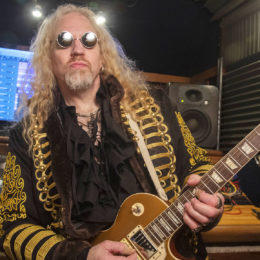
“Then Marvin Gaye walked in. On his session for 'Let’s Get It On,' it was Arthur Wright and me on guitars. I do the lead intro lick. I hit an open G string, and I made a mistake, and you can hear it on the record.”
The 1972 Crown Barney Kessel model guitar used by Peake, who created and played the opening wah-wah introduction on the “Let’s Get It On” date, is on display at The Rock and Roll Hall of Fame in Cleveland, Ohio.
In 1994, Warner Books published Berry Gordy’s autobiography To Be Loved: The Music, The Magic, The Memories of Motown. The title is taken from a song Gordy penned for “Mr. Excitement,” Jackie Wilson.
After talking to Gordy’s book publicist about an interview and having conversations with Ewart Abner of Vee-Jay Records fame, a former President of Motown Records himself, now running The Gordy Company, arrangements were made for the meeting.
I was on Q. and A. assignment for the weekly US music trade magazine HITS, and preparing a profile of Mr. Gordy for Goldmine magazine, a collector’s periodical.
I drove to Gordy’s Bel-Air mansion.
In our conversation, I asked BG about Marvin Gaye.
“The truest artist I’ve ever known. Whatever he was going through in his life, he put on records. I mean, I’ll hear Marvin Gaye’s What’s Going On album. He had three voices: Marvin on top of Marvin on top of Marvin. Just incredible. So, if you want to know Marvin, just listen to one of his records. Each one of us is different, though, and I tell artists to bring out their own uniqueness. That’s why you’ll get a Stevie Wonder, a Marvin Gaye, a Smokey Robinson. You’ve got to nurture that. That’s what we try to do. Nurture their difference.”
In 2002, at the Knitting Factory club on Hollywood Boulevard, I spoke with several Funk Brothers around the premiere of the movie Standing in the Shadows of Motown. Drummer Uriel Jones worked with Sarah Vaughan, Billy Eckstine, Mahalia Jackson, and Dakota Staton, and joined the Motown session band in 1964 after touring with Marvin Gaye.
“On [Marvin Gaye and Tammi Terrell’s] ‘Ain’t No Mountain High Enough,’ Marvin liked to use two drummers,” underlined Jones.
“He didn’t like one drummer bashing. He’d rather have two drummers giving the power and still laying back. Get that smoothness. Marvin used to love singing ballads. Lovely voice.”
In my 2002 joint interviews with the Funk Brothers, I spoke with Jack Ashford. The percussionist and vibraphonist came to Motown at the request of Marvin Gaye in 1963. His tambourine was frequently heard much higher than was the norm in the recording mixes of the day. Jack was in the Hitsville studio on Motown classics as “War,” “Ooh Baby Baby,” “Where Did Our Love Go,” and “What’s Going On.”
Marvin Gaye recorded the song, “What’s Going On,” inspired by an idea from Renaldo “Obie” Benson of the Four Tops after Benson witnessed an act of police brutality at an anti-war rally in Berkeley. The tune was composed by Benson with Gaye and Al Cleveland, and the single reached #1 on the R&B charts. The album, which was Gaye’s first-ever million-seller, launched two more Top 10 singles in “Mercy Mercy Me (The Ecology)” and “Inner City Blues.”
"We knew it was Marvin’s first time being a producer with What’s Going On,” underlined Ashford.
“So that was nice. We knew he was talented, and I didn’t know it extended to the area of writing, producing, and playing. ’Cause he played on the date. It was a different kind of session because he approached it differently. He didn’t approach it as a producer. He approached it from a rehearsal and said, ‘Let’s try this and see if it works.’ That type of thing, but with a concept in mind. It was new to him, too. Something was different about it, and I knew the very night we laid the tracks that something very unusual was in that session. Everybody in the session felt it.”
(Harvey Kubernik is the author of 21 books, including 2009’s Canyon Of Dreams: The Magic And The Music Of Laurel Canyon, 2014’s Turn Up The Radio! Rock, Pop and Roll In Los Angeles 1956-1972, 2015's Every Body Knows: Leonard Cohen, 2016's Heart of Gold Neil Young and 2017's 1967: A Complete Rock Music History of the Summer of Love.
Sterling/Barnes and Noble in 2018 published Harvey and Kenneth Kubernik’s The Story Of The Band: From Big Pink To The Last Waltz. In 2021, they wrote Jimi Hendrix: Voodoo Child for Sterling/Barnes and Noble.
Otherworld Cottage Industries in 2020 published Harvey’s Docs That Rock, Music That Matters. His Screen Gems: (Pop Music Documentaries and Rock ‘n’ Roll TV Scenes) was published on February 6, 2026 by BearManor Media. Kubernik is currently researching a book on the Beatles for a UK publisher.
Harvey spoke at the special hearings in 2006 initiated by the Library of Congress in Hollywood, California, discussing archiving practices and audiotape preservation.
In 2017, he appeared at the Rock & Roll Hall of Fame in Cleveland, Ohio, in its Distinguished Speakers Series and as a panelist discussing the forty-fifth anniversary of The Last Waltz at the Grammy Museum in Los Angeles in 2023.
During 2025, Kubernik was interviewed in the Siobhan Logue-written and -directed documentary The Sound of Protest,airing on the Apple TVOD TV broadcasting service. The film also features Smokey Robinson, Hozier, Skin (Skunk Anansie), Two-Tone's Jerry Dammers, Angélique Kidjo, Holly Johnson, David McAlmont, Rhiannon Giddens, and more.
Harvey was an interview subject along with Iggy Pop, the Beach Boys’ Bruce Johnston, Love’s Johnny Echols, the Bangles' Susanna Hoffs, Victoria and Debbi Peterson, and the founding members of the Seeds for director/producer Neil Norman’s documentary The Seeds: Pushin' Too Hard. In summer 2026, GNP Crescendo releases the film on DVD/Blu-ray). Author Miss Pamela Des Barres narrates).