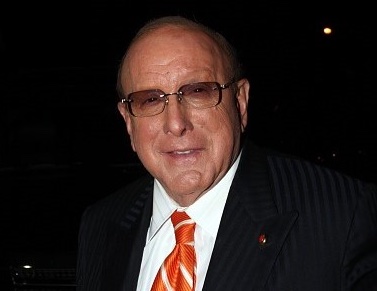
Music Connection is saddened to learn of the passing of music industry titan Clive Davis. In tribute, writer Harvey Kubernik shares his 2012 interview with Davis...
I conducted an interview with Clive in 2012 for a book on The Monterey International Pop Festival that I co-authored with my brother Kenneth Kubernik "A Perfect Haze: The Illustrated History of the Monterey International Pop Festival," published by Santa Monica Press.
Clive Davis: "It’s still many years ago but vivid in memory. I was really just getting my feet wet. I was on the business side of it for a year. I was working with Andy Williams, the young Barbra Streisand, and Bob Dylan, and signed Donovan, and I was observing. When you get a title of President, before you start making active moves, you sort of appraise the situation. Columbia (Records) at the time was preminent in the field of classical music and Broadway, middle of the road music, coming out of the Mitch Miller era, with artists like Tony Bennett and young Streisand, and Andy Williams, among others. I was seeing the business change.
I was seeing music change, but I was waiting for the A&R staff to lead into these changes that were showing evidence in becoming important in music. So when I really came to Monterey not knowing what to expect, but seeing a revolution before my eyes that became evident as artists, known or unknown, to the stage. All of a sudden seeing (Jimi) Hendrix, Janis Joplin and Big Brother and the Holding Company, the Electric Flag, and the artists that were there, there was no question that the predominance there was a change in contemporary music. A definite hardening, edgier, rockier amplification was taking place that truly was signaling a major revolution in rock music.
I was going there really as a friend of Lou Adler, and we had that record “San Francisco,” the first record under the Ode Records’ deal, Lou and Abe were on the Board of Directors, and I was really going for a music enjoyment weekend. I had no idea what awaited me. I had no knowledge of what was going on in San Francisco, for example. So I really was going with my wife to spend a three- day weekend enjoying I think the first pop music festival. When I saw the crowd, it was visually stunning, the dress and the attitude.
When Janis (Joplin) took the stage, it was an unknown group to me totally, Big Brother & The Holding Company, and right from the outset it was something you could never forget. She took the stage, dominated, and was absolutely breathtaking, hypnotic, compelling and soul-shaking. You saw someone who was not only good but was doing something that no one else was doing.
With that fervor, that intensity, and impact, So yeah, that in effect, coupled with everything around me, the way people were dressing, what was going on in Haight Ashbury, the spirit in the air, and the feeling. I just said, ‘You know, I am here at a very unique time. I’m feeling it. I’m feeling it in my spine. I’m feeling it in my sense of excitement. I’m feeling it in the impact, it’s not only musical changes, but in society changes, and I, in effect, said, ‘This is really, although it sounds hokey or cliche, this is the time that must mean that I’m gonna have to make my move.’
There’s no question that the primary signing was Big Brother and Janis Joplin, but the Electric Flag was very powerful with Buddy Miles on drums, and Mike Bloomfield on guitar. Laura Nyro was not great at Monterey, and I didn’t come away with the feeling I must sign here then. I was aware of her through Monterey, and subsequently came to know of her more particularly through David Geffen, who managed her, and when she came to my office to play her material and her songs, it really was the listening to her songs that overcame what had been a negative in person at Monterey.
The success of the artists I signed at Monterey gave me confidence that I had good ears. There was no question I was going to get confidence from nothing else. I mean, basically, that was a move I had made, and the fact that they came through in a resounding way, and were critically welcomed as well as commercially they reverberated, there’s no question that the streak that I was in with each of them making its mark in an important way led me imperatively ‘cause I had no idea I had ‘ears.’ I had no idea that I could do this. It never occurred to me that I would be doing it, and so as each step came through it emboldened me and gave me the confidence to trust my own instincts. And, that’s the only way that I’ve ever done it.
Because obviously, up until that time, my background was totally different and it was a talent that I never knew I had. And as each came through it emboldened me that I this was something that I not only loved doing but I had a talent for. Monterey is a without question, probably the most vivid memory from a career point of view, from an emotional point of view from a character-affecting point of view that I’ve ever had."
Photo by Christopher Peterson, licensed under the Creative Commons Attribution 3.0 Unported license.