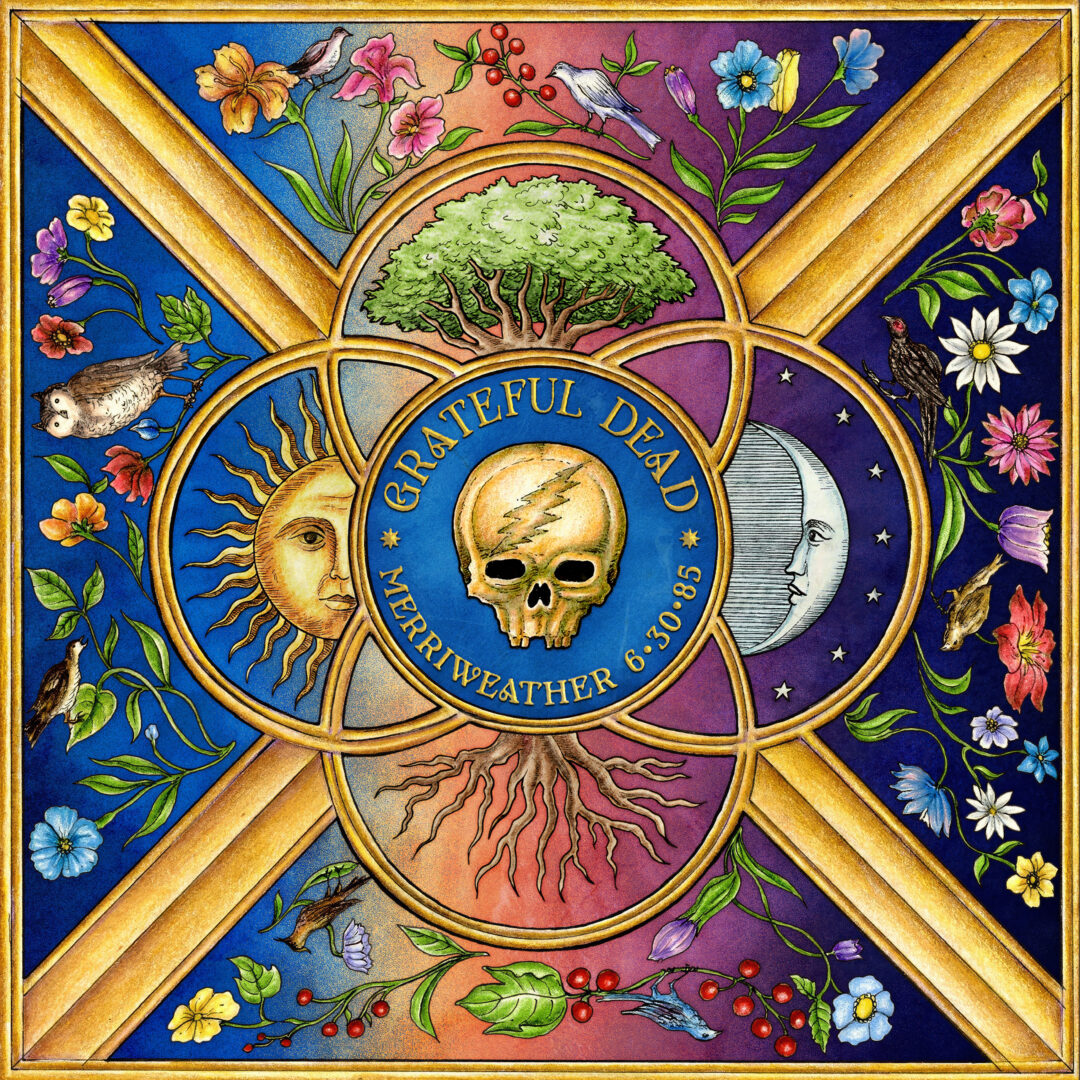
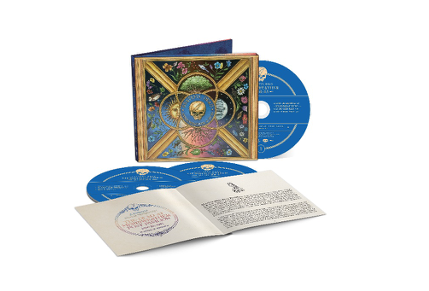
A new 20-CD boxed set from the Grateful Dead featuring seven previously unreleased concerts from the "Twenty Years So Far" Tour is due September 18. Limited to 10,000 individually numbered copies, the collection will be available exclusively from Dead.net. ALAC and High Res FLAC downloads will be released the same day.
The set includes all three official Grateful Dead 20th anniversary shows at the Greek (6/14-6/16/85); Saratoga Performing Arts Center (6/27/85); Hershey Park Stadium (6/28/85); and Merriweather 6/30/85. All the performances were recorded by the band’s longtime sound engineer Dan Healy and mastered by GRAMMY® Award-winning engineer David Glasser at Airshow Mastering.
Celebrating the magical and spiritual fusion of communal energy, musical improvisation, and psychedelic style, this high-concept boxed set visually captures the transformative "concert alchemy" of the Grateful Dead's summer 1985 tour.
Multidisciplinary artist Marcos Alvarado, known for incorporating alchemical symbolism in his surreal figurative drawings, guides us through an allegorical journey, introducing an array of new characters through striking original artwork that draws inspiration from classical illuminations. The 96-page book features new essays by Nicholas G. Meriwether and David Lemieux, photos and more original artwork from Alvarado. Clever design features in this boxed set and its bonus items add a sense of continued transformation and discovery that honors the Grateful Dead's enduring legacy.
Grateful Dead Legacy Manager and Archivist Dave Lemieux became a fan of the 1985 summer tour as a teenager after trading for a copy of the second set from June 15 at the Greek. "I had a few tapes by this time from 1983 and 1984, but this 1985 Grateful Dead was something entirely different, a freshness that sounded like a band now celebrating 20 years (!), but still just getting started. From that moment on, I was on a mission to collect as much 1985 Dead as possible."
Also on September 18, Rhino will release 3CD and 4LP versions of the legendary Merriweather 6/30/85 concert from the set.
Lemieux says the show's biggest moment is a version of "Shakedown Street" that's "widely considered one of the greatest single performances of any song by the Grateful Dead, up there with the 'Dew' from Europe '72, 'Viola Lee Blues' from Harpur College, and 'Eyes Of The World' from 3/29/90. Yes, it's that good."
The anniversary tour began in Berkeley, CA at the Greek Theatre (June 14-16, 1985), one of the band's favorite venues since its debut there on October 1, 1967, a day before the police famously raided their home at 710 Ashbury Street. Opening night, the band surprised with the debut of Eric Clapton's "Keep On Growing" with Phil Lesh and Brent Mydland sharing vocals. The following night they opened with "Touch Of Grey," a song whose success two years later would make it impossible for the band to return to the Greek after 1989. They saved a special bust-out for the final night, playing "Cryptical Envelopment" for the first time in 13 years. Jerry Garcia's eerie vocals and funhouse guitar once again provided a bookend around Bob Weir's thundering anthem, "The Other One."
Moving East to Saratoga Springs, NY and the Saratoga Performing Arts Center (June 27, 1985), the band faced a dangerously over-capacity crowd where fans hanging from the balcony forced an early-show warning from the stage. As cooler heads prevailed, the crowd was rewarded with a rare first-set appearance of "Crazy Fingers" that tapered gently into the jam from "Supplication," Weir's 1976 gem with Kingfish. The second set closed with "Turn On Your Lovelight," originally a showcase for Ron "Pigpen" McKernan, who urged members of Mother McCree's Uptown Jug Champions to go electric in 1965 and was a member of the Grateful Dead until his death in 1973.
The momentum carried into Hershey, PA and Hershey Park Stadium (June 28, 1985) for a challenging, rain-soaked performance where Bill Kreutzmann and Mickey Hart drove a powerful and sweeping "Terrapin Station" to its crashing climax before launching into "Drums" and "Space." Sound engineer Dan Healy joined in, using new electronic gear to manipulate the PA and shape a three-dimensional soundscape in the venue. A short drive away, the band took over Merriweather Post Pavilion (June 30–July 1, 1985), an outdoor amphitheater in Columbia, MD originally designed by Frank Gehry for the National Symphony Orchestra. After a showstopping "Shakedown Street" on the first night, the band closed the second night with a double encore, pairing the Rolling Stones' "(I Can't Get No) Satisfaction" and Bob Dylan's "It's All Over Now, Baby Blue"—the perfect grace note for a show that many raved was the best of the tour.
Lemieux adds, "Certain things are indicative of the Grateful Dead being 'on,' and a rare double encore always means they're having a blast and don't want the show to end. This boxed set's seven gigs feature THREE double encores, and it's those 'little things' that reveal a band still having more fun than a frog in a glass of milk."
In the Summer Magic 1985 excellent liner notes, Nicholas G. Meriwether (Executive Director, Grateful Dead Studies Association) writes: "The seven shows this box presents... offer a snapshot of the artistic process that was the Grateful Dead, making a powerful statement of the band's project as they marked their 20th anniversary. ...this box not only lets us revisit what these shows sounded like at a peak of the band's PA prowess, but it also lets us finally hear what these shows meant, the alchemy of time and memory finally revealing the gold of those concerts."
Summer Magic 1985 Concert Listing
Greek Theatre, University of California, Berkeley, CA (6/14/85)
Greek Theatre, University of California, Berkeley, CA (6/15/85)
Greek Theatre, University of California, Berkeley, CA (6/16/85)
Saratoga Performing Arts Center, Saratoga Springs, NY (6/27/85)
Hershey Park Stadium, Hershey, PA (6/28/85)
Merriweather Post Pavilion, Columbia, MD (6/30/85)
Merriweather Post Pavilion, Columbia, MD (7/1/85)
Merriweather Post Pavilion, Columbia, MD (6/30/85)
3CD Track Listing
Disc One
“Mississippi Half-Step Uptown Toodeloo”>
“C.C. Rider”>
“Brown-Eyed Women”
“Mama Tried”>
“Mexicali Blues”
“Keep On Growing”
“Big Railroad Blues”
“Looks Like Rain”>
“Don't Ease Me In”
Disc Two
“Shakedown Street”>
“Samson And Delilah”
“Gimme Some Lovin'”>
“He's Gone”>
“Cryptical Envelopment”>
“Drums”
Disc Three
“Space”>
“The Other One”>
“Stella Blue”>
“Around And Around”>
“Sugar Magnolia”
“U.S. Blues”
Merriweather Post Pavilion, Columbia, MD (6/30/85)
4LP Track Listing
Side A
“Mississippi Half-Step Uptown Toodeloo”>
“C.C. Rider”>
“Brown-Eyed Women”
Side B
“Mama Tried”>
“Mexicali Blues”
“Keep On Growing”
Side C
“Big Railroad Blues”
“Looks Like Rain”>
“Don't Ease Me In”
Side D
“Shakedown Street”>
“Samson And Delilah”
Side E
“Gimme Some Lovin'”>
“He's Gone”>
“Cryptical Envelopment”
Side F
“Drums”
“Space”>
Side G
“The Other One”>
“Stella Blue”>
Side H
“Around And Around”
“Sugar Magnolia”
“U.S. Blues”
On an August 1976 visit to Mill Valley, California, just north of San Francisco, I interviewed Jerry Garcia at the home of promoter Bill Graham. Portions of this interview originally appeared in the August 21, 1976, issue of the Melody Maker.
HK: Jerry, the San Francisco music scene.
JG: I really think the scene out here created the possibility for Woodstock to happen. The Monterey International Pop Festival— the thing, the activity, music, and people. The setup was out here.
HK: Is there a reason for your longevity?
JG: We’re serious. One of the things you could say about all the bands that came from San Francisco at that time was that none of them were very much alike. I think each of us has dealt with it in various ways. For me, I know what I’m supposed to do, and I’ll do what I’ll have to do to be able to play. I think almost all the people I’ve known around this area, involved around the music scene, have been faithful to that thing.
HK: Didn’t you ever feel you represented something special to the music community?
JG: I always did. I think that the world has changed. I think the United States has changed very visibly in the last ten years. A lot of it had to do with what happened in San Francisco. I can’t say how or why, but I also think it’s affected everything.
HK: Like how?
JG: Just all the interest in things like ecology. All the interest in the sense of personal freedom as expressed by all kinds of movements. All these things were designed to free the human. Social overtones. All that stuff. The communal spirit.
HK: Have you always liked playing live?
JG: I like the live experience. That’s where it counts. That’s when music is real. It’s real in that situation. That’s the situation that I feel I have the greatest sense of personal responsibility about. I don’t mind putting out a bad record, but I really hate a bad concert. That really is depressing.
HK: You get into other musical avenues with solo projects away from the Grateful Dead. Has there ever been any conflict in doing a tune for the Dead or keeping it for future solo endeavors?
JG: It’s not judgmental. You can’t deal with it in a yes/no kind of fashion. For example, my band is a band that could best be described as consonance and harmony. Conceptually, everybody in the band thinks pretty similarly. In the Grateful Dead, it’s a situation in which almost no two people have the same conception musically, which makes it harder. Nobody gets their way. However, what we all respect about that situation is that there is a potential for a larger central viewpoint which none of us, individually, are capable of perceiving, but which we all add to because of the diversity and the conflict.
HK: Did you ever think ten years ago that the Grateful Dead would get beyond the ballroom circuit and that rock and roll would be presented in large indoor arenas and baseball and football stadiums?
JG: When the Acid Tests were happening, I personally felt, “In three months from now the whole world will be involved in this.” So, as far as I’m concerned, it’s been slow and disappointing. Why isn’t this paradise already [laughs]? My personal feeling has been one of waiting around.
HK: How long do you feel you can continue the hectic pace of touring?
JG: I’ve learned that it requires a certain discipline for me personally. And I know I’ll approach it in a certain way. I’ll definitely burn out, and I wouldn’t survive a tour, for example. For me, it’s a matter of surviving. This is the set of givens. You’re gonna be in airports, motels, exposed to any number of strange drugs, strange experiences, intensity of this sort, and so forth. Within that framework, how do you stay even? What you do is learn so it becomes a thing of pace, Vitamin C, protein. You try and stay alive. That’s a fundamental problem.
I’m just the sort of person who deals with things on that level. Once I know things that I have to cope with, it’s just a matter of adjustment. I just hate personal failure, being on stage and going through the changes and playing bad because I’m either not well, tired, too stoned, whatever. To me, it’s an aversion therapy thing. It’s the reason I’ve been able to survive.
HK: Do you have high and low points looking back over the last ten years?
JG: Well, I can get into that really easily. The worst for us and for me personally was Woodstock: the ultimate calamity. First, we were really stupid in the way we dealt with it. It was raining, and we went on just after it got dark. There was maximum confusion going on, sound logistics. Really weird. Plus, I was high, of course. And I went on stage in a state of confusion. Huge crowds of people over the stage. The stage had sheet metal and stuff on it, it’s wet, and I’m getting incredible shocks from my guitar. Pretty soon, I started hallucinating a ball of electricity rolling across the stage jumping off my guitar.
Meanwhile, [there were] all the little citizen band radios and walkie-talkies and things with the amplifiers, so weird voices are coming out of the amplifiers. It’s dark, and you don’t see any audience, but you know there’s 400,000 people out there. Then somebody leans over across the stage, since everyone is ganged up, and says the stage is about to collapse. I’m standing there in the middle of this trying to play music. Then they turn on the lights, and the lights are a mile away. Monster super troopers. Totally blinding, and you can’t see anything at all. Here’s this energy, and everything is horribly out of tune ’cause it’s all wet, damp, and humid. It was just a disaster. It was humbling [laughs].”
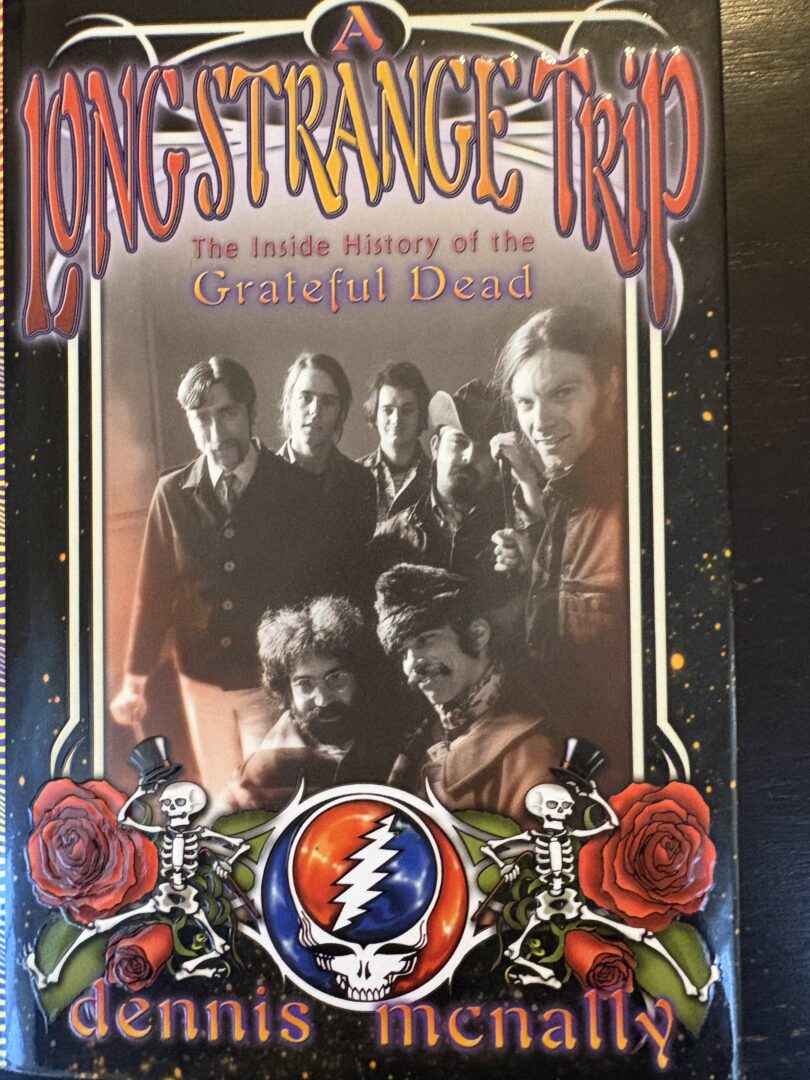
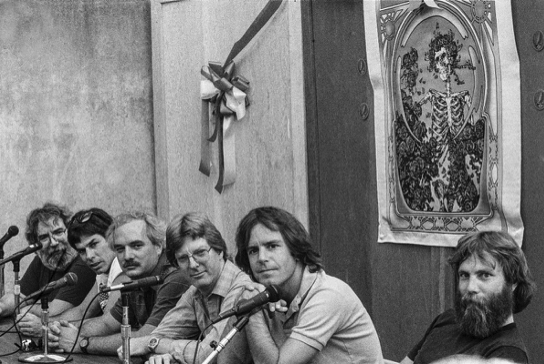
Dennis McNally, in 2002, penned his 600-page Grateful Dead memoir, A Long Strange Trip: The Inside History of the Grateful Dead.
McNally earlier wrote his first book, Desolate Angel: Jack Kerouac, the Beat Generation.
Born in Maryland, McNally graduated from Saint Lawrence University in Canton, New York, and received a Ph.D in American history from the University of Massachusetts. After being selected as the Grateful Dead’s official historian in 1980, he assumed head publicity duties in 1984.
Actor/author Peter Coyote lent an endorsement for the book, offering “Dennis McNally knows the Grateful Dead as intimately as they know themselves. His historian’s eye, his immersion as a Dead ‘family-member’ and his crazed hippy heart have made this ‘The book to read about the life, times, and twisted, double-helix road of the band’s evolution. It’s a great read.”
Q: You’ve always known that the Grateful Dead could work visually on the page.
A: They are very interesting that way. The Grateful Dead…One of the things is that when we get approached by video people, I point out to them that, unlike the Beatles, who always had a camera, a still photographer, or motion picture equipment in their nose from 1962 on, from at least once a week literally. Brian Epstein was very smart that way and left a record. God bless him. This is not the case with the Grateful Dead.
In 1984 they needed a publicist, and I was halfway into my research. They needed a publicist, and I needed a job. So, I started as a publicist. I tried to do both for a while, but it was impossible. And at that point I put the book on the shelf and just took notes. And it was that way until 1997. It ended up being a 12 -year break, although I was saturated in the experience of the band and it wasn’t like I had forgotten the book. It was my first thought ten times a day. And finally in ’97 was able to go back and integrate all that information and review everything and finally write the book.
If there is one lesson I learned from writing the Kerouac book, my Grateful Dead book is that for every painter, writer, and musician, the older you get, is that less is more. The cleaner and simpler you can approach something, the better. Clarify your mental lens, and you say things more simply and directly. And leave it at that and don’t try and dress it up.
Q: Most of the books written on or about the Grateful Dead focus on Jerry Garcia. Why did he emerge, even before his death, as the focal point of books about the band? At least this new book goes a long way toward distributing the action to everyone else.
A: And, yes, it does do that, and it isn’t Jerry-specific. But the fact is that Jerry got more attention for the simple reason that he probably had one of the best raps. He liked talking. He enjoyed conversation. Most musicians, when they do an interview, they have a purpose. They’re selling something, they’ve got something in mind, or they will try out a dialogue. Jerry would get into an interview, and it would become a conversation. He would be curious what the other person’s life was like.
Q: I interviewed Jerry in 1976, and we chatted about Jack Kerouac and the Beat Generation. Later, Jerry wrote a liner note for The Jack Kerouac Collection box set of recordings that I was project coordinator on.
A: Exactly. With Jerry, you would have a genuine conversation. In the early ‘90s, the few interviews Jerry did, I would watch very experienced, cynical journalists come out of conversations with him mind blown. It was a conversation. It was mutual. It was an exchange. And, Garcia was as curious about them as they were about him. And they would enjoy it. He also is philosophical, introspective, and articulate, and the combination…
Jerry did it possibly as well as any musician ever, and I’m talking about any genre, any time. He was phenomenally articulate, certainly about his own music and about what the Grateful Dead could do. So, he did tend to get…When you got a situation in which you’re going to make quotes of musicians, it’s gonna end up focusing on Jerry ‘cause nobody could speak as well as he could.
He did interviews well because he didn’t try to do it as promotion. He tried to do it as a human activity of conversation, which is one of his favorite things.
Q: And in working with the band, and especially Garcia, who brought you into the mix, partially because he dug your Kerouac book, can you describe some of the working relationship you had with him, like when you conducted interviews with him.
A: With the people I was dealing with, particularly Jerry, who was singularly open and on a lot of levels ego-less, it only made it easier. The more I knew, the more sophisticated a question that I could ask.
Well, I have a Ph.D in history. My obligation as a historian is to tell the story completely. And those folks and their contributions need to be remembered, especially for Deadheads, who, for instance, are- post ‘Touch of Grey.’ At any rate, for Jerry it was never really the Grateful Dead after Pig Pen died, ya know.
I became a fan in 1972. So, anything before that…It’s relatively personal. I’m sitting there thinking I’m a historian and aware of the evolution of it, but I only became an employee in 1984, and when got a 30-year phenomenon, you’re covering a lot of ground. And this book covers it all. And there are pockets when I’m sitting there overwhelmed personally, like when Jerry dies. And I’m thinking about the day he died and dealing with the press and the madness of all that, the funeral and all of that…
And events like going in and telling them that ‘Touch of Grey’ was in the top ten. And Garcia looking at me and saying, ‘You got to be kidding me.’ Jerry looked up and said, ‘I’m appalled...’ The concept. It was so crazy… There is that, but there is earlier stuff where I’m just as much a visitor to what is going on.
Q: The established bond the Grateful Dead has always had with their audience. It’s formed by the band members and their fans together.
A: Absolutely. It’s the relationship between those two. It’s so tightly bound that it is like a force field. That is what the Grateful Dead is all about.
Q: But I also got the feeling early on, Jerry especially knew and felt documentation was going to be important to him and probably his audience.
A: Yes and no. Jerry liked to be in the moment and not worry so much about…I don’t think it was an ongoing thing, but he caught the flash with me, and it made sense to him, and he got me going. I started working on my book in a very intense way.
Q: Being a part of Grateful Dead Productions, logging over 20 years with the band, how did you and Garcia feel about the emergence of the CD format initially? I also realize that the band in general always felt playing live was the thing, not being captured in a studio setting for an album.
A: The irony is that the Grateful Dead played in 90- minute segments. Between 70 and 90 minutes to get a sense of how they played. Which meant, of course, that LP’s do not work for them and that CD’s do. If you want to hear a Grateful Dead set and you don’t want an interruption, you want a CD. It comes much closer to becoming a proper presentation of what they do and who they are.
Q: How come they were more successful live than in the recording studio?
A: No audience in the studio! They did something very interesting, a flawed masterpiece in Anthem Of The Sun, and progressively they got less and less interested in the studio.
Q: The Grateful Dead Arista Records albums and recordings are available now with wider distribution. Can you run down that Arista label scene and how the band worked with their label head Clive Davis?
A: Clive Davis is a really smart man, as his entire career has documented. He was the most hands-on, with the possible exception of Nesuhi Ertegun, hands-on executive of any record company ever. But Clive was also smart enough to know and realize it wasn’t gonna work with the Grateful Dead. And he let go. And when we finally brought him the big hit, which turned out to be ‘Touch of Grey,’ he basically challenged…
In preparing my book, I went and talked to people who worked for Arista at that time, and they all said the same thing, that Clive made it clear that it was critically important that everybody at Arista back it, because it was a good one to do, and this wasn’t another Shakedown Street or whatever.
It was understood in 1987 that if you were going to put out a CD and a single, you have to do a video. The reason the Grateful Dead chose the video they did, quite frankly, was it involved them the least. The label had their own video guy, which would have required two or three days of shooting…And besides the puppets, the Grateful Dead members themselves were involved a total of two hours. They came out, they lip-synced two or three versions one night after a show. They stayed, they ate, they kicked back, and we let part of the audience back in ‘cause they were all camping done in Monterey. Then the band left, and you had the puppets for the rest of the night until 3:00 a.m. And it turned out fantastically good.
Out of the randomness of the universe, that was the only time when there was a conscious thought at MTV that would be really nice to do something or have some exposure of what you would call classic rock bands.
In the period before that, from 1981-1987, they had gone Madonna or Michael Jackson, really showbiz, glitzy look, and after it eventually turned into sex and heavy metal and rap, but there was this brief period where there was some interest in a kind of thing like the Grateful Dead. Then they saw the ‘Dead video, and it was the right kind of band, and it was good. Bingo! We got a hit.
The point is that Arista Records were working to be responsive and people like me were sober and returning phone calls. That’s really all it takes. You’re not selling your soul. If the record company is consciously interested in working to your benefit, then it’s not so tough.
Q: In your Grateful Dead book, and checking out a page documenting where Bob Dylan “toured” with the Grateful Dead, I was reminded how uneven and weak the live album culled from those dates sounds on CD. I know you were at the Dylan and Grateful Dead rehearsals and at their live gigs. Do you have any reflections on that relationship?
A: The official live album selections were made by Bob Dylan for his own Delphic, perplexing and never-to-be-understood reasons. And they’re most unfortunate. In general, the tour was not as good as it should have been. I was at the rehearsals. I think Dylan said later he learned a lot about his own material from the ‘Dead from the way they played it.
And the fact is the band was clean, sober, and psyched to work with him. And he just wasn’t in as good shape as they were and it didn’t come off. Out of the six nights, there was one that I really loved at the time at Giants Stadium. Nothing as good as it should have been.
Q: The Grateful Dead, since maybe the seventies or early ‘80s, always allowed taping by fans at their concerts. There were taping sections. You once said in an interview they permitted taping for no other reason than that they didn’t want to be cops. But the result was that they doubled their audience when they started to allow taping. People weren’t charging for cassette and later CD dupes, but the climate has changed over the last 10 years, particularly recently with new laws and ramifications about downloaded music.
A: The answers I don’t know. That was a wonderful thing it was done, but it was done with the explicit understanding that there would be no money changing hands. And I am troubled, and I’m not pro-Napster.
(Harvey Kubernik is the author of 21 books, including 2009’s Canyon Of Dreams: The Magic And The Music Of Laurel Canyon, 2014’s Turn Up The Radio! Rock, Pop and Roll In Los Angeles 1956-1972, 2015's Every Body Knows: Leonard Cohen, 2016's Heart of Gold Neil Young and 2017's 1967: A Complete Rock Music History of the Summer of Love.
Sterling/Barnes and Noble in 2018 published Harvey and Kenneth Kubernik’s The Story Of The Band: From Big Pink To The Last Waltz. In 2021, they wrote Jimi Hendrix: Voodoo Child for Sterling/Barnes and Noble.
Otherworld Cottage Industries in 2020 published Harvey’s Docs That Rock, Music That Matters. His Screen Gems: (Pop Music Documentaries and Rock ‘n’ Roll TV Scenes) was published in February, 2026 by BearManor Media. Kubernik is currently working as Creative Director on a book on the Beatles for a UK publisher scheduled for a 2027 publication date.
Harvey spoke at the special hearings in 2006 initiated by the Library of Congress held in Hollywood, California, discussing archiving practices and audiotape preservation.
In 2017, he appeared at the Rock & Roll Hall of Fame in Cleveland, Ohio, in its heralded Distinguished Speakers Series, and as a panelist, where he discussed the forty-fifth anniversary of The Last Waltz at the Grammy Museum in Los Angeles in 2023.
During 2025, Kubernik was interviewed in the Siobhan Logue-written and -directed documentary The Sound of Protest,airing on the Apple TVOD TV broadcasting service. The film also features Smokey Robinson, Hozier, Skin (Skunk Anansie), Two-Tone's Jerry Dammers, Angélique Kidjo, Holly Johnson, David McAlmont, Rhiannon Giddens, and more.
Harvey was an interview subject along with Iggy Pop, the Beach Boys’ Bruce Johnston, Love’s Johnny Echols, the Bangles' Susanna Hoffs, Victoria, Debbi Peterson, and founding members of the Seeds for director/producer Neil Norman’s documentary The Seeds: Pushin' Too Hard. In summer 2026, the GNP Crescendo company will release it on DVD/Blu-ray).