It was an honor to have known and collaborated with visual/graphic artist and musician Dennis Loren.
Dennis supplied poster art for several of my books. He also contributed reflections and essays on recording artists.
Loren was born in Detroit, MI, and began to create seminal concert posters in 1967 for Muddy Waters, the Youngbloods and the Jimi Hendrix Experience.
His artwork graced album covers, posters and tour merchandise for Frank Zappa, Brian Wilson, Paul McCartney, Bob Dylan, Jefferson Starship, and Big Brother & the Holding Company.
Sometimes the best way to describe a person is how they write about music.
Dennis Loren: I arrived in San Francisco in the spring of 1967, I felt like I had ‘died and gone to heaven.’ I usually went to The Matrix on Thursday night, The Avalon Ballroom on Friday and The Fillmore Auditorium on Saturday. I frequently went to The Jazz Workshop, Coffee & Confusion (where, according to Chet Helms, Janis Joplin got her first gig) and The Coffee Gallery. They were all located in in North Beach, and The Blue Unicorn
Coffeehouse near the Haight-Ashbury district.
The first time I saw the Jimi Hendrix Experience was on evening of Saturday, June 24th, at the Fillmore Auditorium on a concert bill with Jefferson Airplane and jazz guitarist Gabor Szabo. I was amazed by the music this trio – of guitarist Jimi Hendrix, bass player Noel Redding and drummer Mitch Mitchell – made together. So were my friends and fellow band members, Joe Toschi and David Green, who attended the concert with me. Both Joe and David were guitarists and truly fascinated by all the different sounds Hendrix got from his guitar.
I would see the group perform again the following afternoon in the Panhandle of Golden Gate Park. Ace of Cups opened.
This extension of the park was located between the streets Fell and Oak. At the intersection of Masonic was an area where The Digger’s handed out free food to the growing population of hippies that poured into the Haight-Ashbury district of San Francisco during the summer of 1967. This was the location of many free concerts that summer, as well.
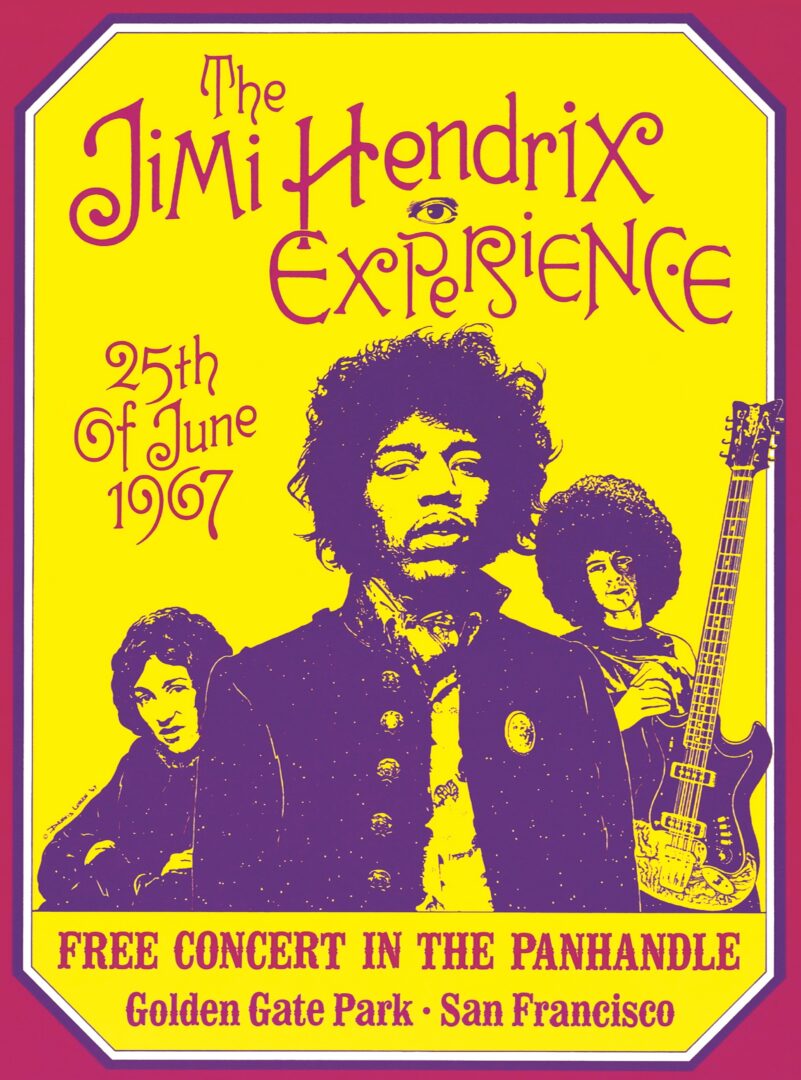
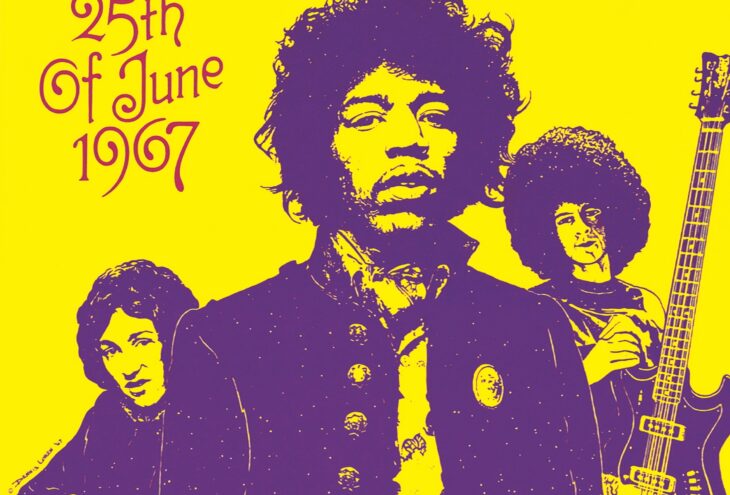
Since I had designed the poster for this concert, I thought it might good opportunity to have my Digger friends introduce me Jimi Hendrix and the band, which they did. Behind the flatbed truck stage, I also met future Band of Gypsy’s drummer Buddy Miles.
I could have gone to the "Monterey International Pop Festival," but I didn't. I knew about it, but I didn't feel the need to drive down to Monterey that weekend. There was already so much going on in the San Francisco bay area. In fact the weekend before Monterey Pop, I had already gone to the "Magic Mountain Music Festival," hosted by radio station KFRC, on June 10th and 11th, 1967. This festival was originally scheduled for June 3rd and 4th, 1967, but do to bad weather, was rescheduled to the following weekend. Stanley Mouse did a great poster for the event that initially got my attention. 15,000 people showed up for this event on Mount Tamalpias at the Sidney B. Cushing Memorial Amphitheater. Monterey Pop gets all of the attention, but Magic Mountain was really the first outdoor rock music festival. Many of the same groups played at both weekend events: Canned Heat, Moby Grape, The Byrds, Country Joe & The Fish, Jefferson Airplane, Hugh Masekela and The Steve Miller Band. This festival didn't have The
Jimi Hendrix Experience and The Who, et al, but it did have The Doors and The Seeds and many other interesting groups. Monterey Pop, had more international media muscle, a movie and therefore got more attention.
I have loved art and music since I was a small child and San Francisco had an abundance of both. Beautiful posters, handbills and flyers kept me informed as to all of the things happening in "The City." I usually went to The Matrix on Thursday night, The Avalon Ballroom on Friday and The Fillmore Auditorium on Saturday. On Sunday, any number of events might take place, street fairs, free concerts in Golden Gate Park and other neighbor- hood parks in and around San Francisco. I haunted art galleries in both North Beach and on Sutter Street.
Here is a good example of two Sunday afternoon happenings that I chanced upon while passing through different neighborhoods. I drove by a small park somewhere between The Fillmore district and the Pacific Heights district. I heard music and saw a group of old black men making barbecue. I stopped to check it out. I bought a plate of food from those men and sat down on the lawn to enjoy the music. I had not seen either of these two bands before. One was called Mad River and the other was called Mother Earth, featuring Tracey Nelson and Powell St. John. After each set, I talked with various band members. Mad River had recently arrived from Yellow Springs, Ohio and Mother Earth came from Austin, Texas. Both bands would eventually make their mark on San Francisco's music scene and each landed recording contracts with Capitol Records and Mercury Records, respectively. A month earlier, I was wandering around North Beach and discovered a street fair taking place on Samsome Street. This was were I first saw Country Joe & The Fish, Freedom Highway and Phoenix. I never spent a boring weekend back in those days. There was always something happening.
Another reason I didn't go to Monterey was, because I was working on my poster portfolio. Ever since I arrived in San Francisco, I stayed in touch via the telephone with my girlfriend Kay Jackson. In the spring she was still attending art school at Cooper Union in New York City. When the semester was over, she returned to Detroit. We always talked about music and art. Once, I mentioned to her, that I wanted to build a portfolio and do some concert posters. I told her about all of the wonderful concert posters that fellow Detroiter Stanley Mouse was doing for The Family Dog's Avalon Ballroom.
In the early 1960s, Kay and I use to see Stanley Mouse annually at the State Fairgrounds in Detroit, airbrushing hot-rod monster t-shirts, while Motown vocal groups performed nearby in the band shell. She knew what I was talking about, because we both had seen a few of The Grande Ballroom posters designed by Gary Grimshaw. Kay said that she would help me find a poster job for a venue in Detroit. She called me the following week (in early June). Kay had gotten me a poster job for an upcoming Muddy Waters concert series at The Living End (where a young Joni Mitchell performed with her former husband and local folksinger Chuck Mitchell) in Detroit. Kay was going to do a couple of poster designs, as well.
I had recently run into poster artist Rick Griffin, when I had gone to visit a poster publisher in Berkeley called Berkeley Bonaparte. I mentioned to Rick, that I would love to get started doing some concert posters, but I didn't know whom to contact. He said, "The Avalon Ballroom and The Fillmore Auditorium both use a handful of really good artists in some kind of regular rotation." Wes Wilson, Alton Kelley – Stanley Mouse's design partner – Victor Moscoso and Rick himself, were doing a bulk of the work then. But other artists were beginning to break through, such as, Robert Fried, Bonnie MacLean, Bob Schnepf, Steve Resnick, John H. Myers and Jim Blashfield. Rick added, "Maybe you should try one of the smaller clubs, to get started." He mentioned Victor Moscoso's self-published "Neon Rose" series for The Matrix. Rick continued, "The Matrix is a small club and really can't afford to print the same kind of elaborate color posters that Chet Helms and Bill Graham produce. If you are willing to cover the cost of printing like Victor, maybe the Matrix will let you do one." He went on to say that once I had few of these poster designs under my belt, I would have something to show the other promoters. I did exactly what he told me to do. I contacted the management of The Matrix, where I was already a regular patron and they let me do a poster for an upcoming Youngbloods show.
On the evening of June 19th, I was hanging the Youngbloods posters on Haight Street. On one corner, I began talking to some Diggers. These guys were really informed about upcoming events in the neighborhood. They talked about this "super spade cat guitar player" named Jimi Hendrix that had just "wowed" everyone down in Monterey. They told me that he would be playing with the Jefferson Airplane and jazz guitarist Gabor Szabo at the Fillmore Auditorium all week (June 20-25, 1967). They said Jimi was planning to play in the Panhandle during the day of the 25th and they were going help with the staging. At that moment, it struck me that I should do a poster. I could do just what I had just done for The Matrix. I asked them if they thought it would be all right to make a poster for this event. One of them said, "Hey man, it's a free concert and you're free – do it and if anybody asks you who your doing this for – tell them The Diggers. Besides, Jimi will love it." I had heard "Purple Haze" on the radio, so I was already aware of Hendrix''s music. The real question was, could I do it in time? I had only two or three days at most to draw, design and get the poster printed. Was it even possible? I would give it my best shot and maybe things would fall into place.
The next day I headed to the Gramophone record shop on Union Street. I needed some photo reference, because I didn't know what the band looked like. For the Youngbloods poster I had drawn a portrait of the band from a photograph on the back of their album cover. I knew that the Gramophone shop carried import albums and might have something that I could use. The shop had copies of two English music newspapers (Melody Maker and Disc, as I recall). One paper had an article about the Jimi Hendrix Experience and a group photo. The other had a photo spread, including some individual pictures of the band members in London. Earlier that day I called the printer who had done the Youngbloods poster and he said that he would be busy all week working on projects and couldn't do it.
On my way home, I drove down Lombard Street and spotted a small print shop. I decided to stop and ask if they could print the poster. Inside was an older white haired man setting some small metal type by hand, behind the counter. I asked him if he could print a three color offset poster by Thursday if I brought him the artwork to him the next day. He rubbed his chin and said, "Maybe, don't get much call for posters anymore. These days, I mostly do business cards, stationary and wedding invitations. I just use this old platen press for those jobs, but in the back room I've got an old one color Heidelberg press that we could dust-off, I suppose." He had a twinkle in his eye, when he said this. I told him that when I was in High School, I had taken a print shop class and could do the film-work if he had a darkroom. He smiled and said, "Don't worry, I can take care of that. Where is your artwork?" I said, "I haven't done it yet." He laughed so hard, that he almost cried. "Tell you what, if you bring me the art by around 5pm tomorrow, I will print your poster by Thursday. How's that?" I was overjoyed and gave him a big grin in return.
I spent the next, 24 hours, drawing. lettering and cutting two rubylith film overlays. I made a "call out" tissue and used magic markers to indicate the three colors I wanted and wrote the PMS color numbers at the tissue – just as I had been taught at Edsel Ford High School – by my printing teacher, Mr. Stolfo. I chose dark red, yellow and purple colors. I figured that I could hide the yellow overlay cut lines under the dark red and purple color and that it wouldn't be too noticeable. Maybe the printer would know how to make a "knock-out." When I walked through the print shop door – with only minutes to spare – the old gentleman didn't look all that surprised. He said, "I just knew you'd make it. My names Pete, by the way, what's yours?" I told him and we shook hands. "Well Dennis, I've only got about two hundred sheets of soft texture stock large enough for your design.
We will lose a few to make-ready, but I figure that we'll end up with about one hundred and eighty clean copies. How's that sound to you?" I hadn't even thought about how many copies to make. The Youngbloods poster was done as a screen print at the Presidio Sign Shop and there had only been about a hundred copies, maybe less (I never really counted them). Kay had the Muddy Waters poster printed at an offset shop in Detroit and had ordered two hundred copies. I grinned at Pete and said, "I think that will be just fine." Old Pete was a man of his word and had the posters finished on Thursday, just as he had promised. I shook his hand and told him that I couldn't thank him enough, but he just laughed and said, "Good job, kid."
I gave most of the posters to the Diggers to distribute, who had befriended me a few days earlier. I kept about 35 copies for myself and to give to friends. I hung about a dozen of those in the Richmond, Cow Hollow and Marina districts. On Saturday the concert in the panhandle was great. My Digger friends introduced me to Jimi and the Experience band members. My big regret was that I didn't bring a camera. Jim Marshall was there, because years later – when I worked at Creem magazine in Detroit – I found an old photograph of Jimi Hendrix playing in the Panhandle, in the photo files. I've also heard that Spencer Dryden and Jack Cassidy of Jefferson Airplane were responsible for supplying the drums and amps for the flatbed truck set up. The Diggers came up with the generator and flatbed truck. Looking back – it all seems like a dream to me now – but it did really happen.
Many years latter Hila & Tsve Deer told me that one of the posters got put in the window their boutique on Haight Street. Also, I was given a picture that a friend took of three hippies in the Richmond district walking down Clement. Faintly in the distance you can see the poster hanging on the outside wall of a laundromat, where you could still wash your clothes for a quarter. That night, I went to The Matrix and saw The Youngbloods concert. When they finished playing, I got the chance to talk with Jesse Colin Young and Banana. I told them, that my brother David and I use to play "Get Together." We had taken from a 1964, Hamilton Camp Elektra Records album called "Paths Of Victory." They told me they had gotten the song from Dino Valenti. Of course, later that song would become a huge hit for The Youngbloods. All that happened that weekend was pretty heady stuff for this young man. I had just turned 21 on June 15th.
Ironically, a week later, I realized that my first three posters were for shows that all took place during same week and/or weekend. Kay Jackson was planning to come out to San Francisco later that summer. She was technically, a much more talented artist than I was at the time, even though I had more of a printing and design background. I looked forward to collaborating with her on many projects. Sadly, I received a call in August, from my close friend and guitarist David Halstead. Kay had been killed in an automobile accident near Ann Arbor. I wandered around in a state of shock for months. The music scene eventually brought me back. Kay would have wanted it that way. So, I formed a band with guitarist David Green, bass player Bobby Scadari, guitarist Joe Toschi and drummer Rick Butler called The New Gothic Blues Unit. This band would soon morph into Mercury Vapor with the addition of Marty DeClerq, when Bobby left suddenly.
Eventually, Jim Green (no relation to David Green) took Rick Butler's place. After the band was up and running and playing regularly at the Presidio Service Club, I decided to drop by Pete's print shop to make some flyers. Something was different. The sign above the door had changed. I went inside and found out that Pete had retired and sold the shop to new owners. In the front of the counter, they had a new contraption called a Xerox machine. Thankfully, Pete had returned my artwork and the film. In the early 1990s Electric Posters in Los Angeles, reprinted an edition of 1000 copies of the Jimi Hendrix poster from the original film. In 2004, Kent Wood of Cahoots Graffix & Posters in Concord, California, reprinted an edition of 500 copies. In 1999, I contacted Experience Hendrix magazine (published by Jimi's half-sister). In the back of that magazine, they were selling reprints of posters by my friends, Gary Grimshaw and Mark Arminski. I offered them my poster to sell in the magazine. I never received a reply. Several months later the magazine ceased to exist.
Experiencing The Soul Of Otis Redding:
By Dennis Loren
There is something very special and intimate about seeing and hearing an exceptional solo artist or great band perform in a small venue. I have been fortunate to witness a long list of musicians in this type of setting. Arlo Guthrie at The Unicorn Coffeehouse in Boston and The Blues Magoos at the Night Owl Café in New York City, before both acts became well known recording artists. Sitting at a table that was only a few feet away from John Lee Hooker, as he mesmerized an audience at The Soup Kitchen in Detroit. This list also includes The Doors, The Youngbloods and many other groups at The Matrix in San Francisco, as well as Charlie Mingus and Mose Allison at The Jazz Workshop in San Francisco’s North Beach.
When I lived in San Francisco in the late-‘60s, I was a regular at the larger venues, such as the Avalon Ballroom, the Fillmore, the Straight Theater and Winterland, but I also frequented smaller places. The North Beach area had a profusion of small clubs and coffeehouses. From the Committee and the Hungry I to the Coffee Gallery and Basin Street West. In August of 1967, I attended an Otis Redding concert at Basin Street West. This was another venerable jazz club where artists such as Miles Davis performed, yet by 1967 also featured the likes of Ike & Tina Turner, Little Richard and even Jefferson Airplane. The times were – indeed – changing, to be more eclectic and inclusive.
I hadn’t gone to the Monterey International Pop Festival and so I missed seeing Otis Redding. That Summer I heard Otis’ song “Try A Little Tenderness” on the radio, sandwiched between Jefferson Airplane’s “Somebody To Love” and Procol Harum’s “Whiter Shade Of Pale” and other hits of the day. This was my first and – as it turned out – only opportunity to see and hear Otis Redding in concert. He appeared on stage to a fanfare of horns and immediately launched into “Respect.” From that moment until the end of the set, he completely captured the audience. Although Otis Redding was only an inch and a quarter taller than I, he seemed like a giant to me because of the energy he put into his music. Although he performed many of his own songs, I found it ironic that he also covered The Beatles’ “A Hard Day’s Night” and The Rolling Stones’ “Satisfaction.” Otis closed with a moving rendition of “Try A Little Tenderness” and left the stage as the band played on. To me he seemed completely spent and dripped with sweat, but the audience would not let him go. Otis did three encores to standing ovations.
Another great memory, among so many from that incredible year of 1967.