
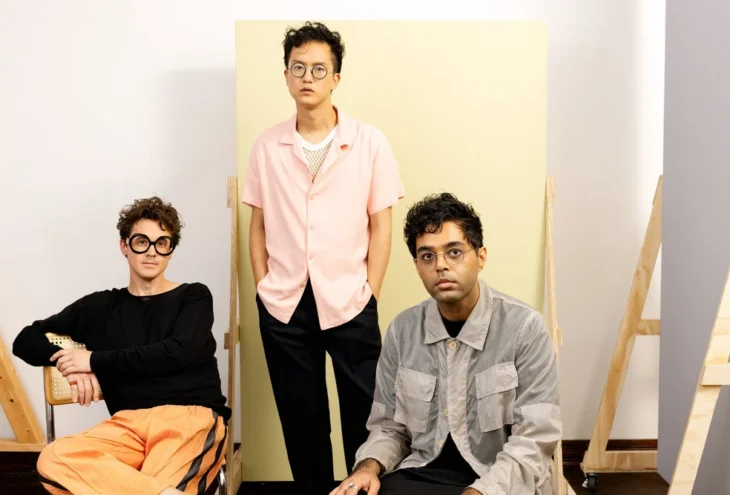
The Band Members: Ryan Lott, keyboards, vocals; Rafiq Bhatia, guitars; Ian Chang, drums
The Storyteller: Ian Chang
The Song: An unnerving, compressed warmth emanates from the first keystrokes of the detuned Sequential Prophet-5 synth in Radiohead's "Everything in Its Right Place.” These thick, muted analog tones reverberate until vocal glitches give way to Thom Yorke’s disembodied fantômatique vocals, which ultimately bleed through, leaving the listener suspended within a jarring, dissociative state.
This deceptive cadence of unresolved hypnotic sonics sends shivers up the spine; like static, these tones are left fritzing and ungrounded, unable to connect to the mind — a subtle signal, a psychic warning that things are very much out of line. It is a chilling soundscape, an environment where emotions are gridlocked and detached worldly observations serve as a brilliant way of introducing the chthonic internal atmosphere heard throughout Kid A.
A sharp departure from their earlier alt-rock anthems — including the iconic, violent guitar chuck that ignites the guttural operatic cries in “Creep” or the orchestral melancholy of “Karma Police” — this solemn stylistic deviation heralded the arrival of a starker, more introspective electro-ambient chapter for the revered art-rock titans. The band’s experimental production process of constructing sound worlds through structural deconstruction creates a dazzling audio labyrinth where a suspended sonic space is as unsettling and haunting as it is gorgeous and sublime.
The Background: Viewing songwriting as a massive auditory puzzle, composer-producer Ryan Lott launched Son Lux as a solo experimental electronic-meets-classical endeavor — a musical canvas where scattered pieces of sounds found everywhere are captured, meticulously assembled through synthesizers and software, and eventually reworked and painted into live compositions of pretty anxious post-rock.
This solo sonic dissectologist journey eventually reached outward — reverberating and resonating with the chameleonic guitarist Rafiq Bhatia and super fluid sensory drummer Ian Chang. Brought together on the road, the two musicians permanently integrated into the project, expanding Son Lux into an unconventional trio dedicated to seizing and recording fractured auditory bits and found sound of all musical sorts. By augmenting these intricate layers on stage, they transformed their studio creations into an immersive, living performance.
This boundary-pushing chemistry culminated in mammoth amounts of material, spawning sprawling multi-album conceptual arcs and hours of dense aural world-building. Throughout these expansions, Son Lux’s work maintained a distinctly eerie, uncanny quality that touched the synapses of neuroscience—experimenting with how sound loops and acoustic shifts register in the brain before cognition even kicks in. By 2022, their uniquely chaotic yet cohesive arrangements garnered the attention of directors Daniel Kwan and Daniel Scheinert (The Daniels), tasking the band with the otherworldly, Oscar-nominated score and song for Best Picture winner Everything Everywhere All at Once.
Following a few more years of expanding their sonic palette—a stretch that included scoring additional films both individually and collectively, alongside various other side releases—the band capped off this prolific stretch with the intricately crafted songs of their recent 2026 release, Out Into. For drummer Ian Chang, this new assemblage of boundary-eliminating tracks marks yet another evolution in a career dedicated to cataloging sounds. It is an artistic pathway that can be mapped back to a specific, formative encounter: a quiet retreat within a music store filled with aisles stacked with jewel cases and vinyl.
The Story: Prior to creating music by analyzing the variant frequencies of sound, or having constructed entire cinematic multiverses, Ian Chang’s relationship with music began as a means of escapism. During the twilight era of massive music storefronts, Chang embraced the lovely moments of solitude, wandering through endless aisles of records and CDs, waiting for an arresting visual to disrupt his drift. For him, it was a striking album cover featuring a landscape of stark white icebergs outlined in blood-blackened red that ultimately pulled Chang toward a headphone listening rack. He recalls how that visual became his gateway to other universes:
“It was a very different time in music consumption! I was 12 or 13 the first time I heard "Everything in Its Right Place" by Radiohead. I was living in Hong Kong at the time, and one of my favorite things to do was to go to HMV to learn about music by spending time at the listening stations. I loved checking out the artwork, reading about the artist, and diving into the sound world.”
This immersive ritual highlights a cornerstone of musicology—the multimodal perception of the visual-to-auditory experience. It is the way an arresting optic can act as a psychological trigger to intensify a connection with heard melodies and harmonies, binding the event into an interconnected sensory awakening, a memory:
“I remember the artwork for Kid A caught my eye, prompting me to give the album a spin. This was my first introduction to Radiohead, which in retrospect was a bit of a strange introduction to them, but it was a formative experience for sure. I remember listening to this opening track multiple times before moving on to the rest of the album.”
Stepping into that unfamiliar audio universe without predictable melodies was a crash course in hearing a sort of strangeness in music, a realization of how songs can tap into adjacent, parallel, and at times scary realities. This emotional upheaval was so tantalizing it encouraged Chang to play the opening track on a continuous loop, as he recalls:
“I felt completely bewildered at first! At that point in my life, I was pretty musically omnivorous, but I hadn’t heard anything like this at all; it was borderline uncomfortable. I admit that there were a number of songs on the album that I couldn’t get into at the time, but "Everything in Its Right Place" really hit me right away. It’s maybe the first song I heard where I experienced the feeling of something haunted and otherworldly.”
As Chang leaned further into that unsettling atmosphere, the macro-shock of what exists out there in the world through a song gave way to an acute curiosity; he began trying to isolate the exact sonic elements that made him realize these strange audio worlds could be real.
“The first thing that really grabbed my attention was all the mangled babbling vocal textures at the beginning. It was maybe my first introduction to how production can create a surreal listening experience,” Chang recalls. “The combination of all the elements really impacted me emotionally. The lyrics, harmony, soundworld, and Thom’s voice hit me just at the point in my life when the veil on the ills of society was being lifted. In a way, it soundtracked my transition out of innocence. It provided a lot of new and uncomfortable thoughts and emotions… a sonic space for them to steep in.”
This insightful awakening stayed with him as an enduring memory — one that weirdly put focus on how much of the world, both musically and existentially, remained unresolved. A few years later, that lasting impression led Chang into a sharp micro-analysis of its production — a creative fascination with engineering alien sounds that would ultimately define his future identity in Son Lux. He explains:
“It wasn’t until I was 15 or so that I went back and figured out what was going on under the hood of this song. I learned about the KAOSS pad that they used to create the vocal effect at the beginning, and the interesting, changing meter of the song, as well as the haunting chord movements.”
By demystifying the technical machinery, Chang expanded his unique way of composing — an exhaustive foray into analyzing these atmospheric landscapes that completely reshaped his artistic worldview.
“There is an incredible minimalism to the arrangement of this song that was very inspiring to me. Up until encountering this song and album, I mostly thought of music in terms of melody, harmony, and lyrics,” says Chang. But as he adds, “this really blew my mind and got me to think more deeply about the power of arrangement and production, and how it can be as impactful to the feeling of a recording as any of the other elements I mentioned before.”
Moreover, this revelation connected directly back to that initial spark — the sudden awareness that there was something so much more going on in what he was hearing, and parallel to that, the world outside.
“As a band, Son Lux often comes at songwriting first through sculpting sound and production, rather than harmony, melody and lyrics, so this lightbulb moment marked a shift in my perspective on music that influences how I make music to this day.”
For Chang, that shift became an ongoing artistic pursuit to capture the same elusive, emotional visual-meets-auditory memory that struck him so profoundly in Hong Kong decades ago. And now, laying out that master puzzle piece is part of his auditory ethos:
“I would say that a lot of Son Lux’s music is indebted to this song and to Radiohead in general. The feeling of haunting beauty that this song gives is something that we are often chasing.”
Photo Credit. Anna Powell Denton