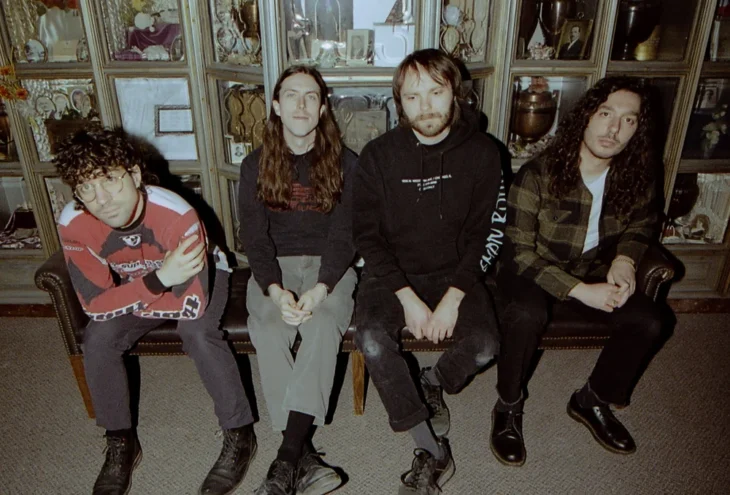
The Band Members: Rob McWilliams; guitars, lead vocals, Phil Cangelosi; bass, rainstick, Patrick Dunn; drums, Spencer Ouellette; synths, lap steel guitar, saxophone, flute, keys.
The Storyteller: Spencer Ouellette of REZN.
The Song: A disembodied, ghostly ‘Izvikva’ lead voice soars high above the heavy, multi-layered ‘Slaga’ vocal drones of “Kalimankou Denkou” (Калиманко Денко). The stark, biting beauty of this intricate diaphonic composition strikes the subconscious, marooning the mind in an otherworldly state.
Within this eerie soundscape, the complex style of Bulgarian choral folk singing utilizes tightly intertwined voices which reverberate at different frequencies to form beautiful textures. These stacked harmonies build a towering column of sound, forcing the moving melodies to collide directly with the oscillating, droning undertones to form bright-sounding microtones. Because these notes ride within a vertical slipstream, the music seems to swing in a perpetual suspension that has fascinated iconic artists like Peter Murphy of Bauhaus, Kate Bush, George Harrison, and Elizabeth Fraser of Cocteau Twins. Today, that same hypnotic dissonance continues to ripple through modern music, directly influencing the dark, shadowy elements of Zola Jesus and setting the stage for the doom-laden atmospheres of REZN.
The Background: Drawing from the creative energy of Chicago's heavy, low-end gravity well for all things metal, REZN has used their natural knack for stacking monumental, slow-rolling sonics to carve out a distinct style of doom gaze psych-rock. From the very beginning of their decade-long career, the band has consistently pushed past conventional heavy boundaries, crafting songs that balance a massive physical presence with vast, expansive atmospheres—all while infusing down-tuned riffs with unexpected left-field instrumentation.
In their formative years, REZN already embraced colossal sonics—an identity evident in the saturated bassline fuzz on their debut, Let It Burn (2017). From that monolithic launching pad, they dove into Calm Black Water’s (2018) oceanic depths, where swirling synths and saxophones submerged in cavernous reverb hovered over murky riffs. This dense atmosphere opened significantly with the celestial desert planet themes of their breakthrough, Chaotic Divine (2020), which introduced traditional sitars and raga-style drone structures to bring listeners into a hypnotic space-rock odyssey.
From those barren cosmic sands, REZN’s trajectory shifted into a distinct light-and-dark dynamic with Solace (2023) — a highly acclaimed entry showcasing a more mesmeric side of their signature heavy psych-doom landscape — and its aggressive companion piece, Burden (2024). Backed by extensive touring with instrumental post-metal titans Russian Circles and prog-gaze stalwarts Pallbearer, the band perfected their unique delivery to draw a brand-new set of listeners into an experimental sonic territory steeped in apocalyptic surrealism.
In their latest album, Cycles in the Infinite Dream (2026), REZN sinks into the depths of the human subconscious, exploring the strange world where the margins of reality blur into altered dream states. Strikingly, the music channels the dissonant, intricate beauty of traditional Bulgarian choral music. Spencer Ouellette of REZN explains how the group manages to weave this style of spellbinding, folk-noir frequency directly into their towering walls of distortion, creating fluid soundscapes with traces of sonic geometry.
The Story: Musical compositions possess a beguiling ability to tap into human consciousness, binding memories and emotions into knots within the human psyche—ones that, when found and unbound, set off unexpected awakenings that can be profound. Often unforeseen, some of the most transformative musical connections arrive precisely when a creative reset is required. For Spencer Ouellette, this timely revelation struck later along his musical path, eliciting a monumental response that redefined his relationship with sound.
"I think sometimes you just kind of lose the light with discovering music and everything just becomes sort of uninteresting."
But even in total burnout, the subconscious runs its own silent, desperate search for an artistic lifeline. Fortuitously for Ouellette, a powerful attachment locked in exactly when his bond with music had completely dissolved—a period of heavy mental exhaustion under which musicians can so easily find themselves drowning. It was during one of these airless moments that he encountered “Kalimankou Denkou” by the Bulgarian State Television Female Choir.
"This [song] crossed my path in a way that totally took me by surprise and made me fall in love with music discovery all over again," he notes. "I think I first heard it sometime in my early twenties. I've listened to it so many times I don't even remember where or when it was the first."
Stumbling upon the track set off an immediate physical reaction—a sudden realization that the recording was harnessing a haunting energy that completely bypassed standard intellectual analysis.
"I remember (and it still does this to me) feeling one of those overwhelming, full-body-chills sensations," Ouellette recalls. "Once again, I can think of dozens of songs that do that to me, but this one yields an unnaturally long duration. It's definitely more of an intuitive response, seeing as I don't know a lick of Bulgarian."
Heard without any preconceived notions, the track offered Ouellette a microtonal beauty that existed completely outside of familiar scales and musical notations. Untethered from rigid constraints, the performance sat far beyond Ouellette's creative comfort zone.
"If we are looking at this music through a conventionally Western lens," he explains, "there are a few modulations, key changes, and harmonies that just laugh in the face of anything you'd hear anywhere else."
Experiencing this firsthand freed the band to double down on an uncompromising vision for their music. Rather than diluting their own heavy psych-doom to appease standard metal expectations, REZN refused to bend in the studio or on stage and instead expanded their sound even further.
"I'd say that this song has probably reinforced a philosophy that what might seem inaccessible to the average listener on paper is not necessarily true in practice," Ouellette explains, "and you owe absolute trust to the listener to understand what it is you're trying to do without making any 'more digestible' compromises."
This breakthrough ultimately served as a strongpoint for how REZN approaches their own songwriting. By immersing himself in a foreign vocal arrangement capable of holding such an intense emotional charge, Ouellette recognized that heavy atmospherics can communicate well past what words ever could.
"I think it just furthered the notion that if executed with heart and purpose, lyrics don't have to matter that much at all," he says. "If anything, it just made me want to make more use of the musical tools that have always been at our disposal and generally just collect dust otherwise."
Because of that profound artistic shift, the intricate vocal compositions of “Kalimankou Denkou” now exist as a ghost-in-the-machine presence within the band's music.
"We have admittedly sampled this and used it as an element in live sets," Ouellette reveals, "but it's been so convoluted that you might be hard-pressed to recognize it."
For REZN, taking this sonic road less traveled has proven to be wonderful. No matter how heavily disguised or woven into their sonic tapestry, the sheer magnitude of the original recording remains completely undiluted for him.
"It never gets old," Ouellette asserts. "It's just a marvel of what could be and how much innate beauty there is in the human voice and all the 'in-betweens' of the mainstays of Western music."
Photo Credit: Tom Birch