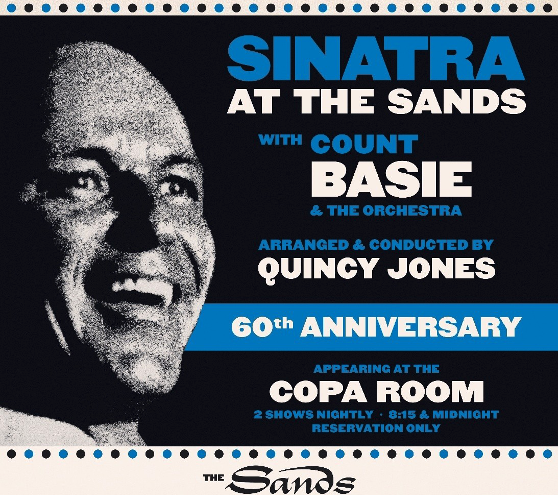
Capitol Records/UMe and Frank Sinatra Enterprises just announced a special new suite of physical and digital releases to celebrate the 60th anniversary of Frank Sinatra's first-ever live album: Sinatra at the Sands with Count Basie & The Orchestra, arranged and conducted by Quincy Jones. On October 23, 2026, Sinatra at the Sands was reissued on 2LP 180gm black vinyl as the next release from UMe's acclaimed Vinylphyle series.
A news release from UMe described the retail package.
“Arriving in tandem, fans can experience five complete shows from the original sold-out 1966 Sands' Copa Room residency for the first time on the brand new 5CD set - Sinatra at the Sands 60thAnniversary.Dolby Atmos versions of both Sinatra at the Sands releases will be available the same day on streaming platforms.
“The new Vinylphyle Edition of Sinatra at the Sands boasts 2026 mixes from Sinatra's longstanding trusted engineer Larry Walsh and best-in-class mastering courtesy of Joe Nino-Hernes at Sterling Sound. The 2LP Vinylphyle Edition is housed in the original gatefold packaging, which “features GRAMMY®-winning liner notes by Stan Cornyn and now includes an insert of never-before-seen photos shot during the residency and new liner notes by New York Times best-selling author Charles Pignone.
“While the original Sinatra at the Sands 2LP set was curated from several shows, Sinatra at the Sands 60th Anniversary showcases five complete, previously unreleased performances from the iconic residency, which ran from January 26, 1966-February 1, 1966.
Sinatra at the Sands 60th Anniversary is also packaged in a collector-worthy digipak with an alternate cover inspired by the original Vegas residency poster. Adding to Pignone's notes are a myriad of candid eyewitness quotes, Sinatra band personnel, and rare photos of Sinatra alongside Basie and Jones as they prepared to make history on the Las Vegas Strip.
“Indicative of its impact, Sinatra at the Sands peaked at #9 on the Billboard 200, achieved a Gold certification from the RIAA, and has gathered tens of millions of streams to date.
“Looking back, Billboard raved, "Sinatra at the Sands, the singer's definitive (and first) live album, captures it all flawlessly," proceeding to profess, "When we think of Frank Sinatra, we think of thisFrank Sinatra - the whiskey-swilling, joke-cracking singer and entertainer that has become an American icon." All About Jazz summed it up succinctly, "Frankie struck gold. Sinatra at the Sands was, simply put, brilliant!"
“The original Sinatra at the Sands remains one of the most influential live recordings of all time. Six decades later, relive Vegas in its heyday and Sinatra in his prime with Sinatra at the Sands.
“In the end, Frank Sinatra summed it up best, "Working with Basie and Quincy...it was probably the most exciting engagement I have ever done in my life!"
Yes, the Sinatra stage monologues on this Las Vegas collection are a little dated and schmaltzy, but still a terrific document of early 1966 Sinatra, just before Frank recorded “That’s Life” in October ’66 and back on the charts.
My parents, Marshall and Hilda Kubernik, attended one of Sinatra’s Sands Hotel shows during the 1966 engagement.
In the very early fifties, my parents saw Sinatra sing several times at small restaurants and steak houses in Palm Springs when the entertainer was down and out. It was a period when Frank’s contract was not renewed by Columbia Records. He had lost his voice, agent, and career.
Then came his artistic and commercial renaissance, assisted by his then-wife Ava Gardner, who helped convince Columbia Pictures studio head Harry Cohn, in 1952, to cast Sinatra for the low-paying acting job over higher-priced actor Eli Wallach in From Hell to Eternity.
It earned Sinatra a Best Supporting Oscar in 1953, after he inked a new and basic entry-level recording contract with President Alan Livingston at Capitol Records.
In the mid-sixties, I went with my family to Las Vegas, Nevada, where Sinatra was on the marquee at the Sands Hotel and Casino. I was locked up in their hotel room watching television, but heard some action when I wandered into the venue to sit with my parents. Comedian Buddy Hackett, his opening act, was funny and naughty.
From 1962-1972, my mother worked as a secretary and in the stenographer pool at Columbia Pictures in Hollywood at Gower Gulch. She would take me to live tapings in Television City at a CBS sound stage in West Hollywood and witnessed some Sinatra television specials.
I also have a fond memory of the television special Frank Sinatra: A Man and His Music + Ella + Jobim taped at NBC studios in Burbank and broadcast in November of 1967.
My mother and I caught Frank Sinatra again in 1978 at the Universal Amphitheater in Universal City when I was West Coast director of A&R for MCA Records on the Universal lot. We were seated with Liza Minnelli. I told her Freddie Mercury of Queen really loved her act and saw her London Palladium engagement in 1972. I earlier interviewed Freddie for Melody Maker. My mom in 1939 saw Liza’s mother, Judy Garland, in Chicago when she opened her show with “Zing! Went the Strings in My Heart.”
Author Richard Havers in his 2004 book Sinatra, interviewed my mother about Frank and his musical and cultural impact in the forties.
“I lived in Chicago and was a big fan of Frank. I had seen him at WMAQ in Chicago when he did a radio show with Tommy Dorsey in 1940, and I was determined to go to New York and see him at the Paramount Theater in December of 1943. My cousin, who lived in Brooklyn, met me at the train station and we went straight to the Paramount. Frank was amazing: I was not a screamer. I just sat there paralyzed. We stayed and watched every performance until they threw us out at around 10:30 or 11:00. I left Sunday and went back home to Chicago Monday morning. Looking back, I think what was important was that he was there when we needed someone.”
In the sixties, I would see Frank and his daughter Nancy at Los Angeles Dodgers baseball games at Dodger Stadium. They were season ticket holders. I was so preoccupied watching pitcher Sandy Koufax that I barely noticed them.
In 1976, Frank, who was a close friend of newly hired Dodger’s manager Tommy Lasorda, sang The Star-Spangled Banner national anthem the first day Tommy was on the job.
In the early eighties, my parents were invited to a party at Chasen’s restaurant in West Hollywood arranged by Steve Wynn, owner of the Golden Nugget Hotel. Frank and his wife Barbara were present and visited all the guests at booths and tables.
Hilda Ria Kubernik finally met Francis Albert Sinatra. My mother told Frank she was at one of the 1943 Paramount Theater shows in New York, as a giddy girl who had just graduated high school in Chicago. She enthusiastically posed for a photo with him, and Frank immediately turned to my father Marshall and suggested to him, “I think your broad needs a drink.”
In 1970 I saw Nancy Sinatra perform in Las Vegas and over the decades maintained a professional friendship with her. I have a happy memory from earlier this century being invited along with my mother and father to a screening she hosted at the Radio and Television Museum in Beverly Hills of her 1967 TV special Movin’ with Nancy that Jack Haley, Jr. directed. We were seated with Nancy’s mother, Nancy Sinatra Sr.
Since 1968, I would encounter arranger, producer, composer Quincy Jones every few years around town. At a recording studio, a restaurant, the A&M Records lot on La Brea Avenue, or at a bank on Sunset Blvd.
I worked at Cherokee Recording Studios when Jones was producing Paul McCartney and Michael Jackson, and interviewed Quincy’s former wife, actress and singer Peggy Lipton.
It was Quincy who heard the Beatles literally before anyone in America, around his jazz, pop and R&B sessions. Brian Epstein touted the group. Little Richard, fresh off some European gigs with the Beatles, was newly signed as well to Vee-Jay in the USA. Jones produced Little Richard’s return to rock The King of Gospel Singers,” in 1962.
After a Billboard Magazine1977 Disco Convention panel at Century Plaza Hotel in Los Angeles, Quincy and I chatted about how he attempted to secure an American record deal for Epstein’s lads in late 1962 and early 1963. He saw the Beatles before they came to the United States and thought they were fantastic. He would then produce many hit records with singer Lesley Gore.
During 1978-1979, Quincy and I were both working at MCA Records in Universal City. One afternoon I bumped into him at the commissary. He was on the lot scoring music for The Wiz. Hetold me, “It was a bad experience, but I met Michael [Jackson] on the set!”
In the early eighties, I was seated with Quincy at the Santa Monica Civic Auditorium for a Yamaha Music Convention event. Steely Dan’s studio members, including Walter Becker, jammed with a house band.
Quincy, like my parents, was born in Chicago. He discussed with me the role of the arranger in record production. It was a music lesson I hadn’t really planned on.
Over an hour, he talked about first meeting Sinatra in 1958, working with him and Count Basie at The Sands, and the life-altering event in the very early sixties on a European tour that was poorly planned and forced him to deal with an economic crisis.
“We were the best jazz band, but we were literally starving.”
Mercury Records label head Irving Green came to the rescue, loaned him some money, and hired Quincy to helm the company’s New York division.
In 1961, he became vice-president of Mercury, and produced memorable recording sessions. By 1964, he composed the music for director Sidney Lumet’s The Pawnbroker, and relocated to Los Angeles.
As I held the 2026 edition of the Sinatra Live at the Sands with Count Basie & His Orchestra Arranged by Quincy Jones, I thought about that evening in Santa Monica, where Quincy regaled me with insights into the record business and touting Kobe Beef in Japan.
During the night, Jones left me for a while and asked me to babysit his two daughters, Kidada and Rashida, as he was continually sought after by Japanese musical equipment manufacturers in attendance.
Man, I really miss this dude…
TRACK LISTING FRANK SINATRA'S SINATRA AT THE SANDS WITH COUNT BASIE & THE ORCHESTRA ARRANGED & CONDUCTED BY QUINCY JONES
2 LP Vinylphyle Edition:
Side A
1. Come Fly With Me 3:45
2. I've Got A Crush On You 2:42
3. I've Got You Under My Skin 3:43
4. The Shadow Of Your Smile 2:31
5. Street Of Dreams 2:16
6. One For My Baby (And One More For The Road) 4:40
Side B
1. Fly Me To The Moon (In Other Words) 2:50
2. One O'Clock Jump 0:53
3. "The Tea Break" (Monologue) 11:48
4. You Make Me Feel So Young 3:21
Side C
1. All Of Me 2:56
2. The September Of My Years 2:57
3. Get Me To The Church On Time 2:21
4. It Was A Very Good Year 4:01
5. Don't Worry 'Bout Me 3:18
6. Makin' Whoopee! (Instrumental) 4:24
Side D
1. Where Or When 2:46
2. Angel Eyes 3:26
3. My Kind Of Town 3:04
4. "A Few Last Words" (Monologue) 2:30
5. My Kind Of Town (Reprise) 1:00
Sinatra at the Sands 60th Anniversary 5CD Set:
Disc 1: January 26, 1966 - Second show
1. Come Fly With Me (3:39)
2. I've Got A Crush On You (2:56)
3. I've Got You Under My Skin (3:33)
4. The September Of My Years (3:11)
5. Street Of Dreams (2:20)
6. One For My Baby (4:41)
7. Fly Me To The Moon (2:37)
8. One O'clock Jump (Basie Instrumental) (:53)
9. "The Tea Break" (Monologue) (15:37)
10. You Make Me Feel So Young (3:02)
11. The Shadow Of Your Smile (2:43)
12. Luck Be A Lady (4:33)
13. It Was A Very Good Year (4:03)
14. Don't Worry 'Bout Me (3:08)
15. My Kind Of Town (3:33)
16. "A Few Last Words" (Monologue) (2:04)
17. My Kind Of Town (Reprise) (1:28)
Disc 2: January 27, 1966 - First Show
1. Come Fly With Me (3:42)
2. I've Got A Crush On You (3:05)
3. I've Got You Under My Skin (3:34)
4. The September Of My Years (2:52)
5. Street Of Dreams (2:12)
6. Fly Me To The Moon (2:37)
7. One O'clock Jump (Basie Instrumental) (:57)
8. "The Tea Break" (Monologue) (4:59)
9. You Make Me Feel So Young (2:59)
10. The Shadow Of Your Smile (2:44)
11. Luck Be A Lady (4:33)
12. It Was A Very Good Year (7:11)
13. Don't Worry 'Bout Me (3:02)
14. My Kind Of Town (3:38)
15. "A Few Last Words" (Monologue) (6:32)
16. My Kind Of Town (Reprise) (1:13)
Disc 3: January 28, 1966 - First Show
1. Come Fly With Me (3:51)
2. I've Got A Crush On You (4:24)
3. I've Got You Under My Skin (3:42)
4. The September Of My Years (3:07)
5. Street Of Dreams (2:21)
6. Fly Me To The Moon (2:54)
7. One O'clock Jump (Basie Instrumental) (:56)
8. "The Tea Break" (Monologue) (11:05)
9. You Make Me Feel So Young (3:07)
10. The Shadow Of Your Smile (2:48)
11. Get Me To The Church On Time (2:12)
12. It Was A Very Good Year (5:26)
13. My Kind Of Town (3:37)
14. "A Few Last Words" (Monologue) (5:39)
15. My Kind Of Town (Reprise) (1:31)
Bonus Tracks: January 28, 1966 - Second Show
16. Angel Eyes (4:10)
17. Where Or When (2:39)
Disc 4: January 29, 1966 - First Show
1. Come Fly With Me (3:45)
2. I've Got A Crush On You (3:34)
3. I've Got You Under My Skin (3:24)
4. The September Of My Years (3:06)
5. Street Of Dreams (2:23)
6. Fly Me To The Moon (2:41)
7. One O'clock Jump (Basie Instrumental) (:56)
8. "The Tea Break" (Monologue) (14:56)
9. You Make Me Feel So Young (3:08)
10. The Shadow Of Your Smile (2:38)
11. Get Me To The Church On Time (2:26)
12. It Was A Very Good Year (4:04)
13. My Kind Of Town (3:54)
14. "A Few Last Words" (Monologue) (4:58)
15. My Kind Of Town (Reprise) (1:13)
Disc 5: February 1, 1966 - Second Show
1. Come Fly With Me (3:38)
2. I've Got A Crush On You (2:55)
3. I've Got You Under My Skin (3:26)
4. The September Of My Years (2:57)
5. Street Of Dreams (2:22)
6. One For My Baby (4:53)
7. Fly Me To The Moon (2:37)
8. One O'clock Jump (Basie Instrumental) (:51)
9. "The Tea Break" (Monologue) (5:44)
10. You Make Me Feel So Young (3:07)
11. The Shadow Of Your Smile (2:41)
12. Luck Be A Lady (4:47)
13. It Was A Very Good Year (3:56)
14. Don't Worry 'Bout Me (3:11)
15. My Kind Of Town (3:25)
16. "A Few Last Words" (Monologue) (6:26)
17. My Kind Of Town (Reprise) (1:34)
(Harvey Kubernik is the author of 21 books, including 2009’s Canyon Of Dreams: The Magic And The Music Of Laurel Canyon, 2014’s Turn Up The Radio! Rock, Pop and Roll In Los Angeles 1956-1972, 2015's Every Body Knows: Leonard Cohen, 2016's Heart of Gold Neil Young and 2017's 1967: A Complete Rock Music History of the Summer of Love.
Sterling/Barnes and Noble in 2018 published Harvey and Kenneth Kubernik’s The Story Of The Band: From Big Pink To The Last Waltz. In 2021 they collaborated on Jimi Hendrix: Voodoo Child for Sterling/Barnes and Noble. Otherworld Cottage Industries in 2020 published Harvey’s Docs That Rock, Music That Matters. His Screen Gems: (Pop Music Documentaries and Rock ‘n’ Roll TV Scenes) was published in February 2026 by BearManor Media. Kubernik is researching a multi-voice book on the Beatles for a UK publisher with a planned fall 2027 publication date.
Harvey spoke at the special hearings in 2006 initiated by the Library of Congress held in Hollywood, California, discussing archiving practices and audiotape preservation.
In 2017, he appeared at the Rock & Roll Hall of Fame in Cleveland, Ohio, in its Distinguished Speakers Series and as a panelist discussing the forty-fifth anniversary of director Martin Scorsese’The Last Waltz at the Grammy Museum in Los Angeles in 2023. Kubernik attended the 1976 event celebrating The Band).