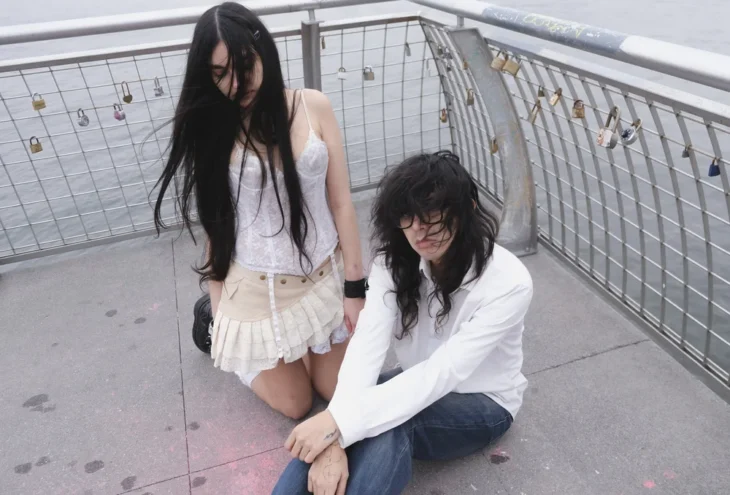
The Band Members: J.C. Vargas, guitar; Silvia K., vocals
The Storytellers: J.C. Vargas and Silvia K.
The Song: Eerie, electronic blips and whirring, warping loops open Autolux’s “Plantlife,” eventually meshing and swirling with dark atmospherics augmented by haunting harmonics and sophisticated, extended 7ths. Through a calculated kidnapping of traditional root chords, the band mutates standard progressions to create their own brand of semi-electrified, spacey tones.
The early-2000s alternative exemplars conjure a spellbinding soundscape that simultaneously feels surreal and nostalgic. This fusion of noise-gaze tension matched with magnetic melodics is one of many compositional tricks that attracted revered artists like Nine Inch Nails, PJ Harvey, Jack White, and UNKLE to take note of their phantom echoes. Decades later, the trio’s distinct sonic footprint continues to lure up-and-coming musicians seeking to decode the band’s decades-long, highly unconventional, heavily obscured library of sounds.
The Background: Bearing a name that invokes the vintage photographic printing process where chemicals and sunlight interact to create reversed silhouettes — leaving stark white outlines of images and spaces imprinted atop oxidized, Prussian-blue washed paper— the Brooklyn-based duo, cyanotype, uncannily creates music in a similar manner. In lieu of physical images, they download the internal soundscapes within, transposing these sonic visions into stark, glowing negative-space melodies cast onto digital landscapes.
Having honed their distinct indie-gaze wave as a sonic blueprint, cyanotype earned swift NYC notoriety through packed underground warehouse shows and exclusive limited-capacity rooftop sessions. Fresh off the release of their single “wish sometimes,” — boasting mixing by Sonny DiPerri (DIIV, My Bloody Valentine, STRFKR) and mastering by Dave Cooley (Paramore and Silversun Pickups) — the track stands ready to captivate a wider audience. Reflecting on its creative journey, the duo describes how this collaboration inadvertently solidified a mystical, almost predestined connection, bridging their personal histories while influencing the duo’s otherworldly sound.
The Story: Lead vocalist, Silvia K., describes how she first heard Autolux’s “Plantlife” during a late-night sojourn during a pivotal crossroads in her life — a fragile moment, wondering whether to venture out into the unstable world of the unknown. For her, connecting with the song functioned as a piece of divination, opening an entirely new realm.
“I first heard it walking through Brooklyn at night by myself, around 4 or 5 am. Everything was silent and almost starting to wake up. I had been going through a period of emptiness and isolation that felt never-ending, and hearing the song sort of punctured through it.”
This sudden puncture was not just a passing auditory whim; it mirrored her internal landscape with peculiar precision. The track’s striking ambience matched her psychological state at the time. “I was trapped inside this feeling of numbness and apathy. Circling through the same day, every day, as if my life was only in pursuit of self-preservation, but not really living,” she explains.
Beyond this mental alignment, the track triggered a visceral reaction; the music was a living current. “The way it sounds like electricity running through the walls and how it all comes together just to fall apart felt magnetic,” Silvia says. “And the sweetness and heaviness in the vocals felt surreal on top of the distressed sonic scene pictured in my head. The song captured everything I was feeling and in a way that alleviated the numbness.”
This wasn’t a fleeting, temporary moment of comfort. The track burrowed deep into her subconscious, offering a necessary emotional awakening. “It felt like a pinched nerve — a heaviness that felt so strong it turned light,” Silvia explains. “Like when you accidentally burn yourself, and for a second it feels cold until the heat settles into your skin. It was an alleviation to the numbness of depression.”
Repeated listening crystallized the emotional release, unearthing a deeper truth buried within the song’s design. The way the lyrics and sonic texture intertwine exposes a fragile human vulnerability — the futile, desperate need for control. “It was how the textures weaved and interlocked with each other that stayed with me,” Silvia says. “At the 1:58 mark, where everything feels like it falls apart, you’re falling apart along with it. It encapsulated a lot of my inner emotional turmoil — the need to have a tight grip on things or else it’ll fall apart, and how it always falls apart anyway.” The friction is mirrored in the track’s poetic lyricism: “you can be afraid of this or callously go on…bend to me, darling, you’ll see darling it’s a violent way we have even when we smile.”
While that solitary Brooklyn night would have been enough to forge a permanent association with Autolux’s “Plantlife”, the song wasn’t done communicating. Its influence would soon surface again, shifting from a solo experience to a beautiful shared memory marking the second phase of a mystical alignment.
Silvia describes the experience, “Juan and I were on a road trip — something with purpose, but neither of us really remembers where exactly. Somewhere in Middle America, where the highway was blanketed with warm tones of lights and the streets were glowing from the aftermath of an earlier rain as we drove by firework stores off the exit and billboards with faux ironic phrasing.”
As the pavement rolled underneath, the two began trading sonic maps of their lives. “We were playing songs for each other and reciting passing billboards and verbally sketching out ideas,” she says. “He prefaced the next track by sharing how he found it. His longtime collaborator, friend, and mentor, Sonny, had shown him this song and how it completely shaped and influenced him.”
When the audio began to play, she fell into a state of disbelief. It was Autolux’s “Plantlife” that had saved her during her darkest times. “When something excites me, I have to nearly beat the knowledge of how much it excites me to the ground,” Silvia admits. “I was over the moon at how serendipitous this moment seemed… I think we both shared this feeling. It felt like hearing it for the first time again.”
For J.C., the connection was equally profound. The track had completely dismantled his understanding of guitar music. “The soundscape and feeling of breaking down helped shape and connect a piece of sound I hadn’t thought of yet,” he says. “It was as if a new door opened in my world.” Reflecting on its uniqueness, he notes how it broke the mold of its contemporaries: “Standing apart from the traditional indie rock sound of the 2000s, this track distinguished itself as an outcast of its era — hidden away, yet deeply inspiring those who found it.”
This sonic alienation permanently rewired his approach to his Fender Stratocaster, guiding him toward a more minimalist, shadowy song structure. “It made me think of entirely different ways of creating sound through my Stratocaster,” he explains. “Not going full into a dive of Sonic Youth noise, but taking a cleaner, minimalist approach of diving noises and drums that carry every hit and strum. It just made me stray away from what is in the foreground more and more as I listened to it.”
The impact of "Plantlife" has not faded for the duo; time has only intensified its influence in their creative process. “Listening to it brings me the same feeling of cutting through the dullness or numbness and brings me back inside myself," Silvia says. "Songs and the little worlds within them are my sanctuary. I feel safe inside the song every time I listen to it, and I feel like I grow with it as time goes on.”
Ultimately, the track remains a permanent imprint etched within cyanotype’s core, directly affecting how they create. As Silvia concludes: “The sound of the song and the feelings within it continue to be kept in my pocket and in my heart when I write. The drums feel so alive and explosive; the vocals, bass, and guitar mirror it. It is hauntingly beautiful and forms flashes of light behind my eyes. My approach to music is in the vein of creating language and understanding, like the personification of two names being carved into an oak tree. ‘Plantlife' feels like that.”
Photo Credit: Skyli Alvarez