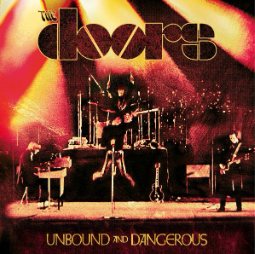
The Doors’ Robby Krieger and John Densmore team with the band’s longtime engineer and mixer Bruce Botnick for Unbound And Dangerous, a new double live album that revisits their 1970 Roadhouse Blues tour. Focused on hard-rocking performances, the collection sets a breathless pace, capturing The Doors at their menacing, bluesy best.
The 16-track collection arrives October 23 on CD and as a 2-LP set pressed on translucent red vinyl, available HERE,Rhino.com and thedoors.com. A Blu-ray edition features Botnick’s new Dolby Atmos and high-resolution stereo (192/24) mixes.
Morrison Hotel became the Doors’ fifth consecutive Top 10 album in February 1970, reaching #4 in the U.S. and winning critical praise for its raw mix of blues and rock. Jim Morrison, Ray Manzarek, John Densmore, and Robby Krieger hit the road in support, recording several shows along the way during the Roadhouse Blues Tour. Highlights appeared a few months later in July on Absolutely Live, the group’s first-ever live album and another Top 10 hit.
Krieger, Densmore, and Botnick sequenced Unbound And Dangerous from those recordings, which include newly remixed performances from New York City, Philadelphia, Pittsburgh, and Detroit. “Soul Kitchen” is the lone exception, coming from the second show July 21, 1969, at the Aquarius Theatre in Hollywood.
The collection leads with “Dead Cats, Dead Rats” as a preamble before roaring into “Break On Through (To The Other Side)” and then downshifting quickly for an epic psychedelic journey through “When The Music’s Over.” From there, the band doesn’t let up, powering through rockers like “Roadhouse Blues,” “Five To One,” and “Build Me A Woman.” The apocalyptic 15-minute version of “The End” that closes the show starts with Morrison repeatedly shouting, “Bring out your dead!” before the band hurtles headlong into the song’s dark subconscious.
The brand-new liner notes by Krieger, Densmore, and Botnick recall painter Henri Matisse, who was famously branded a “Dangerous Madman” because his art was too revolutionary for its time. Half a century later, The Doors earned a similar reputation. Three men who lived it discuss what that danger meant.
“I knew Jim was ‘dangerous’ from the beginning. Talented, and dangerous,” says drummer John Densmore. “He seemed to want to challenge everything. Then there were his words. That’s what seduced me... those words were about freedom. Freedom of speech, freedom to be free. He wanted to free us all. What a gift. This live album captures that wild spirit.”
“I’m not sure why The Doors were considered dangerous,” says guitarist Robby Krieger. “It was the ’60s man, anything goes, and we didn’t really think of Jim as being dangerous... Once the Kennedys were gone and Vietnam was happening, that was the danger, not The Doors… The closest we came to being dangerous was in Miami or in Cleveland when the audience went crazy.”
“Dangerous equates to excitement,” says Botnick. “The fans came in the thousands to Doors concerts looking for danger and excitement. Jim was always reading the room and knew how far to push the envelope... there was always, will he do something really dangerous?”
The Doors’ Robby Krieger and John Densmore team with the band’s longtime engineer and mixer Bruce Botnick for Unbound And Dangerous, a new double live album that revisits their 1970 Roadhouse Blues tour. Focused on hard-rocking performances, the collection sets a breathless pace, capturing The Doors at their menacing, bluesy best.
Unbound And Dangerous
2LP Track Listing
LP One
Side One
1. Introduction
2. “Dead Cats, Dead Rats”
3. “Break On Through (To The Other Side)”
4. “When The Music’s Over”
Side Two
1. “Roadhouse Blues”
2. “Alabama Song (Whisky Bar)”
3. “Back Door Man”
4. “Five To One”
5. “Build Me A Woman”
LP Two
Side One
1. “Petition The Lord with Prayer”
2. “Light My Fire”
3. “Crawling King Snake”
4. “Soul Kitchen”
Side Two
1. “Bring Out Your Dead”
2. “The End”
3. “Thank You And Good Night”
Unbound And Dangerous
CD Track Listing
1. Introduction
2. “Dead Cats, Dead Rats”
3. “Break On Through (To The Other Side)”
4. “When The Music’s Over”
5. “Roadhouse Blues”
6. “Alabama Song (Whisky Bar)”
7. “Back Door Man”
8. “Five To One”
9. “Build Me A Woman”
10. “Petition The Lawd”
11. “Light My Fire”
12. “Crawling King Snake”
13. “Soul Kitchen”
14. “Bring Out Your Dead”
15. “The End”
16. “Thank You And Good Night”
In 2017 I interviewed Jac Holzman about the Doors for my book 1967: A Complete Rock Music History of the Summer of Love. Holzman is the visionary talent scout, A&R man, and founder of Elektra Records.
“I saw myself as a midwife to their music. I think the word channeler is better. They recorded it. I helped supervise how it was going to be taken in and what I hoped would be willing ears. That’s my job. And it’s my job to talk tough when I need too. But I never had that kind of problem with the Doors.”
Holzman did suggest a therapeutic commercial moment for the Doors when Jim Morrison was criminally charged with indecent exposure and lewd behavior after the band performed on March 1, 1969 at the Dinner Key Auditorium in the Coconut Grove area of Miami Florida. Morrison was facing Dade County jail time in September 1970.
“The only time was when there was much screaming about Miami. I said, ‘If your shows are being cancelled, we will figure something out about how we’re going to bring you back live. In the meantime, go into the studio. Start writing another album.’ And that was Morrison Hotel.
“And then we did two evenings of Doors’ concerts [on Sunset Blvd. in Hollywood] at the Aquarius Theater and those tickets were two dollars. We underwrote the rest. We picked up the tab. But it was there where we launched them. And that idea came from us. That’s kind of what you do when you live your artists anguish and you try and help them and you over the tough spot.
“Morrison died young. Jimmy Dean. That’s part of it. But he lived his life as full and he lived his life without any attention to convention, or what anybody else thought and a flame that bright usually does not burn long.
“I was more impressed by Ray Manzarek at the beginning than I was by Jim,” admitted Holzman.
“Jim had the vocal chops, but that persona crept out once he knew he had a safe home or a safe perch to work from. Remember: The Doors were a band that had been signed to Columbia and they couldn’t even get to make a single. And the reason I offered them a three-album guarantee was that I never wanted them to feel that they would get booted out the door if the first LP didn’t sell.”
In 2011, I spoke with Bruce Botnick and asked what astounds him 40 years later listening to his collaboration with producer Paul Rothchild and the Doors.
“The thing that still works for me is, first and foremost, the music. The musicianship. The performance. And all of those when these guys connected as a unit and became unconscious is good or better than anything I’ve ever heard. And that’s one of the things I have to hand to my friend producer Paul Rothchild. That we went for performance and tried to stay out of it not to become too technically in the front of the albums that were manufactured.
“In the case of the Doors, Paul was the man who drove the train and kept it on the tracks. But the reality is that there were six of us in the studio making these records together. And it wasn’t a matter of one person ‘being the person.’ Paul never took that point. At some point during the relationship and especially when Jim got busted in Miami, where Paul had to step up and take more control. Because somebody had too or otherwise it would have never got done. But generally, his approach was to get the performance. And we weren’t afraid of editing between takes. You get an amazing first verse and second verse and a chorus and verse into the bridge and it would sort of fall apart and we would grab another take that had it and edited it all together. And it was about the performance. It wasn’t about overdubbing. Because in the majority of what the Doors played on their records was played live.”
“In live performances, I had to work harder on the tempo because Ray’s left hand was the bass,” John Densmore explained to me in a 2009 interview.
“And when he took a solo, he’d get excited and speed up. ‘Hold it back. Hold it back.’ But, without a separate guy doing bass line runs and grooves, there are holes. ‘OK. I’m going in.’ Sometimes I didn’t do anything. That was my territory between the beats.
“I saw Chico Hamilton at the Light House club. There was this ride cymbal riff that Chico did on a song. The ride cymbal on ‘The End,’ once I get to the kit and I’m playing the tambourine. It’s Chico Hamilton. That’s where it came from. Chico was direct. ‘Oh, that kind of cool cymbal riff I think would fit in that song’ I was thinking to myself, like, going into the bridge on ‘Wild Child.’ That’s the press roll from Art Blakeley. That was direct from the records on Pacific Jazz and World Pacific.
“During band rehearsals or just before we recorded, mainly I heard Jim’s words live and by himself in the garage, or Ray would hand me a slip of paper and they were pulsating rhythms of words. Because Jim was a poet they were edited. Like, ‘Break on Through’ was so percussive. When we were recording and locked in, I was in it. We were just so in it. We were lost. Playing live there were big sections on ‘The End’ or ‘When the Music’s Over,’ when we would vamp, and Jim would throw in anything. And then, ‘Oh yeah? I’ll throw that back at you. Check this out.’ ‘The End’ was a raga tune.
“Let me tell you, at the Rock and Roll Hall of Fame Doors induction, (Bruce) Springsteen came up to me and said, ‘I like your drumming. It’s so quiet, and then you drop a bomb.’ Thank you, Boss.
“Jim had an astounding baritone. Un-schooled. Never got nodes like Grace Slick and had to have surgery. God, if you don’t have that bottom… It was luck. It was fate. He never sang before I saw him in the garage. It was kind of squeaky in the early days. He just was afraid to open up. How audacious. ‘OK. I’ve never sung and I’m gonna be the lead singer of a rock band.’
“I wasn’t thinking cinematic, but certainly Ray and Jim coming out of the UCLA Film School were cinematic dudes. That’s for sure. I mean, I hear the world. Filmmakers see it,” observed John.
“The last song we did on the Strange Days album was ‘When the Music’s Over,’ emailed Robby Krieger in 2017. “We had been doing it live a lot, and it was fun because it was different every night, kind of like ‘The End.’ Lots of improvising.
“So, the night before we were to record, the phone rings about 4 in the am. I knew who it was. Jim says…‘Robby, Pam and I took too much acid man, you gotta come over. You got to help us.’ I got out of bed and drove over there fearing the worst. They were like helpless babies, not on a bummer, but more just bored.
“I immediately knew what to do. When on acid, always seek nature! They wanted me to take some but I refused. I said ‘Let’s go across street to Griffith Park. It’ll be great!. ‘Yeah. Yeah,’ they were excited! As they started out the door, I said ‘Shouldn’t you get dressed first?’ They agreed and out we went. They were freaking out, having a great time, so I figured they were OK.
“I said, ‘Jim; remember we’re recording tomorrow.’ ‘I’ll be there.’
“Of course he wasn’t. Probably asleep we assumed. What to do? Ray said ‘Let’s just do the track, and leave spaces where Jim does his thing...’ We decided it was worth a try. So, we laid it down, trying to imagine where Jim would come in, and other such improvisations that were different every time we played it.
“Finally Jimbo shows up 8 hours late, pretending to have forgotten the 2pm start time… He got it in one take. Amazing!”
Over a 40-year period, I interviewed Ray Manzarek a dozen times.
During 2003, I asked the DePaul University and UCLA graduate him about Bruce Botnick and Paul Rothchild, who helmed and guided the Doors in the recording studio.
“Paul Rothchild was the guy who had produced the Paul Butterfield Blues Band and also Love, along with engineer Bruce Botnick. The two of them did those albums together. So, it was a great combination of six guys. That first album was basically the four Doors and the two other Doors in the control room making the sound. We made the music. They made the sound. And they did an absolutely brilliant job. And it was a real joy and a great learning experience.”
In a 2009 interview, Ray and I discussed the Doors of 1969.
“After The Soft Parade and the Aquarius shows, we said, ‘Let’s go back to the blues. Let’s get dark and funky for Morrison Hotel.’ [Issued in January 1970].
“The Doors are a collective journey that's a good way of putting it. It's of course Jim Morrison as the charismatic lead singer, and I've got to address Jim Morrison, but it's Densmore, Krieger and Manzarek (too). It's a journey of these four guys, The Four Horsemen of The Apocalypse, the diamond-shaped, no bass player that made a five-point pentagram, shape of the diamond. It's the inverted pyramid, it's an archetypal journey of four young men into the unconscious, and coming out of that and creating a musical art form.
“The whole Doors’ organ sound, what makes that work, that’s my whole Slavic upbringing. That’s being a ‘Polish Pianist.’ That’s that dark Slavic Stravinsky, Chopin, that great mournful Bartok type thing. Dark, mournful Slavic soul married so perfectly with the southern gothic American Florida ‘Tennessee Williams’ boy poetry, that the two of us went ‘Crunch!” and the whole thing came right together perfectly.
“The Doors were never part of the folk-rock country rock/laid back ‘Peaceful Easy Feeling’ of Los Angeles. The Doors were part of Raymond Chandler, John Fante, Dalton Trumbo. It was the dark streets and The Day Of The Locust, Miss Lonely Hearts. That’s where The Doors come from. You see, nobody came here to make it. Jim and I came to go to the UCLA School of film school, and John [University High School] and Robby [Pacific Palisades High School] are natives. Westside boys who surfed for God’s sake. The Doors are L.A. The beach, and downtown L.A.,” Ray summarized.
“First of all, the left hand created that hypnotic Doors’ sound,” stated Manzarek. “For instance, during the ‘Light My Fire’ solo section, it’s an A-minor triad to a b-minor triad that just repeats like John Coltrane’s ‘My Favorite Things.’ The same sort of sortasortmodal chord structure that I Coltrae,plod used in ‘My Favorite Things.’ Left-handed I’m playing the same thing over and over. The right hand is just playing bbehind RbyRRobby Krieger, punctuating with chords, punctuating with single notes playing with RobbKrieger. When I’m soloing, I’m playing anything I want to play. And that bass line just keeps on going. It never varies and it never stops. Over and over like tribal drumming or [Howlin’] Wolf playing one of his songs without any chord changes. On and on and on. The same pattern. Now, if I were to have added a bass player to play that the guy after about 2 or 3 minutes playing the same two triad…I’ve had guys say to me, ‘I can’t do this Ray…’
“The same three notes over and over. And off he goes, man. So, I think the secret to the Doors’ hypnotic sound comes out of the left-hand keyboard bass. Meanwhile the right hand thinks its Johann Sebastian Bach.
In 2010 we discussed the Doors relationship to film and television. Ray revealed the impact a film class had on him while attending the UCLA School of Film with director Josef Von Sternberg (The Blue Angel, Morocco, Shanghai Express). Von Sternberg eventually applauded Manzarek’s student film Evergreen.
The director’s influence informed the way Manzarek and Morrison would eventually wed cinema and music that’s inherent in their audio and celluloid work.
“He’s the guy who really kind of gave a real sense of darkness to the Doors, not that we wouldn’t have been there anyway,” Ray explained. “But having Von Sternberg and seeing the deep psychology of his movies, and the pace at which he paced his films, really influenced Doors’ songs and Doors’ music. The film school is always there.
“Our song structure was based on the cinema. Loud. Soft. Gentle. Violent. A Doors’ song is again, aural, and aural cinema. We always tried to make pictures in your mind. Your mind ear. You hear pictures with the music itself.
“Film school guys founded the Doors. When we made the music, each song had to have a dramatic structure. Each song, whether it was two and a half minutes or an epic like ‘The End’ or ‘When The Music’s Over,’ you had to have dramatic peaks and valleys. And that’s the sense of drama within the Doors’ songs which comes right from the theatre.”
“I served in the military before the Doors started,” Manzarek reinforced to me. “And Jim came from a military family. His father [Captain George Stephen Morrison] commanded the Carrier Division during the Gulf of Tonkin, an incident which justified President Lyndon Johnson to escalate the Vietnam War.]
“On Waiting For The Sun, wequestioned government on ‘The Unknown Soldier’ and ‘Five To One.’
“That was a time when we started questioning the government. Everyone was questioning the government. That was all based on the war in Vietnam. And why are we in Vietnam? Why are we fighting these people?”
I asked Ray about Jim’s lyrics to “When The Music’s Over.’ A song where terror, ecological and environmental concerns are examined.
“I knew Jim was a great poet. There’s no doubt about that. See that’s why we put the band together in the first place. It was going to be poetry together with rock ‘n’ roll. Not like poetry and jazz. Or like it, it was poetry and jazz from the ‘50s, except we were doing poetry and rock ‘n’ roll. And our version of rock ‘n’ roll was whatever you could bring to the table. Robby bring your Flamenco guitar. Robby bring that bottle neck guitar, bring that sitar tuning. John bring your marching drums and your snares and your four-on-the-floor. Ray bring your classical training and your blues training and your jazz training. Jim bring your Southern gothic poetry, your Arthur Rimbaud poetry. It all works in rock ‘n’ roll. So, Jim was a magnificent poet. I loved his poetry. The fact that he was doing ecological poetry. ‘What have they done to the earth?’
“But don’t forget that’s late 1967, and the potheads were aware. That’s what was so great about marijuana opening the doors of perception along of course with LSD.
“The pot heads were the first mass ecological movement. And I hope they continue on and continue it into future because it’s our obligation to save the planet. We were working in the future space. The Doors on their third album were in future space. And many things have come to fruition that Jim Morrison wrote about.
“The Doors. Pure serendipity. It was an energy of the time. Morrison had a great line, ‘in that year we had an intense visitation of energy.’ Those years lasted from approximately 1965 to 1970. The psychedelic generation had come of age. The young people had come of age. We were the fruit of the American dream. We had everything. All the education and all the pampering. Low and behold, we are all one with everything. Everything is one with us. We, especially the hippies, are all each other’s brothers and sisters. Now let’s become artists and let’s see if we can change the world. Let’s see if we can take love and make love change the world.
“So, what happens with the playing of Doors’ music you enter at a lower state of consciousness into an almost hypnotic state and at the same time an elevated cosmic state of consciousness. So you are comically aware and you are hypnotically down into the vibrations, the energy of the telluric force, the energy of the planet, the energy of the thousand miles an hour spinning globe that we’re on. With that hot molten center you’re part of that and you’re part of the infinite cosmos at the same time all in playing your music. And that’s what Doors’ music is about. It’s right there.
“It is a collective journey that's a good way of putting it. It's of course Jim Morrison as the charismatic lead singer, and I've got to address Jim Morrison, but it's [John] Densmore, [Robby] Krieger and Manzarek (too). It's a journey of these four guys, The Four Horsemen of The Apocalypse, the diamond-shaped, no bass player that made a five-point pentagram, shape of the diamond. It's the inverted pyramid. It's an archetypal journey of four young men into the unconscious, and coming out of that and creating a musical art form.”
In 2003, Steven Van Zandt, songwriter, record producer/guitarist in Bruce Springsteen & the E Street Band, and actor, invited me to see their concert in Sacramento, CA.
Later that year, Steven emailed me about the Doors.
“I didn't like the Doors as a kid. I didn't get it. I was a total Anglophile on top of being prejudiced against most things from the West Coast. Any guitar player not from the Eric Clapton school was irrelevant, Mike Bloomfield being the only exception, so I didn't appreciate Robbie Krieger's Ravi Shankar influenced guitar style.
“Poetry was beyond me, the only exception being Bob Dylan, so Jim Morrison's Rimbaud meets Dionysius routine went right over my head. John Desmore's drum craft gently weaving the guitar and keys together was too subtle in my world of Keith Moon, Ginger Baker, and BJ Wison. Ray Manzarek was the exception, being obviously impressive with every keyboard player tested by his ‘Light My Fire’ riff. But I wouldn't appreciate keyboardists playing with one hand until much later (he played bass with the left).
“Nobody in my neighborhood took the band seriously. And while we're on the subject, we let the Rascals get away it but we weren't so forgiving with the Doors' weird ass no-bass-thing either. As it turned out, of course, I couldn't have been more wrong. It's obvious to me now, they were fantastic. They would be one of the defining bands of the psychedelic era.
“They were a brilliant combination of extremely cinematic rock, pop, and art, that featured Existential philosophy, beat poet influenced lyrics, Eastern-style Indian scales, Western-style self-psychoanalysis, and Native American primal, ritual performance. Awesomely original, they were an unpredictable, exciting visionary energy for a new world that never quite came to be.”
In 2024, I received an email from UCLA graduate, the novelist Daniel Weizmann.
“In ‘79, on a rare broadcast series called Album Greats, Ray Manzarek told L.A. radio station KLOS-FM that ‘Once you see where you stand in relation to eternity, making pop songs for AM radio seems a little inconsequential,’” emphasized Weizmann.
“Hollywood psychedelia was always a strange Janus-faced animal--part freak out, part show biz, part burlesque, part teenybopper a go go--but even by these anti-standards the Doors stood apart...from their peers, their audience, even from each other as they jammed choppy organ jazz and broken poetry in the shadows.”
(Harvey Kubernik is the author of 21 books, including 2009’s Canyon Of Dreams: The Magic And The Music Of Laurel Canyon, 2014’s Turn Up The Radio! Rock, Pop and Roll In Los Angeles 1956-1972, 2015's Every Body Knows: Leonard Cohen, 2016's Heart of Gold Neil Young and 2017's 1967: A Complete Rock Music History of the Summer of Love.
Sterling/Barnes and Noble in 2018 published Harvey and Kenneth Kubernik’s The Story Of The Band: From Big Pink To The Last Waltz. In 2021 they wrote Jimi Hendrix: Voodoo Child for Sterling/Barnes and Noble.
Otherworld Cottage Industries in 2020 published Harvey’s Docs That Rock, Music That Matters. His Screen Gems: (Pop Music Documentaries and Rock ‘n’ Roll TV Scenes) was published in February 2026 by BearManor Media. Harvey is currently writing a book on the Beatles.
Harvey spoke at the special hearings in 2006 initiated by the Library of Congress held in Hollywood, California, discussing archiving practices and audiotape preservation.
In 2017, he appeared at the Rock & Roll Hall of Fame in Cleveland, Ohio, in its Distinguished Speakers Series and as a panelist discussing the forty-fifth anniversary of The Last Waltz at the Grammy Museum in Los Angeles in 2023).
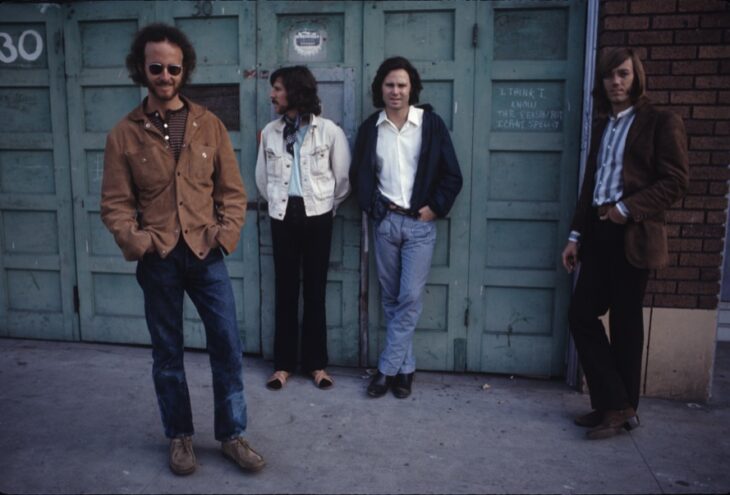
Photo by Henry Diltz, Courtesy of Gary Strobl at the Diltz Studio