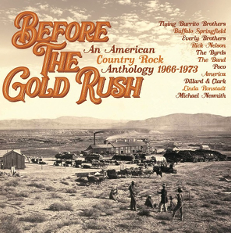
A new collection that celebrates the early days of the country rock movement, featuring such seminal acts as Buffalo Springfield, The Byrds, The Flying Burrito Brothers and Poco, is being released on October 23, 2026. The 3-CD set, Before the Gold Rush: An American Country Rock Anthology 1966-1973, via the Americana imprint of Cherry Red Records, is available to order in the U.S. The collection features a 48-page booklet that includes many rare photos and the story behind each of the 76 songs.
From the label’s announcement: The American country rock genre wouldn’t peak in commercial terms until the mid-1970s, when the likes of Linda Ronstadt and her former backing band, later to become the Eagles, smoothed out the musical rough edges to achieve huge mainstream success and inspire a whole host of like-minded singers and bands. Before the Gold Rush chronicles the early days of the North American country rock scene, from the pioneering efforts of established names like Rick Nelson, the Everly Brothers and Jerry Lee Lewis to a new wave of proto Americana acts that stretched from the Nitty Gritty Dirt Band and Pure Prairie League to rampant musical cross-pollinators like The Band and Little Feat.
The American country rock genre wouldn't peak in commercial terms until the mid-1970s, when the likes of Linda Ronstadt and her old backing band, Eagles, smoothed out the musical rough edges to achieve huge mainstream success and inspire a whole host of like-minded singers and bands.
Nevertheless, it's generally acknowledged that the genre's creative peak occurred in the second half of the 1960s and the early 1970s, when long-haired California hippie rock musicians rejected the peacock plumage of psychedelia to hijack the musical traditions of Nashville and the Grand Ole Opry, playing out their Old West cowboy/outlaw fantasies while also following the counter cultural desire to "get back to the garden".
Featuring four hours of music across 76 tracks, Before The Gold Rush is a fascinating look at some of the finest, most enduring sounds to emanate from rock music's most tumultuous era.
DISC ONE
1. Rick Nelson – Things You Gave Me
2. The Monkees – Papa Gene’s Blues
3. Buffalo Springfield – Hot Dusty Roads
4. The Lovin’ Spoonful – Nashville Cats
5. Gene Clark with The Gosdin Brothers – Needing Someone
6. Hearts & Flowers – Rain, Rain
7. (Gib) Guilbeau and (Gene) Parsons – Louisiana Rain
8. Stone Country – Life Stands Daring Me
9. The Youngbloods – Sugar Babe
10. Sonny Curtis – I Fought The Law (And The Law Won)
11. The Nitty Gritty Dirt Band – These Days
12. Stone Poneys featuring Linda Ronstadt – Some Of Shelly’s Blues
13. Lee Hazlewood – She Comes Running
14. Merle Haggard & The Strangers – Mama Tried
15. The Band – The Weight
16. The Beau Brummels – Cherokee Girl
17. The Everly Brothers – Mr. Soul
18. Merrell Fankhauser & H.M.S. Bounty – Your Painted Lives
19. The Flying Burrito Bros. – Hot Burrito #1
20. Jerry Lee Lewis – Louisiana Man
21. Linda Ronstadt – The Only Mama That’ll Walk The Line
22. Sir Douglas Quintet – Texas Me
23. Poco – Calico Lady
24. John Stewart – Omaha Rainbow
25. Lothar & The Hand People – Midnight Ranger
26. Polly Niles – For What It’s Worth
27. Joshua Fox – Come What May
28. Kenny Rogers & The First Edition – Reuben James
29. Taj Mahal – Six Days On The Road
DISC TWO
1. Dillard & Clark – No Longer A Sweetheart Of Mine
2. Quicksilver Messenger Service – Words Can’t Say
3. Brewer & Shipley – Rise Up (Easy Rider)
4. The Dillards – Brother John
5. Ron Elliott – Molly In The Middle
6. Great Speckled Bird – Long Long Time To Get Old
7. Eagle – Brown Hair
8. Goose Creek Symphony – Charlie’s Tune
9. Jesse Winchester – The Brand New Tennessee Waltz
10. Brethren – Don’t Talk Now
11. Mason Proffit – Two Hangmen
12. Shiva’s Headband – Take Me To The Mountains
13. We Five – Never Goin’ Back
14. The Allman Brothers Band – Midnight Rider
15. Yellow Hand – Down To The Wire (album version)
16. Turnquist Remedy – Cowboy Song
17. Michael Nesmith & The First National Band – Silver Moon
18. Morning – It’ll Take Time
19. Ry Cooder – My Old Kentucky Home
20. Jesse Ed Davis – Tulsa County
21. Otis Williams & The Midnight Cowboys – I Wanna Go Country
22. Crazy Horse – Dance Dance Dance
23. Timber – Pipe Dream
24. Rio Grande – Idle Idabelle
DISC THREE
1. Grin – Everybody’s Missin’ The Sun
2. Gene Clark – The Virgin
3. Bob Lind – I Love To Sing/ Sweet Harriet
4. Roger Tillison – Good Time Gal
5. Mountain Bus – Rosalie
6. New Riders Of The Purple Sage – Last Lonely Eagle
7. Deerfield – Me Lovin’ You
8. Charlie Daniels- Georgia
9. Swampwater – Ooh-Wee California
10. Chuck & Mary Perrin – Picking Up The Pieces
11. Cowboy – 5’ll Getcha Ten
12. John Prine – Angel From Montgomery
13. Pure Prairie League – Woman
14. Little Feat – Willin’
15. Bob Mosley – Thanks
16. Michael Gately – Sometimes I Get A Notion (Gotta See The Country)
17. Burnt Suite – Sally Salamander
18. Marlin Greene – Forest Ranger
19. Danny O’Keefe – Good Time Charlie’s Got The Blues
20. J. D. Souther – How Long
21. Eggs Over Easy – Runnin’ Down To Memphis
22. America – Don’t Cross The River
23. Byrds – Cowgirl In The Sand
In my March 24, 1976 interview with Emmylou Harris for Melody Maker, we discussed the popularity of country music in England and Europe.
"I was nervous I looked forward to playing overseas because I had this feeling there was an audience for my kind of music, especially since Gram's albums did so well there. He had been recognized critically in Europe and England far more than in the States. I don't think people here realize the magnitude of how he affected music," offered Emmylou Harris during a rehearsal break at Alley Sound in North Hollywood.
Emmylou was delighted by her reception in Britain. "There seems to be more respect toward country music, and I have this feeling that the audiences over there who like country music have not been exposed to the prejudices that exist here. They can appreciate a straight country performer like George Jones for being almost a folk hero. It seems that the audience in London doesn't have any reservations, because of musicians like the Burritos and Gram. They were really hip to Gram's two albums. We tried to go back and do those old country songs, not to re-create an old song but pay respect to the old and add the new."
'Sin City' is a favorite that is very meaningful to a lot of people and in our repertoire since the Hot Band began last April.”
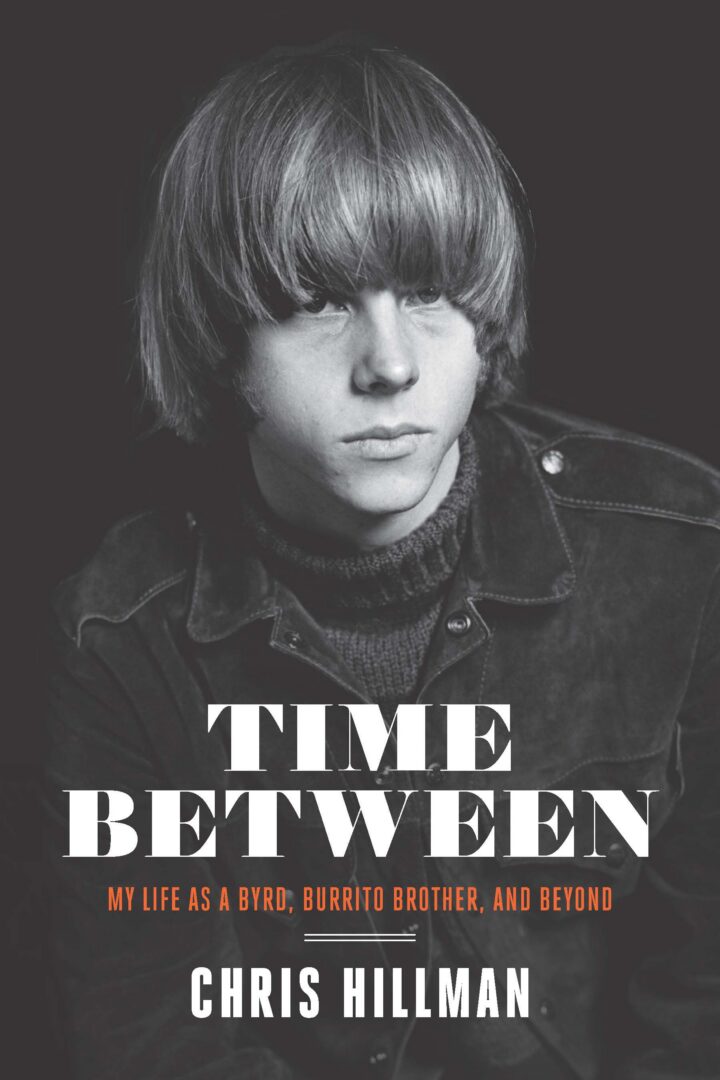
“The Byrds on Turn! Turn! Turn! album with ‘Satisfied Mind,’ which really was a Porter Wagner hit, and I think we had heard Hamilton Camp do it, but it’s such a great song,” reflected the Byrds’ Chris Hillman in a 2007 interview I conducted with him.
“And then, I still think ‘Time Between’ was our country rock song of the time. That’s when we started doing that stuff. When we had Clarence White come in and played on Younger Than Yesterday. I’m not taking credit for any of that. Rick Nelson deserves credit in the country rock thing, too. Big credit. Way beyond anybody else. But you know how this business works.
“The original concept in 1969 of the Flying Burrito Brothers was as plain as day. Here we are. We wanted to do country stuff. And the first two years with Gram was very good, very productive and on the same page. I think if I was to look back and say, ‘Well, If only…’ and I don’t go there, but if I did, and it was a question presented to me. He was far more confident. He was a charismatic figure. He was an interesting man at the time. I’m not saying he was a great singer. He wasn’t. He was a good singer on a couple of tracks, probably on the first album.
“I knew Gram and I will always cherish a couple of years when we really worked together. We were sloppy. The Flying Burrito Brothers with Gram. I just had come out of a band that recorded ‘Eight Miles High’ that went from doing Bob Dylan songs to being able to do a song like that, to doing something that musical, and to be on a par with the Who or the Beatles. The point is we became a really tight good band. And I’m in the Burritos, and I’m looking at it not from a sterile place of it should be perfectly tight, but it wasn’t.
“We didn’t put any time into it. And I must say, and I’m not padding myself on the back, when Gram left and Bernie (Leadon) and I took that band, and we tightened it up and we made it a good band. And when Bernie left we lasted another six or eight months. It became a musical band then. Did it have the magic that Gram offered? Not really. I still was learning how to sing. And Gram was an interesting guy. He had that thing. And I don’t know what the attraction is that other than he died in such a mysterious way. Yes, he did some good songs. He had a bunch of good songs. Two songs, ‘Hot Burrito #1’ and ‘Hot Burrito #2’ are Chris Etheridge songs. Chris brought those in and Gram helped finish them. ‘She.’ Great song. Etheridge. And with all due respect to Gram, he was a good collaborator.”
I interviewed Roger McGuinn of the Byrds in 2007. At the time, I told him that guitarist Clarence White, who played on the Byrds’ Sweetheart of the Rodeo, was an overlooked hero in the birth and development of country rock. He did a bluegrass touch coupled with a rock ‘n’ roll beat on “Time Between Us” from your 1966 Younger Than Yesterday LP. He also played on your The Notorious Byrd Brothers LP. And, going back to 1965 folkish/country Byrds’ offerings of “Oh! Susannah” and “Satisfied Mind,” a Porter Wagoner song, and the beat and country feel of his own playing and song structure of “Mr. Spaceman.”
“I agree with you,” replied Roger. “I was a fan of country music, and we were dabbling in country rock before Gram came in. And even ‘Mr. Spaceman’ has a country beat to it. I mean, it’s a silly sci-fi song, but it’s got a country, Buck Owens approach kind of song. We were dabbling in that, and something we did for fun, and the only difference when Gram came along is that we decided to do an entire album of it and do nothing but that.
“That was the difference. And I think it was because Chris had an ally. That’s what he feels. He found an ally in Gram. And the two of them kind of swung it over to that at the time.
“There was unity. We used to play poker every day. I mean, we were buddies who would sit around, drink beer and play poker. And when we were off in L.A., we’d ride motorcycles together. I mean, we were having a good time. It wasn’t like there was this weird animosity. There was very little of that going on. It was a friendly band. Maybe too much fun. We enjoyed it. ‘Lazy Days’ is a cool song Gram wrote. They’re all good songs. We have to give Gram credit for bringing a lot of them to the sessions. Gram brought in a batch of songs. “Hickory Wind,” William Bell’s “You Don’t Miss Your Water,” and The Louvin Brothers’ “The Christian Life.”
“We all got along great with the musicians in Nashville and stayed at this Ramada Inn and played poker all day until the sessions at night and had a ball. We were country boys. We got into it. I mean, we had cowboy hats and boots. I loved it. A very enjoyable experience. We were just role- playing. Even Gram. He wasn’t that kind of kid. He was a folkie, and he was a preppie, basically. Gram got turned on to Elvis when he was 10 years old, and that changed his life, and he wanted to be a rock star, which he eventually became. He then got into country, he got into Buck Owens, and he got into Waylon and Willie. I think what he really wanted to do was get rid of me and get a steel guitar player.
“Clarence White. Oh, man. Yeah…Incredible. Clarence was a brilliant musician. I mean, it was like working with (Jimi) Hendrix. He was just a triple A plus musician and over the line every time. I see this imagery line, and some musicians come up to it, and they just hit it, and everything is fine. It’s in tune, and it’s in time. But Clarence was way over. He’d just fly over the line.”
A key player and architect in the emergence of the country rock genre, now the Americana format, is Chris Darrow, a founding member of the pan-global world beat collective the Kaleidoscope in 1966-1968.
Darrow recorded during 1968-1974 with the Nitty Gritty Dirt Band, Hoyt Axton, James Taylor, Linda Ronsdadt and John Stewart.
“I got to know Gram Parsons a little bit,” recalled Chris during our 2000 dialogue.
“He and Bernie Leadon would come out to my house and visit. The Flying Burrito Brothers even did a concert right across the street from my house; I designed the poster for the gig. Gram had a mentor from the East Coast who was teaching in Claremont at Pomona College,” disclosed Darrow. “His name was Jett Thomas.
“I think that country rock was a West Coast phenomenon and that the bands were the originators, not the individuals. The East Coast solo artist was a different breed from the West Coast collaborative unit. Most of the situations that arose in the West Coast were band situations, and whether there was strife or not, the element of the band usually prevailed. Guys like Gram Parsons were much more self-directed and solo-oriented than most of the West Coast personalities that worked with him. Chris Hillman has always been a good team player. Bluegrass training!
“What I’m saying is that country rock did not sprout out of the head of Gram Parsons and everybody else followed. He was a talented guy, but refuse to put a single name to the father of this genre.
“The fomenting of this music started early in all our heads and each opportunity to express it was taken. A steel guitar is not the only criterion for country rock music. Clarence White invented a device to play the electric guitar like a steel guitar. He and Gene Parsons developed the Parsons/White Pull-String, eventually called the StringBender, and then renamed the B-Bender, which bends the second string in the same manner as a steel guitar.
“It is a hard style to play, and only a handful of musicians have mastered this technique. I had a chance to play in his band at the Ash Grove a month before his untimely death,” Darrow sighed.
There’s another guitarist/arranger, Don Peake, who played an essential role in developing and exposing country-tinged pop recordings in the 1966-1970 period, after his 1961-1963 tenure as the Everly Brothers’ lead guitarist.
On numerous Monkees’ country-flavored recordings that were selected by member Michael Nesmith, Peake served as arranger.
“Mike Nesmith hired me to be ‘his guy.’ Because he was kind of misunderstood and ignored,” explained Peake in a 2023 conversation with me.
“I had evidently some meetings with him. He came to me and said, ‘Look. We’ve got the Boyce and Hart thing going, but I’ve got some songs I want to express myself, and I need solid musicians and good arrangements.’ And so, I became his arranger.
“Mike Nesmith was a good musician. I just did my thing. I’m like a worker bee. Mike said, ‘Don, I want you to write these charts.’ So, I get out a big book of paper and start writing arrangements for the band. ‘Cause I know how they are going to play because I know these kinds of musicians. And I absolutely make these songs so that they sound like Mike’s songs. My job was to communicate to these musicians how I wanted it to sound so it would be perfect for Mike.
“On my Don Peake Music website, there is a discography for arranging and conducting, and if you click on the years of the Monkees, there are actually many more songs than I recall.
“I remember ‘Mary, Mary,’ I remember ‘Sweet Young Thing,’ I remember ‘Gonna Buy Me a Dog,’ and ‘You May Just Be The One.’
“And I hired Mike Deasy, and I hired Glen Campbell. I’m the guy who hired Glen to come in. I’m still not sure, and it’s a little foggy for me as to who played the beginning of ‘Mary, Mary.’ I don’t know if it was Glen or Mike Deasy. I think Jim Gordon was playing on some of those sessions.
“On the Monkees’ dates I would sometimes pick up a guitar and sometimes I would not. But I was always the guy standing up on the podium. I was the leader. And Mike depended upon me to communicate in musical terms and on paper what he could not. He had some B-sides, you know, we busted him out. I was thrilled to be doing it with him.
“I had my experience with the Everly Brothers 1961-1963, and was very conversant with small combo. I was a band player. The Everly Brothers were those fabulous Bordeaux Bryant songs, amazing songs.”
(Harvey Kubernik is the author of 21 books, including 2009’s Canyon Of Dreams: The Magic And The Music Of Laurel Canyon, 2014’s Turn Up The Radio! Rock, Pop and Roll In Los Angeles 1956-1972, 2015's Every Body Knows: Leonard Cohen, 2016's Heart of Gold Neil Young and 2017's 1967: A Complete Rock Music History of the Summer of Love.
Sterling/Barnes and Noble in 2018 published Harvey and Kenneth Kubernik’s The Story Of The Band: From Big Pink To The Last Waltz. In 2021 they collaborated on Jimi Hendrix: Voodoo Child for Sterling/Barnes and Noble.
Otherworld Cottage Industries in 2020 published Harvey’s Docs That Rock, Music That Matters. His Screen Gems: (Pop Music Documentaries and Rock ‘n’ Roll TV Scenes) was published in February 2026 by BearManor Media. Kubernik is researching a multi-voice narrative study on the Beatles scheduled for a UK publisher with a planned summer 2027 publication date.
Harvey spoke at the special hearings in 2006 initiated by the Library of Congress held in Hollywood, California, discussing archiving practices and audiotape preservation.
In 2017, he appeared at the Rock & Roll Hall of Fame in Cleveland, Ohio, in its Distinguished Speakers Series and as a panelist discussing the forty-fifth anniversary of The Last Waltz at the Grammy Museum in Los Angeles in 2023. Kubernik attended the 1976 event celebrating The Band).
The Byrds' Roger McGuinn, Chris Hillman photo by Henry Diltz, Courtesy of Gary Strobl at the Diltz archive.