
5 RIDE INTO THE SUNSET
Most artists realize that they will probably engage more than one manager during the span of their career. But, artists may not realize that a manager might be entitled to commissions long after the relationship has ended. Anything the manager helped to obtain or arrange during the term of the agreement might be subject to commissions. McLane reports, “It’s not unusual for some managers to want a percentage for anything that happened during the term of the agreement. And, sometimes, that could be in perpetuity unless a ‘Sunset Clause’ is included.” A Sunset Clause reduces a former manager’s commission over time.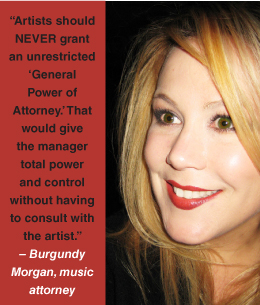
Example: “Manager A” helps you record a demo for shopping purposes. But, you don’t get a deal and eventually move on. Later, you sign with “Manager B,” who is better connected and gets you a deal. In fact, you become a superstar. After a few years you take a break (you’ve worked very hard), but Manager B and your Label don’t want the money train to stop. So, they decide to release the old demo Manager A set up. Everyone thinks it’s a great idea— “Unreleased Songs from the Vault.”
The Problem: If there is no “Sunset Clause” in Manager A’s agreement, Manager A may be entitled to a commission … and so is Manager B. You would be paying TWO Managers 40% instead of one manager at 20%.
Sunset Set-up: Once a management relationship is over and the agreement is terminated, the Sunset Clause kicks in. The terms are negotiable, but essentially it would reduce your ex-manager’s commission over time, e.g. 5% less each year until it reaches 0% (after 4 years). Some managers, however, may not agree to 0%; instead, they might insist that their commissions remain at 3% or so (1% to 3% is average).
Some managers also like to use a Sunset Clause for their benefit. Blasko uses them so that he gets compensated for work he’s doneeven if it is years later. “It’s only fair,” he says. “If you did the work, you should be entitled to share in the profits. By using a Sunset Clause, there’s no question or argument regarding what a manager’s share would be.”
6 LIMIT THE POWER
Management contracts sometimes include a Power of Attorney that gives the manager a variety of powers, including signing contracts for the artist. Essentially, it allows the manager to step into the artist’s shoes. Our attorneys don’t particularly like this clause. In fact, with today’s communication systems being easily accessible (via cell phones, email, faxes, etc), this provision may be as dated as hair metal.
Morgan strongly emphasizes, “Artists should NEVER grant an unrestricted ‘General Power of Attorney.’ That would give the manager total power and control without having to consult with the artist. There must be strict limitations on it—like only when the artist is unavailable, has been notified and approves.”
McLane goes even further. “It’s really not wise for management to sign things for artists. Most managers I know prefer to have the artist sign documents. In fact, I would worry if a manager insists on having a Power of Attorney with no restrictions. That would be a big red flag.”
7 DISPUTE RESOLUTION
Even in the best of relationships, disagreements will arise. How you resolve them can determine whether or not your relationship will survive. Many management agreements will specify that “arbitration,” prior to or in lieu of a lawsuit, is mandatory.
Arbitration is a form of alternative dispute resolution that resolves disputes outside of the courtroom. It is a proceeding in which an impartial arbitrator resolves a dispute. Non-binding arbitration is similar to mediation, in that a decision cannot be imposed on the parties. However, the principal distinction is that whereas a mediator will try to help the parties find a middle ground on which to compromise, the (non-binding) arbitrator remains totally removed from the settlement process and will only give a determination of liability and, if appropriate, an indication of the damages payable.
Attorney McLane informs, “Usually, you have to decide if you want arbitration to be binding or non-binding. Arbitration is faster and less expensive than a lawsuit.”
The reality today, however, limits your options. According to McLane, “In Los Angeles, you are forced to go to arbitration before you can pursue a lawsuit.” As such, arbitration is a procedure you must seriously consider. The only choice you have is whether it is binding or non-binding. And, it’s important to note that the prevailing (winning) party is usually entitled to have their attorney’s fees and legal costs covered by the losing party.
PLAYING FAIR
What’s most interesting is the fact that everyone seems to be more savvy than they were years ago. Artists are smarter (hopefully because of Music Connection), and management contracts are evolving accordingly. In fact, Morgan has noticed, “Lately, management contracts appear to be more fair than they ever were before. Even when I see a contract that is very one-sided, it’s not necessarily a turn-off.”
What Morgan discovered is that even when a contract is hideously oppressive, it is not necessarily a deal-breaker. She expounds, “I found that managers who presented bad, one-sided contracts were usually trying to save money and simply copied and pasted old agreements together or took something off the Internet.”
That may give an artist cause for concern regarding a manager’s business acumen and expertise. But, it really depends on what an artist wants the manager to do. If you already have an attorney, then your manager doesn’t have to review contracts. There’s only one problem with it, though. According to Morgan, “It can cost you a lot––thousands of dollars––to negotiate a one-sided contract.” Instead, she recommends, “You may want to simply counter with a contract that has been approved by counsel (maybe even one from the Internet), or have an attorney draft a template for you.”
Whatever you do, just make sure the contract is fair for all concerned. In fact, if you’re a new act and your manager is going to grow with you, be sure to re-examine your agreement on a regular basis so that it remains fair to everyone.
CONTACTS:
ATTORNEYS
Ben McLane
McLane & Wong
http://benmclane.com
bcmclane@aol.com
Burgundy Morgan
Burgundy Morgan Law Offices
Co-author, …But Where Do I Sign?
http://burgundymorgan.com
burgundymorgan@aol.com
MANAGEMENT
Rob “Blasko” Nicholson
Mercenary Management
http://mercenarymanagement.com
info@mercenarymanagement.com