Frank Zappa’s vaunted Vaulternative Records imprint returns in 2026 after nearly a decade, reigniting the revered archival series in the Zappa catalog. Originally launched in 2002 by Gail Zappa and overseen by Vaultmeister Joe Travers, the direct-to-fan label carved out a space for releases that lived outside the scope of traditional catalog titles, spotlighting rare live recordings, deep cuts, historically significant performances, and the random and obscure, all chosen directly from Zappa’s vast archive. Vaulternative Records went dormant following 2016’s Chicago ’78, but now reemerges with a refreshed identity and a renewed commitment to presenting the raw, exploratory side of Zappa’s work.
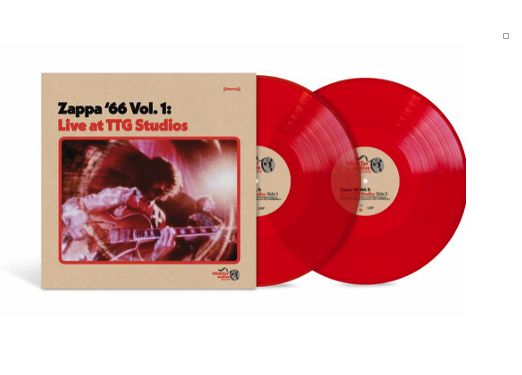
Kicking off this next chapter is Zappa ’66: Vol. 1 – Live at TTG Studios, arriving May 15 via Zappa Records/UMe.
The collection features 17 unearthed tracks, only one of which has been previously released, captured during a pivotal October 1966 recording session, available as a 180g 2LP set on translucent red vinyl, CD, and via digital download and streaming, including hi-res audio. Produced, restored, and assembled by Travers, the release features new 2026 mastering by John Polito, sourced from original ¼-inch analog tapes recorded to Zappa’s reel-to-reel system. Interview segments taken from a rare 1966 radio session are also included. All formats will include liner notes by Travers, along with photos by Earl Leaf, film stills by Barry Feinstein, posters from the Freak Out! era, and additional ephemera from The Vault.
All Vaulternative Records releases will be exclusively available via Zappa.com, uDiscover Music and Sound of Vinyl.
A news release from Zappa Records /UMe describes the upcoming 2026 retail release.
‘“We’re very pleased to announce the relaunch of Vaulternative Records, which creates a direct line from The Vault to fans,’ said Joe Travers, Zappa Vaultmeister. “Frank’s AAAFNRAA philosophy — Anything Anytime Anyplace for No Reason At All — really applies here, because the material can take so many forms. It might be an interview, a raw live recording, something Frank worked on that was never released, or a fully realized concert. The goal is to uncover and share the things we know fans will appreciate most. We’re excited to bring Vaulternative back as another way to open up The Vault and deliver more of that content to the people who want it.’
“Vaulternative’s return is also being marked with a new merch collection. Check out the offerings at Zappa.com.
“Beyond its role as the first release in the revived Vaulternative series, Zappa ’66 serves as the opening salvo for the 60th anniversary of Freak Out!, the debut album that introduced The Mothers of Invention to the world, capturing the group during a formative stretch as both the band and the surrounding Los Angeles underground were rapidly evolving.
“In 1966, Los Angeles had become a hub for an emerging countercultural movement that blended experimental music, performance art, and audience participation. Zappa and The Mothers were at the center of that activity, staging multimedia happenings that blurred the lines between concert and spectacle. Through his work with local press outlets and self-produced promotional materials, Zappa played a direct role in shaping how this scene was presented and experienced.
“As the scene continued to grow, it began attracting wider media attention. One television production set out to document shifting youth culture and social attitudes, with a particular focus on themes of sexuality and personal freedom. Originally conceived under the title Sex in the ’60s, the program was ultimately released as Sex in Today’s World.
“To capture an authentic snapshot of the movement, The Mothers were invited to stage one of their immersive “Freak Out” events for the cameras. The performance, filled with lights, smoke machines and a large freak contingent, brought together musicians, dancers, and key figures from the scene, including Vito Paulekas and Carl Franzoni, along with a broader cast of participants whose uninhibited energy helped define the moment.
“The performance documented on Live at TTG Studios stems from that session. Recorded in the same Hollywood studio where Freak Out! had been completed months earlier, the event placed Zappa in the role of both bandleader and conductor, guiding performers and audience alike through a fluid, unpredictable set. Vocalists, musicians, and participants contributed layers of sound, texture, and spontaneous interaction, resulting in a recording that feels as much like an environment as it does a traditional concert.
“Captured on Zappa’s reel-to-reel tape machine, the performance preserves a uniquely important moment in the band’s history, documenting a period of transition for The Mothers of Invention. Zappa ’66 showcases the only known recording of guitarist Del Casher’s short-lived stint in The Mothers, as well as the earliest recorded appearances of percussionist Billy Mundi and keyboardist Don Preston, both newly added to the lineup at the time, while the group is rounded out by core Mothers Ray Collins (vocals, tambourine), Roy Estrada (bass), and Jimmy Carl Black (drums, percussion), all of whom appeared on Freak Out!.
“The material itself reflects that period of rapid evolution, resulting in a recording that feels loose, exploratory, and distinctly of its time. Compared to the more structured approach of The Mothers’ early studio albums, these performances lean further into extended instrumental jams, improvisation, and psychedelia, offering a different perspective on Zappa’s quickly evolving sound in 1966. Certain pieces, like ‘Move On,’ exist only in this context, while others hint at musical ideas that would later take more defined shape in Zappa’s catalog. Across the set, the band moves fluidly between structured passages and open experimentation, pulling from rhythm and blues roots, avant-garde approaches, and the droning, modal textures that would become associated with the era’s so-called Raga Rock sound. Taken together, these recordings offer a historically significant window into how quickly Zappa’s musical language was developing in real time, both onstage and in the studio.
“As with many recordings from The Vault, assembling this release required extensive research and restoration across multiple source tapes. Drawing from material recorded on several reels, approximately 90 minutes of audio were located, transferred, and carefully compiled to present the most complete and compelling version of the performance to date.
‘“I decided to take advantage of the 60th anniversary and compile the best edit I could to represent what happened that day in early October 1966 when The Mothers were hired to supposedly show the world what they were responsible for,’ writes Travers in the liners. ‘The Mothers were unlike any other, and Frank Zappa, 25 years old and still within his first year of being a signed artist, was in the middle of making a large impact.’
“With the return of Vaulternative Records, fans are once again invited deeper into the Zappa Vault, where the unexpected, the unfiltered, and the historically significant continue to surface.”
Zappa ’66: Vol. 1 – Live At TTG Studios 2LP:
Side 1 1. “Hello There” 2. Freak Chouflee’ 3. Move On
Side 2 1. FZ & The United Mutations 2. “Tommy, Come Back!” 3. FZ Directs The Freaks 4. Pomp And Circumstance Sequence 5. Legalize Abortion 6. Twistin’ Again 7. The Electric Banana
Side 3 1. I Could Be A Slave/Story Untold 2. “We Keep Changing Personnel Though” 3. A2 Jam 4. Khaki Sack- Prototype Part 1
Side 4 1. Khaki Sack- Prototype Part 2 2. Duke Of Prunes (Edited) 3. Victory Through Vegetables 4. “We’re Havin’ A Freak Out!”
CD: 1. “Hello There” 2. Freak Chouflee' 3. Move On 4. The United Mutations 5. “Tommy Come Back!” 6. FZ Directs The Freaks 7. Pomp and Circumstance Sequence 8. Legalize Abortion 9. Twistin' Again 10. The Electric Banana 11. I Could Be A Slave Story Untold 12. “We Keep Changing Personnel Though” 13. A2 Jam 14. Khaki Sack 15. Duke Of Prunes (Edited) 16. Victory Through Vegetables 17. “We're Havin' A Freak Out!”
“I was born, grew up, and spent my early teenage years in the industrial north of England, light years away from Los Angeles,” explained Zappa scholar, Alan Watts.
“At that time my emerging musical tastes revolved around R&B and British blues: John Mayall, The Stones, The Who etc.; definitely not FZ and the Mothers. Their LA landscape in the 1960s was too far away from my music time zone. In fact, I don’t think I made an effort to listen to Freak Out!, or any of the original Mother’s albums until the early 70s after I’d digested Hot Rats, Chunga’s Revenge, and Roxy & Elsewhere. I was intrigued by some of the album covers, particularly Weasels, but that was about it.
“I finally got around to Freak Out! after hearing ‘Trouble Every Day’ on Roxy; I was curious to hear the original track. Although I liked the vibe on much of the album, the LA and teen culture thing that was central to appreciating Freak Out!—doo wop, cars, the Watts riots, the freak scene, etc.—was completely alien to me at that time. It wasn’t until years later, after I had moved to LA, that I began to understand what was going on with Freak Out!
“Unfortunately, there’s really not much of a recorded legacy that circulates from the 1966 Mothers, which, with the release of Freak Out!, was of course their break out year. Although there are a few still officially unreleased tracks in the web-o-sphere from the June 1966 Fillmore Auditorium show in San Francisco, the extensive and comprehensive 2006 fortieth anniversary MOFO Project/Object is about all that’s out there.
“With that in mind, this new release looks like an absolute winner from the welcome return of Vaulternative Records! As far as I can tell, this October 1966 recording session is completely unknown in the Zappa fan world. Intriguingly, does the title Zappa ’66. Vol. 1 suggest that there is more to come? We certainly hope so!”
“The first time I had heard about Frank Zappa was when he cowrote ‘Memories of El Monte’ by the reformed Penguins,” offered record producer and songwriter Kim Fowley in an interview we conducted earlier this century.
“My impression of Zappa was ‘John Cage-obsessed doo-wop guy with emotional leanings toward East L.A. Latin and black culture, making fun of white people who were superficial and shallow.’ Which, of course, was cool.
“It was at Canter’s Delicatessen on Fairfax Ave. in Hollywood one night in early 1966 that I marched in, doing my rounds, and there was [guitarist] Elliot Ingber, sitting with Frank Zappa. I saw the hustle, because, obviously, when I walked in, Elliot said to Zappa, ‘This guy here has the juke vibe.’ I knew all the code moves. ‘Elliot here says you’re God onstage.’ ‘He’s right! I can tear up a crowd. I’m not the greatest singer in the world, but I know how to control an audience and hypnotize them.’
“Elliot Ingber was in the Gamblers with bassist Larry Taylor. Nik Venet produced after they were with Phil Harvey, and cut ‘Moon Dawg’ and ‘LSD-25’ in 1959 for World Pacific. Ingber on bass. Guitarist Don Peake toured with Sandy ‘Teen Beat’ Nelson.
“Zappa was another guy in the mid-sixties standing around in Laurel Canyon clothes. Nothing more, nothing less. Somewhere between a beatnik and a farmer. So we went that night, someplace where they had their equipment, and he said, ‘Play something!’ I made up a song on the spot, and he said, ‘You’re in the band if you wanna be.’
“The first gig we did was in a venue, a building on Santa Monica Boulevard near the intersection of Crescent Heights. They used to have music there, where people and independent promoters would rent it and four-wall it. Two hundred, three hundred people. The Mothers of Invention went in. I came on for two or three songs. It was raga music, jazz changes, Roland Kirk, R & B, atonal, mantra, rock.
“I was able to not only follow what Frank and Elliot were doing, along with Roy Estrada and Jimmy Carl Black, I was [also] able to move the audience. I looked like the scarecrow of Oz meets Frankenstein. So how could I, as a two-bit hustler/one-hit wonder, get up and control an audience of skeptical hippie morons from Laurel Canyon and the street? Frank never could understand how I did it. Why I did it. But he did understand that he saw it happening, and felt it happen.”
In October, Herb Cohen became the group’s manager. He encouraged them to join the Musicians’ Union—an expensive move, but one that improved their ability to get work. They were then booked at clubs like the Whisky a Go Go and The Trip.
It was at one of these 1966 shows at the Whisky that MGM/Verve Records A&R man David Anderlee saw the group and steered them to producer Tom Wilson at the label.
That March, Zappa and company entered the TTG Recorders studio with Wilson to record Freak Out! and the album was completed on March 12th.
“Frank said, ‘We’re going in the studio to do what we did tonight,’ remembered Fowley. ‘We’re gonna turn the street loose in there, and you can come down and make noise if you want.’
“I walked into the studio with jazz pianist Les McCann and Danny Hutton. I had lived earlier in the attic of a house owned by his mother. Danny had already had his own hit with ‘Roses and Rainbows.’ In comes Mac Rebennack—later Dr. John. I did the vocal arrangements that night when he played piano. I sang ‘Help, I’m a Rock’ and ‘Who Are the Brain Police?’ with Frank. So, we did that album. I received a ‘hypophone’ credit. That’s where you grab your throat and sing.
“Ray Collins, great singer. Tremendous. He was the Roger Daltrey, and Frank was the Peter Townshend. I liked Roy Estrada. Zappa was like James Brown. He knew how to pick a band of sidemen. He knew how to get ensemble-playing done. Like Sly Stone, too.
“Frank wasn’t a producer that night. Tom Wilson was. You have to understand the dynamic. He was Harvard-educated, and acted like a professor of literature from Harvard or Yale. He had produced Dylan’s ‘Like A Rolling Stone,’ and jazz artists. He had worked at Savoy Records.
“It’s funny, he was officiating in the control room, but he never came out on the floor where we were. Then Frank would run back and forth between the floor and control room with Tom Wilson. But there were over a hundred people there.
“For Freak Out!, we were there all night. We didn’t get paid. We did it because Frank convinced us it was historical, and that we were on the cusp of something important. We all bought into it. We all wanted to go have breakfast. That was more important. The Freak Out! album, to me, was John Cage meets 1920s France. A Josephine Baker version of art is anything that you can get away with.
“I also sang and performed with Zappa and the Mothers of Invention a year later at the Whisky a Go Go, for a live album that was recorded.”
“I went to the Whisky a Go Go one night, and someone actually went around and passed out flyers, telling people [about] the Freak Out,” recalled Howard Kaylan of the Turtles in a 2010 interview we did. “Nobody knew what a Freak Out was.
“I go to the Freak Out that night. There are two or three rooms that are being used simultaneously, and Frank had tape recorders going in all of them. There are different tracks being played in all of them, and people are doing different things in every room. Frank would put some guys in one room, and some in another. The environment was more Soupy Sales than, say, Spike Jones.
“He’s creating his own scenarios. He’s making people go up to the mike and either rant in their own language, or getting them to say things. I think I was doing a little bit of both. Then I went into another room, where it seemed to be like an orgy, and that’s where Wilson was. I knew who he was. I was aware that he was the guy who produced Dylan and many other gems. They were just recording random couples and noises, and people who had not met each other before. Frank would actually direct them physically. A touch here. A grope here. ‘Say something about it.’ Almost like he was directing a movie. It was surreal and great. I really wanted to be a part of it. It was so outside of my normal, structured thing.
“I had no idea, and still don’t know, how much stuff was ever going to be used. Brilliant editing job. Still a masterpiece, in my mind. But as far as the commerciality of the venture, I didn’t really think for a minute that it had any potential whatsoever. I’m sure he didn’t think my idiot pop songs had any potential whatsoever.”
As the Freak Out! album was being prepared for release, the band had a name change forced on them by MGM, which was uncomfortable with “the Mothers.” At the time, however, the change appeared to be only for the record company. At the June 1966 Fillmore Auditorium bookings in San Francisco, promoter Bill Graham continued to introduce them simply as the Mothers.
During 1966, Frank Zappa was utilizing the TTG. recording studio in Hollywood at 1441 North McCadden Place. It was co-founded by a colorful Israeli named Ami Hadani, who had a long-standing association with MGM/Verve Records, the label that signed Zappa in 1966.
In the fifties and early sixties TTG had been Radio Reorders and later Conway Recorders before TTG obtained the property license. The venue was owned by sound engineer Ami Hadini and Tom Hidley, who had installed a 16-track machine Ampex 351-2, one of the first in town, and 440 tape recorders. TTG had EMT 140 Echo Plates along with Sony and Telefunken microphones. Bill Parr, formerly of Conway designed the custom TTG board utilized for film scoring upstairs.
The Mothers of Invention cut Freak Out! and Absolutely Free at TTG with producer Tom Wilson. The Velvet Underground and Nico along with Winds of Change, by Eric Burdon and the New Animals also recorded with Wilson. Hadani was a noted engineer with credits on albums by Ray Brown and Milt Jackson, comedian Shelly Berman and actress Lainie Kazan. In 1968, the Doors’ Waiting for the Sun, with the exception of “Unknown Soldier” and “Spanish Caravan,” was done at TTG. During October ’68 Jimi Hendrix recorded at TTG on the recommendation of Eric Burdon.
“To me, Frank Zappa will always be tightly linked to the East L.A. music community,” emphasized Gene Aguilera, East L.A. historian and Hall of Fame boxing book author.
“When I first heard Freak Out! I freaked out. Because there was a lot of doo-wop in there. There was a lot of Chicano in there, like he was sending me a message directly to my heart. And he had Roy Estrada on bass. Chicano from the beginning. One fondly recalls reading Zappa’s liner notes to Freak Out! which mention such East L.A. luminaries as Little Julian Herrera, Art Laboe, Bob Keene, and Huggy Boy.
“Zappa didn’t just do these 3-minute songs of unrequited love. He sang of racial unrest, as in Trouble Every Day, about the August 1965 Watts Riots. It was very L.A., exposing the dark side and underbelly of society. Years later, Zappa played downtown’s Olympic Auditorium, the storied boxing venue on the edge of Skid Row.
“Growing up in East L.A., I was mesmerized by Frank Zappa’s first few albums. I don’t think there were too many 13-year-olds in East L.A. devouring Freak Out! on their record players like I was in 1966. Zappa was the bridge that tied Doo-Wop/R&B to the communal Laurel Canyon/Sunset Strip underground scene. In the summer of ‘68, I don’t think I played any other album more thanWe’re Only In It For the Money.
“I admired Zappa’s connection to the heart and soul of the East L.A. Sound, celebrating the Pachuco and Zoot Suit counterculture of ‘driving to El Monte Legion Stadium’ in Dog Breath, In the Year of the Plague (Uncle Meat, 1969). Then on the Doo-Wop tribute album, Cruising with Ruben & The Jets (1968), Zappa proudly states on the liner notes, ‘The present-day Pachuco refuses to die!’
“As a kid, we cracked up listening to the closing seconds of WPLJ (from the 1969 LP Burnt Weeny Sandwich), when Mother Roy Estrada sings nasty words in street slang, Pachuco calo. Fast forward to 1972, the title of the Mothers of Invention LP, Just Another Band from L.A. (credited to ‘Las Mothers’) appears in resplendent cholo lettering by homeboy artist Leo Limon. It’s all in there, folks. What a genius Zappa was. I have him up on my wall.
“A delicious three-song ‘Oldies-But-Goodies’ satire found on Zappa (Original Motion Picture Soundtrack) kicks off an instant East Los slow-dance grind party. Zappa and lead vocalist extraordinaire Ray Collins open the doo-wop set with Memories of El Monte, their 1963 pre-Mothers original composition and East L.A. anthem (originally done by The Penguins on Art Laboe’s Original Sound label). Zappa and Collins trade off verses so tasty that you could almost feel and smell the sweat dripping off the walls at El Monte Legion Stadium. The next flavorful ditty, Oh, in the Sky, features a rare falsetto lead vocal by original Mothers bassist and fellow Chicano Roy Estrada. The oldies set concludes with a tearful take by Zappa himself on Valerie, an East L.A. favorite originally recorded by Jackie & the Starlites in 1960.
“I was honored to meet Zappa when my musician cousin (and fellow fan) Rick Keffer invited me to see Zappa and Captain Beefheart in concert at Royce Hall UCLA on September 17, 1975. Luckily, Rick had a friend who knew the on-stage orchestra conductor, so we got a quick meeting with Frank. As we were leaving the green room, I mentioned to Zappa that I’d been playing Freak Out! since I was 13 years old, to which he replied, ‘And your neighbors still talk to you?’”
“In January 1967, the 13-year-old me was transported from pastoral Connecticut, where I’d lived virtually all my life, to Los Angeles with my parents,” reminisced poet and writer, Dr. James Cushing.
“I realized right away that I was at a loss to understand this huge, confusing place, and despite their cheery pioneer attitudes, my parents were just as confused as I was. Additionally, the generation gap between us was already evident — I had tried to shareBlonde On Blonde with them, only to discover their disgust for almost all post-1956 popular culture. In other words, I needed a trustworthy representation of Los Angeles.
“So, when the three of us went to a department store in Encino that month, I walked directly to the record department, and saw a double-LP by a band I’d never heard of. A double-LP? The only one I knew was Blonde On Blonde, which was great, so, I figured this one could be great, too. I had six dollars of my Xmas money left, and the store was charging $4.98 for a mono pressing of Freak Out! by the Mothers of Invention. (The stereo pressing was $5.98.)
“Sides one through four of Freak Out! stayed ‘in heavy rotation’ on my turntable for the next five months, and at times I felt that the songs were aimed directly at me. ‘Hungry Freaks, Daddy’ applied perfectly: my junior-high school was trying to fill me with the ‘great big Western hardware store philosophy that turns away from those who aren’t afraid to say what’s on their minds.’ ‘Who are the Brain Police?’ encapsulated one of my favorite novels, Orwell’s 1984,in three hot minutes. ‘I’m Not Satisfied’ was like the Rolling Stones with melody. ‘Trouble Every Day’ articulated my feelings about the Civil Rights movement that I could not yet say out loud — ‘Listen, people, I’m not Black but there’s a whole lotta times I wish I could say I’m not white!’ And when Frank says ‘it’s a drag when you’re rejected’ (‘Help, I’m a Rock’), all the unhappiness of being the new kid in the 8th grade found form.
“For the rest of my life, Freak Out! has been a presence. When my daughter became a teenager, I gave her a copy of it, and the ‘generation gap’ imploded — within a week she was peppering her conversation with Zappa quotes. My favorite (she was hungry): ‘Oh father, it’s important that you believe me, bop bop bop bop, that food must happen here…’”
"When Frank Zappa talked, I always listened," insists Mother-at-heart Gary Pig Gold. "And so, inside my very first copy of Verve V6-5005-2, as a most impressionable young teen I took totally to heart those instructions right there in his Notes on the Compositions Included Herein for 'Hungry Freaks, Daddy' to, and I quote, 'Forget about the Senior Prom and go to the library and EDUCATE YOURSELF if you've got any guts.'
"So, I responded first by glancing directly above in that monumental album's inner spread to the 179 names on FZ's (in)famous Freak Out List. And was duly inspired to, yes, immediately head to the library to find out anything and everything I could about, for starters, Tom Wilson, Tiny Tim, Maurice Ravel, Lenny Bruce, Ravi Shankar, James Joyce, Salvador Dali, Charles Mingus, Pierre Boulez, Charles Ives, and even the mysterious Jeepers.
"Without doubt, across Freak Out's four sides and sixty-one minutes - and throughout untold hours spent listening and studying the man's overall oeuvre this past half century and counting, I must admit, much unlike the words casually thrown onto most each and every other long-playing record's back cover 'way back then, Frank's liner notes proved just as impactful and rewarding as the Motherly sounds which accompanied my reading.
"Oh, and even Bob Dylan - actually one of those hallowed 179 names listed in '66 - emerged during the depths of COVID to state, and again I quote, 'I listened to the Mothers of Invention record Freak Out! that I hadn't heard in a long, long time. What an eloquent record. 'Hungry Freaks, Daddy' and the other one, 'Who Are The Brain Police': perfect songs for the pandemic. No doubt about it, Zappa was light years ahead of his time. I've always thought that.'
"As do I."
Howard Kaylan also worshipped, Zappa’s We’re Only in It for the Money.
“One of the greatest rock records of all time. The cover art, too. It was better to me than the Beatles were at the time. There was a lot more content. A lot more undertone. A lot more subplot. A lot more ‘Wake Up America’ kind of thing. “Whether it was real or imagined, I thought that Frank was the most brilliant writer I had ever seen, socially, since Dylan. I loved the Beatles stuff, and not to take away from it, but this was new. I wore out copies of it on eight-track. I had it everywhere. “It wasn’t just power; it was just a mastery. There was some deep compassion in the man. It actually was very empathetic. He could listen, whether he was listening for his own personal gain to turn that into money later in the creative venture or not,” Howard summarized.
(Harvey Kubernik is the author of 21 books, including 2009’s Canyon Of Dreams: The Magic And The Music Of Laurel Canyon, 2014’s Turn Up The Radio! Rock, Pop and Roll In Los Angeles 1956-1972, 2015's Every Body Knows: Leonard Cohen, 2016's Heart of Gold Neil Young and 2017's 1967: A Complete Rock Music History of the Summer of Love.
Sterling/Barnes and Noble in 2018 published Harvey and Kenneth Kubernik’s The Story Of The Band: From Big Pink To The Last Waltz. In 2021 they collaborated on Jimi Hendrix: Voodoo Child for Sterling/Barnes and Noble.
Otherworld Cottage Industries in 2020 published Harvey’s Docs That Rock, Music That Matters. His Screen Gems: (Pop Music Documentaries and Rock ‘n’ Roll TV Scenes) was published in February 2026 by BearManor Media. Kubernik is researching a multi-voice narrative study on the Beatles scheduled for a UK publisher with a planned summer 2027 publication date.
Harvey spoke at the special hearings in 2006 initiated by the Library of Congress held in Hollywood, California, discussing archiving practices and audiotape preservation.
In 2017, he appeared at the Rock & Roll Hall of Fame in Cleveland, Ohio, in its Distinguished Speakers Series and as a panelist discussing the forty-fifth anniversary of The Last Waltz at the Grammy Museum in Los Angeles in 2023. Kubernik attended the 1976 event.
Harvey was an interview subject with Iggy Pop, the Beach Boys’ Bruce Johnston, Love’s Johnny Echols, the Bangles' Susanna Hoffs, Victoria and Debbi Peterson, and members of the Seeds for director/producer Neil Norman’s documentary The Seeds: Pushin' Too Hard. In summer 2026, GNP Crescendo plans a release for the film on DVD/Blu-ray). Author Miss Pamela Des Barres narrates).