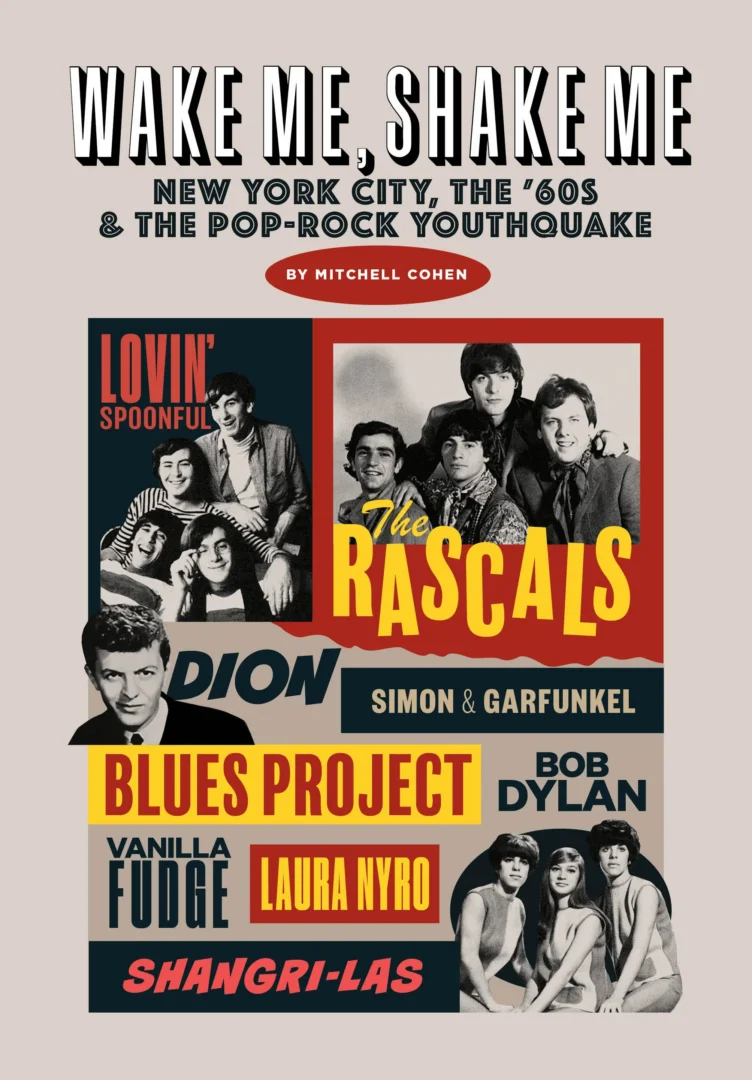
In his just published 2026 book, Wake Me, Shake Me: New York City, the ’60s & the Pop-Rock Youthquake, author Mitchell Cohen, states in the book’s official announcement, “charts the course from doo-wop to girl groups to folk music to R&B to folk-rock to baroque rock to goodtime music with some of the city’s leading stars: the Lovin’ Spoonful, the Rascals, the Blues Project, Vanilla Fudge, the Shangri-Las, Simon & Garfunkel, Laura Nyro, Bob Dylan, Bobby Darin and Dion.
“In the book,” the press release continues, “Cohen fleshes out the story with details about the songwriters, producers, record labels, TV shows and radio stars who all played roles in creating and popularizing the music. So, Carole King, Phil Spector, Morris Levy, Alan Freed, Clive Davis, Leiber and Stoller. Mitch Miller, Murray the K and many other colorful characters figure into it.”
Advance praise hailed the title.
“It was such an exciting time for music, and Mitchell brings it vividly to life.” — Clive Davis
“Mitchell Cohen connects the dots from the perspective of a true believer in rock and roll … Wake Me, Shake Me is music history told with much insight and detail.” —Dion DiMucci
“Cohen puts a decade of profound musical change into celebratory perspective…
“A bravura accomplishment.” — Lenny Kaye
Cohen, who lived in New York through all of this, brings passion, amusement and curiosity to his subject, making it a vibrant, entertaining, and illuminating tale, one best accompanied by a soundtrack of great ’60s music.
Cohen is the author of Looking for the Magic: New York City, the ’70s & the Rise of Arista Records (2022), the co-author of Matt Pinfield’s memoir, All These Things That I’ve Done, and, with Sal Maida, two volumes of The White Label Promo Preservation Society.”
In a September 2026 interview with Jeff Tamarkin for www.bestclassicbands.com, Cohen discussed his book.
“When I think of New York City pop, I think of the records Leiber and Stoller made with the Drifters: “There Goes My Baby,” “Save the Last Dance for Me,” “Up on the Roof,” “This Magic Moment.” Those records felt like the city, filled with romance and promise and heartbreak. The vocal groups were the real sound of New York City rock and roll; suppose you could point to Don Kirshner as an architect of ’60s New York City pop, along with George Goldner, Morris Levy, Ahmet Ertegun and Jerry Wexler.
“The center of the book was always going to be the Lovin’ Spoonful, the Rascals and the Blues Project.
“The Spoonful and the Rascals, obviously, had much more commercial success; at one point, in the 1965-1967 period when hit singles still really mattered, they were the most popular non-British groups in America, and deservedly so. They were as much fun as bands could possibly be. As [Rascal] Felix Cavaliere told me once, “If you were a certain age, we got you.” That was true of the Spoonful as well and, for those of us lucky enough to live in New York, the Blues Project. They were our shared secret, one of the first real “underground” groups, and they were explosive live. That’s why I called the book Wake Me, Shake Me.”
In 2010,I interviewed Felix Cavilere of the Rascals.
“Hearing the Beatles…To me it was ‘I could do this,’” volunteered Felix
“The first time I saw them early they were a band playing and singing live. They had not really done what they did with George Martin. I know they had great singers and the players are OK. But they were starting to write their own songs. They had great songs. I thought. ‘I can do this.’ And I wanted to get the best guys I could find. The best singers and musicians. And it worked. From inception to record deal was six months. That’s unheard of. Ahmet courted us. So did Phil Spector. Seriously, I wanted to produce the group. That was the goal. I didn’t want anybody to take hold of this.
“The good luck was that Atlantic out into the room these geniuses Arif Mardin and Tom Dowd. We opened Arif up to what he was capable of doing. The freedom was there. We had unlimited studio time. And our second record, ‘Good Lovin’’, was number one.
“Then, we cut “Ain’t Gonna Eat Out My Heart Anymore,” penned by Pam Sawyer and Laurie Burton.
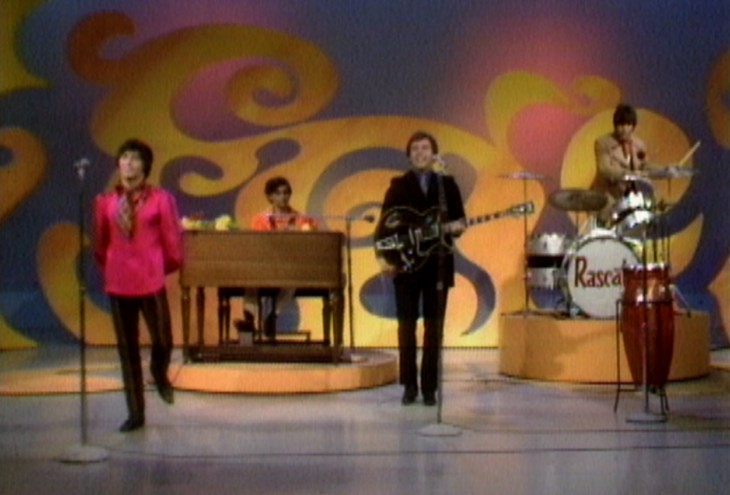
“The Hammond B-3… When I saw an organist playing and singing, he was doing bass, rhythm, lead, vocal. And I said, ‘this is really encompassing a whole part of the music spectrum.’ One of the beauties of the Hammond is that it sort of fills in the sonority area where the voices are. So, when you have singers and Hammond there is a blend. It really fills a room with this beautiful sound. That’s what turned me on. The overall orchestration of the instruments. The Rascals had studio bassists on the albums, jazz session men. Like the Doors who employed a bass player on their albums.
“I would write the song, the title and the chorus on every one of those songs. And Eddie [Brigati] and I were living together for a brief time on 79TH Street in New York City. We had a little piano there and I would play them for him and give him an idea what we were talking about. And I really genuinely felt that his verse lyrics were better than my verse lyrics. They were more colorful. I was a little bit more serious. I would get into the spirit or the politics of things.
“We had a tough time. ‘You Better Run’ and ‘Come On Up’ came out. And, thank God, this woman came into my life and we started with ‘I’ve Been Lonely To Long.’ And, with ‘I’ve Been Lonely Too Long’ and ‘Groovin’ at that point in my life I fell in love and I found a muse. It was just gaga land. I was gone. All of those love songs were about this one particular person. And it was so interesting and the culmination was ‘How Can I Be Sure.’ And then it was over. Things happen for a reason and the reason was to write those songs. That is what she was there for. The word muse is real. The stories were genuinely about being in love. There’s a certain divine thing that happens in every group. And Gene [Cornish] just fit. Initially he wasn’t funky, but he learned. Dino [Danelli] was a wild horse drummer.
“And between Arif and Tommy, they calmed it down. I didn’t have my recording chops together but Tom did. We overplayed, like all young kids and learned to chill. Atlantic Records. The thing was that it was not a corporate entity. The studios were open to anyone. Nobody to keep out. One day Otis Redding sticks his heads in and says, ‘My God! They are white.’ Which I loved. That was cool. At Atlantic studio, everyone was jealous of us because we had eight-track. Can you imagine that? This is where you put the genius of Tommy Dowd. Forget it. They just knew and had tricks they had developed on the four-tracks that we kind of inherited and learned.”
In late 1965, Tom Wilson signed the Blues Project to the MGM/Verve/Folkways subsidiary.
“August 1966: I turn 13 during my last summer as a camper at Moosehead (Casco, Maine),” evoked Dr. James Cushing.
“My group’s counselor John Kirby owns the Cafe Au Go Go LP and plays it on the battery-operated player in the tent… I fall in love with the songs — had I ever heard blues progressions before? — and the frisky force of Tommy Flanders’ voice and the Dylan-ish-ness of Al Kooper’s organ. When I return home in Westport, I buy the LP and put it into heavy rotation in my room.
“January 1967: The Cushings have moved to Encino. I start Harvard School for Boys, a high-class all-male Xtian military toilet where I have no friends and clearly do not belong. The school gives us a long weekend after President’s Day, with a half-day on Friday 2/24/67. My father picks me up from the school around noon that day and drives me to his office on 8701 Wilshire Boulevard. At one point, he puts a $5 bill in my hand and tells me to go have some fun.
“I find a nearby record store and trade my $5 for the 7” 45rpm single of ‘Strawberry Fields Forever’ b/w ‘Penny Lane’ and the 12” LP of Projections — and those two platters dominate my playlist for the whole month of March.
“Three cuts stand out: ‘Flute Thing,’ with Andy Kulberg on electric flute, was certainly my introduction to the idea of jazz improvisation, and it planted the seeds for my deep embrace of jazz five or so years later. ‘Two Trains Running,’ a/k/a ‘Still a Fool,’ ‘Catfish Blues,’ and a number of other titles, offers 11 stellar minutes of Danny Kalb’s unique guitar style, and the group’s use of space around the soloist is unusual for a rock band, although the Miles Davis Quintet was doing something similar that year. ‘Steve’s Song’ offers a take on the idea of neoclassical/rock fusion significantly different from what Paul McCartney and George Martin were doing with ‘Eleanor Rigby.’”
From Windows In The Village
ByMark Sebastian
Displayed with permission.
“Even going back to our world before Beatlemania, when I was 13 or so, my brother was generous about including me in some of his experiences, (as we used to call it,) “outside our door.” We lived within shouting distance of Macdougal Street, Bleecker Street and all the clubs where Folk & Blues artists, (whose records cluttered the corner of our living room,) performed. Also, Washington Square, on a Sunday, was rife with Bluegrass, Blues, every type of music.
“John had accompanied artists like Valentine Pringle, a Calypso/ Folk artist with a powerful voice, and Judy Collins before John joined the Even Dozen Jug Band. I was able to go to their rehearsals at one of the members’ apartment on Gramercy Park. Their music was very fun and I went to concerts they performed in a series Victoria Spivey ran and at other Village concert spots.
“John often would appear at our apartment on Washington Square, (he had decamped, by then, to a small apartment he shared with a onetime classmate at Blair Academy,) and would tell Mom “I’m taking Mark to the Village Gate to hear Lightnin’ Hopkins,” I also saw Mississippi John Hurt, who inspired the Lovin’ Spoonful’s name. I later would perform at the Gaslight Cafe, where many of these titan artists performed. Mom worked in management at Carnegie Hall, so she wasn't hard to sell on these plans, but they opened up a whole new world for me. I was learning to play songs on a beginner’s guitar from Izzy Young’s Folklore Center, and would occasionally write a teenage angst opus of my own. Top ten radio ruled the world inside my room, in my teens. It was all about what song you’d discovered and whether it was moving up on the New York chart. Of course, the Beatles were the big story on NY radio.
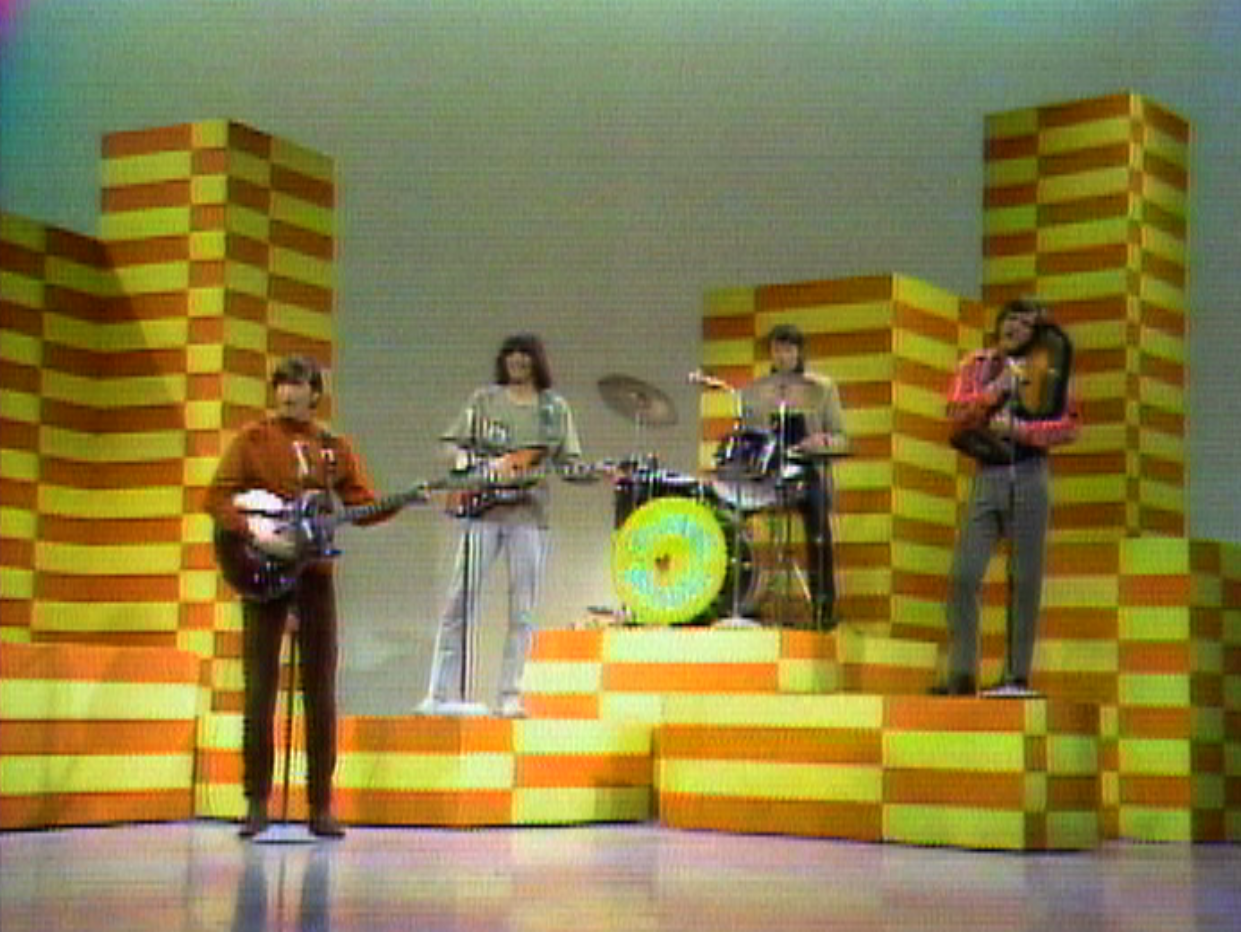
“Soon I was hearing a new band John had joined, the Lovin' Spoonful, at the Bizarre, the Night Owl, and once they got a hit on the radio, ‘Do You Believe In Magic,’ at local colleges. Most of the Folk bands had electrified and were playing Pop.
“Among the Spoonful members, there was a broadly comical guitarist, Zal Yanovsky, constantly in motion, a tall gangly sort of Country band looking bassist, Steve Boone, and Joe Butler, who seemed like the heartthrob in the band, like Paul McCartney was in the Fabs.
“Over time, my music evolved, I learned how to finger pick and developed a songbook of my novice efforts. I performed songs like “St. James Infirmary” in my Friends school's show and tell day. I also won a talent contest on the S.S. Constitution, when Mom and I crossed to Europe. One of the songs I wrote then was “Summer In The City.” It was about the miserable summer heat in the city, during a time when I usually had left for summer camp.
“I had felt most included when John let me attend a few of the sessions for the Spoonful’s Daydream album. I guess I imagined myself their mascot. I had been in recording studios with our dad and even attended a TV show on which dad performed, which included Lightnin' Hopkins and Joan Baez. I knew to be very quiet and not interrupt the process. That was Robert Herridge’s A Pattern Of Words And Music. Our dad performed brilliantly, so did Lightnin’. After that show, my brother attached himself to Lightnin’ and Lightnin’ even stayed at John’s apartment. I walked in the door one day to visit, and there was Lightnin’ Sam perfectly at home on the sofa.
“At a certain point, after the Lovin’ Spoonful’s Daydream album, John visited our apartment, while I was home from boarding school. Mom made a spectacular meal and John and I went back to what had been our room. We’d usually check out my progress on the guitar or just talk. I was often in trouble or being expelled from school.
“He’d occasionally listen to songs I was adding to my songbook. He said “I'm really being pressed for material and I’ve sort of run out of ideas.” Or something to that effect. The Lovin’ Spoonful machine needed grist for the mill and he confessed he wasn’t full of new ideas. He asked me “what was that song you played me about summer in the city?” So, I played it again for John and sent him back to his apartment on West 11th St. with a tape of it and two other songs. I had recorded them on a huge reel-to-reel machine. My memory is that the tape machine had been given to me by family friend, Jimmy Van Heusen, who had heard that I was writing songs.
“As the Spoonful was getting ready to record the album that would become Hums, John told me he’d written another part onto my song. Steve Boone had also added, in the middle, a short, nervous, instrumental section.
“I was congratulated by their manager, Bob Cavallo, who had heard it. Cavallo appropriately means ‘horse’ in Italian. Bob was the band’s proponent and vehicle to success. He had run a club in Washington, DC and managed the Mugwumps, a band John was (briefly) in with John Phillips, Cass Elliott, and Zal Yanovsky. Bob saw the potential in the talents that broke off to become the Lovin' Spoonful and the Mamas and the Papas.
“Months later, the Spoonful were preparing to record Hums, John told me to come by the studio while they were recording our song.
“I went to the session at Columbia Studios and heard the final mix sessions for “Summer In The City.” It sounded huge and totally different in character from my original song. The ending now had an apocalyptic crash, like the world ending. Zal created it by kicking or dropping his amp. This was then added to by using the famous Columbia Studio’s stairwell echo, later heard on Simon & Garfunkel’s ‘The Boxer.’ Roy Hallee engineered that, too. That ending was later scrapped.
“Bob had me into his office and said ‘You know your song came out really well, and it’s sounding like it could be the single!’ I was stunned, since I wasn’t sure it was even going to make the album. The Spoonful’s previous hits like “Daydream,” "Do You Believe in Magic,” Did You Ever Have to Make Up Your Mind” and “You Didn’t Have To Be So Nice” served as perfect entrees for our song and the NY DJ’s gave it lots of plays, since it was from a NY band.
‘“Summer In The City’ has gone on to become one of Pop music's most recorded, most popular summer songs. It's still on the radio around the world, and we just celebrated its 60th anniversary of being #1 for three weeks in a row, on our home town’s top 100.”
“The Fugs were the first ‘rock group’ led by a poet (Patti Smith came later) and I think the idea of them was stronger than their actuality,” described Dr. James Cushing.
“I've heard the ESP-Disk albums -- short, badly recorded, amateurishly played and sung, yet not without an innocent, aspirational charm. The Warner Brothers albums (Tenderness Junction / It Crawled Into My Hand, Honest / Golden Filth) work best as souvenirs of a cultural period when it seemed that anything could happen. For me, Sanders' book-length history-poem ‘1968’ epitomizes the period and gives a substantial taste of what the Fugs were really about: bringing the counterculture to middle America. They were like the Monkees only with explicit sex.”
In his interview with Jeff Tamarkin on www.bestclassicbands.com, Cohen cited the Velvet Underground and the Fugs.
“As I say in the introduction, there are more books about the Velvet Underground than there are Velvet Underground albums. I mean, all of my friends and I bought the banana album, and huddled over it, trying to decode it, but I can’t say it really spoke to us at the time. We preferred the Fugs, to be honest, and went to see them often. They were funnier.”
The Velvet Underground & Nico was primarily recorded in New York City at Scepter Studios during April 1966. Some songs were recorded at TTG Studios in Hollywood with Tom Wilson producing. The LP was issued by Verve Records in March of 1967.
“Lou and his crew created records that hold up, they are sitting on your shelf like a murder of crows on a fence, silently judging you behind those dark sunglasses, daring you to put on ‘Run Run Run’ or ‘Heroin’ again,” emailed Greg Franco, bandleader of Rough Church and Man’s Body.
“I’m an LA guy so I already had my high priest in Jim Morrison, but now Lou elbows past him, like almost shoving a knife in his side. Jim’s still has a hippie you know, vulnerability, ‘Love Street,’ ‘Touch Me,” but Lou is here with his tribal beats, tambourines, messy violins, feedback, and you notice? no cymbals either, seems like he hated cymbals. No complex beats, just earthquake rumblings. Mo is the sound man.
“No Jazz in his mix, an odd atonal piano played by dogs or monkeys, or John Cale. Some fancy German chanteuse who barely knows the language, Nico really? ‘Femme Fatale,’ ‘Heroin,’ ‘European Son.’
“And to add insult to injury this West Coast hating black clad tribe records at TTG in Hollywood, like a finger in your eye, just to show us that our sun and surf have zero effect.
“The most intense life-lasting songs, and lovely ones, ever created on the 1st album, yes Peel Slowly and See! We all are hypnotized by the Velvet Underground. I cannot understand anyone who encounters them and is not changed.”
In her essay, East Coast music in the mid-60s from a West Coast teenage P.O.V., photojournalist Heather Harris reflected on the influential and still impactful sounds that emanated from New York and Southern California.
“Here on the West Coast, we were emergent music enthusiasts despite our tender pre-teen/teen ages and wanting to know everything, ignited by Beatles, Dylan, and in my case an older brother who brought me all manner of East Coast niceties like Phil Ochs, Laura Nyro or Judy Collins who sponsored then sang so many then unknown but outstanding songwriters like Sandy Denny, Richard and Mimi Farina and Joni Mitchell.
“Otherwise, we appreciated the jollity of Lovin' Spoonful until those nasty rumors of cooperation with the fuzz following a weed bust at a party out here with our Buffalo Springfield. Were they true? Google away and try to avoid the A.I. pitfalls. Other brouhaha- only recently did I discover that Zal Yanovsky of the Spoonful probably was the guilty party who destroyed Brian Jones' sitar at Tara Browne's birthday party in Ireland, where the popular but ultimately doomed hip young Guinness heir had hired the Spoonful to play his 21st Birthday bash in 1966. Zal allegedly went nuts jamming with the Rolling Stone's sitar.
“Access to our Sunset Strip scene clubs eventually did train us to appreciate virtuosity way beyond the radio hits, just as the Village incubated same in our East Coast teen equivalents. Yes, we loved Mike Bloomfield's guitar artistry in ‘East-West’ by the Paul Butterfield Blues Band, the title song stretching 13 minutes, and the Blues Project's ‘Projections’ which included the 6-minute ‘Flute Thing.’ You would see these two albums in the record collections of every single music fan you knew. An additional factor was old school technical: one could play these records and then mess around (be romantic and/or partake of illegal drugs) in your favorite friends' bedrooms during these long tracks without interruption to change the record. Summarily, ‘The End’ by the Doors satisfied this function for West Coast music afficiandos. And you thought we loved these bands solely for their musicianship!”
(Harvey Kubernik is the author of 21 books, including 2009’s Canyon Of Dreams: The Magic And The Music Of Laurel Canyon, 2014’s Turn Up The Radio! Rock, Pop and Roll In Los Angeles 1956-1972, 2015's Every Body Knows: Leonard Cohen, 2016's Heart of Gold Neil Young and 2017's 1967: A Complete Rock Music History of the Summer of Love.
Sterling/Barnes and Noble in 2018 published Harvey and Kenneth Kubernik’s The Story Of The Band: From Big Pink To The Last Waltz. In 2021 they wrote Jimi Hendrix: Voodoo Child for Sterling/Barnes and Noble.
Otherworld Cottage Industries in 2020 published Harvey’s Docs That Rock, Music That Matters. His Screen Gems: (Pop Music Documentaries and Rock ‘n’ Roll TV Scenes) was published in 2026 by BearManor Media. Kubernik is currently working on a Beatles book scheduled for fall 2027 publication.
Harvey wrote the liner notes to CD re-releases of Carole King’s Tapestry, The Essential Carole King, Allen Ginsberg’s Kaddish, Elvis Presley The ’68 Comeback Special, The Ramones’ End of the Century and Big Brother & the Holding Company Captured Live at The Monterey International Pop Festival.
Harvey spoke at the special hearings in 2006 initiated by the Library of Congress held in Hollywood, California, discussing archiving practices and audiotape preservation.
In 2017, he appeared at the Rock & Roll Hall of Fame in Cleveland, Ohio, in its Distinguished Speakers Series and as a panelist discussing the forty-fifth anniversary of The Last Waltz at the Grammy Museum in Los Angeles in 2023.)
Photos courtesy of SOFA Entertainment, LLC.