Harvey Kubernik and John Densmore Interview (2008)
Q: Ray Manzarek, is the former Screamin Ray Daniels before the Doors were formed.
A: Ray had a previous relationship with World Pacific Records in 1965 when he was on the label with Rick and the Ravens and recorded for Dick Bock who owned the label, and released Ravi Shankar albums in the U.S. We got a couple hours of free studio time at World Pacific recording studios, and that’s when we got to make a demo in 1965.
I went to Dick Bock’s house in Laurel Canyon. I’m listening to Ravi Shankar records on his label when I’m doing meditation. And then Dick Bock owes me a little time in the studio, so me, Jim and Ray make this little acetate at the World Pacific studio. It’s not lost on me when I walk in and there are tablas on the wall. I was scared. Dick Bock was incredibly generous, wore glasses.
On the way into the studio Ravi Shankar is leaving with Alla Rakha, my idol, who I didn’t know was going to be my idol yet, was on the way out with these little tabla drums, which I soon find out by studying at the Kinnara School, are the most sophisticated drums in the world. I’m in awe of them. It’s the East! And, I’m just a surfer. Not literally, but from West Los Angeles.
The very first TM class was with Clint Eastwood and Paul Horn the year before me. Paul later was in India with the Beatles. Dick was in TM before us with Clint Eastwood and Paul Horn. Robby Krieger and I went to Ravi Shankar’s School of Indian Music in between later Doors’ tours
Q: Jim Morrison’s voice during 1967-1969.
A: Jim had an astounding baritone. Un-schooled. Never got nodes like Grace Slick and had to have surgery. God, if you don’t have that bottom… It was luck. It was fate. He never sang before I saw him in the garage. It was kinda squeaky in the early days. He just was afraid to open up. How audacious. “OK. I’ve never sung and I’m gonna be the lead singer of a rock band.”
Q: Did you ever feel the Doors on stage had some sort of psychic, visual and musical advantage over a lot of other bands of the time period because you were three instruments around a lead singer.
Plus, the fact in live performance you didn’t have a bass player. I saw the Doors at the Forum in Inglewood on December 14, 1968. With strings and horns on stage.
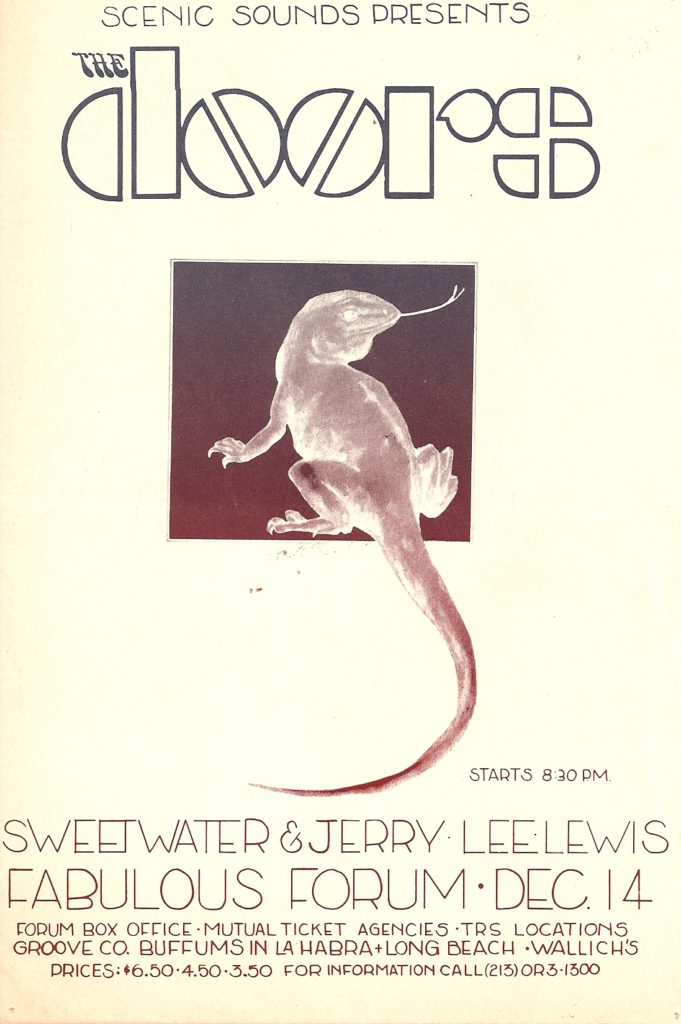
Courtesy of Kirk Silsbee
A: The Doors started the thing of wanting and having fifties rock and rollers on our shows. For the Forum we got to choose the second act and initially we suggested Johnny Cash, but the promoter said no because he was a felon. We then secured Jerry Lee Lewis because he was “acceptable.”
I had to work harder on the tempo because Ray’s left hand was the bass. And when he took a solo he’d get excited and speed up. “Hold it back. Hold it back.” But, without a separate guy doing bass line runs and grooves there are holes. “OK. I’m going in.” Sometimes I didn’t do anything. That was my territory between the beats.
During band rehearsals or just before we recorded, mainly I heard Jim’s words live and by himself in the garage, or Ray would hand me a slip of paper and they were pulsating rhythms of words. Because Jim was a poet they were edited. Like, “Break On Through” was so percussive. When we were recording and locked in, I was in it. We were just so in it. We were lost. Playing live there were big sections on “The End” or “When The Music’s Over” when we would vamp, and Jim would throw in anything. And then, “Oh yeah? I’ll throw that back at you. Check this out.”
Q: What about recording studios like Sunset Sound and Elektra?
A: Sunset Sound had a real echo chamber like the famous echo chamber at Capitol and it had a pocket that was fat. Just a warm fat echo chamber. You can’t buy that kind of shit.
First of all when I went into Sunset Sound in the very beginning I had no clue what a good drum sound was. And I couldn’t believe you had to change the sound and kind of muffle it which Rothchild taught me.
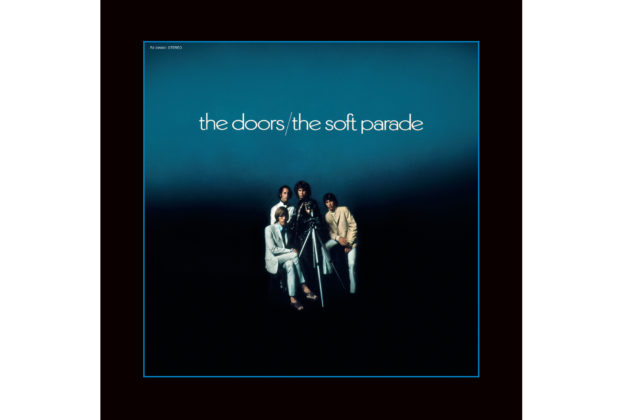
I loved Paul Rothchild but he got so perfectionist. He was tough but taught us so much. And mid-period, Waiting For The Sun and The Soft Parade, he had me doing a s drum sound to tap on each drum and I’d have to do it for a fuckin’ hour. And I was exhausted. We did a 100 takes for ‘The Unknown Soldier.’
Elektra was a good studio. My thing was that I taped my wallet to my snare drum. And then we’d go to eat and I’d leave my wallet and I didn’t have to pay for drinks. (laughs). Not on purpose. Like in the 1950’s drummers used to do that before mufflers.
Q: But, when your first album was high on the charts that Summer of Love, and all through your Doors’ career, where did you learn to be both a support and lead musician?
A: I saw (drummer) Roy Haynes earlier this year. He’s 80, and he’s fuckin’ stronger than me at my peak. And, I said, “Roy. I know your secret. And, I’m into it too. Dynamics.” It pulls people in. It’s human. Very loud and very soft. Rather than one level. I didn’t know that. I just heard it. I saw Coltrane. Roy Haynes told me that he sat in with the Allman Brothers at Carnegie Hall.
When I wrote my autobiography, (Riders On The Storm: My Life With Jim Morrison And The Doors), I took it to Elvin. My hands were shaking. I mean, he’s a jazz guy and I’m a rocker. I gave it to him, and inscribed, “Elvin, you gave me my hands.” He was so sweet and flattered. By the end of his life I’m carrying his cymbals to the car at the Jazz Bakery. That’s called mentorship.
I noticed with Elvin Jones and John Coltrane there was communication. So, I thought, “I’m gonna keep the beat. That’s our job as drummers. But, I’m gonna try and talk to Jim during the music.” Like, “When the Music’s Over.” “What have they done to the earth….” That’s Elvin. I knew I wasn’t playing jazz.
I saw Chico Hamilton at the Light House. There was this ride cymbal riff that Chico did on a song. Really the ride cymbal on ‘The End’ once I get to the kit and I’m playing the tambourine. It’s the Chico Hamilton. That’s where it came from. Chico was direct. ‘Oh that kind of cool cymbal riff I think would fit in that song’ I was thinking to myself. Like, going into the bridge on ‘Wild Child,’ that’s the press roll from Art Blakeley. That was direct. Pacific Jazz and World Pacific Records.
I went to Professional Drum Shop and they had used cymbals. ‘What’s this cracked piece of shit?’ ‘Oh…That’s Jimmy Cobb’s old cymbal.’ ‘Oh! I’ll take it.’ I like used old stuff that had personality. I never played my drum heads. I played real thin jazz sticks and broke them all the fuckin’ time and had to have a pile of them to grab in the middle of a song. But, you can play fast with those little fuckers, you know. And you know, and I always used to make fun of heavy metal drummers using tree trunks. You can’t get around the kit as subtle and fast with these heavy clump things.
Q: Yet, I know what kind of historic influence the Doors have had on culture and contemporary bands, let alone kick starting Acid Rock and later Goth. But your work with the band in the Summer of Love gigs and your first three seminal albums also reminded me that the bands Cream, the Rolling Stones, and Jimi Hendrix Experience all had fellow jazz drummers playing rock ‘n’ roll.
A: That’s right. That’s good. I forget you’re a drummer. Ginger Baker. Cream’s “Sunshine Of Your Love” was out and we’re in the studio, trying to play “Hello, I Love You,’ and we’re in the studio, and Robby says, “Why don’t you try and do that Cream beat where Baker sort of turns it around.” And I did. Two bars of Ginger Baker is in “Hello, I Love You.” (laughs). Ginger was in a trio with a lot of poly rhythm shit goin’ on. Like Elvin. Charlie Watts’s feel. He had the pocket. He got it from hearing all those jazz guys like Stan Levey and Chico Hamilton. I saw Chico at the Lighthouse and stole one of his cymbal things that I used in “The End.” Mitch Mitchell’s hands are really fast. More than Keith Moon. And, Mitch is fluid as hell. I actually did “Little Wing” on a Native American recording and did an instrumental version on a hand drum and still did Mitch’s fills. A little tip of the hat.
Q: What did the 1967 Summer of Love achieve?
A: 1967, we were naïve, but felt, “we’re changing the world.” Their were long hairs in every city, not in the Midwest so much, and thought we were taking over. And, actually, it was just seeds being planted which are blooming and will bloom a hundred years from now. Civil rights, feminism, peace movement, ecology, Native American rights, all that was planted. I remember poet Gary Snyder on a cable TV show, and they were trying to pin him down, “You’re an ecological poet. You must be very depressed by the way the ecology environment is going and beaten up.” He replied, “I’m not gonna buy that. Maybe it will be 200 years before big blooms come out from the seeds.”
Q: And the influence of your band and Summer of Love still informs the music created today beyond everyone going out to buy your 1967 Ludwig model drum set with 7A sticks.
A: It seems to. I sorta hoped it would last ten years. It must be the drums, I guess. (laughs). 7A. No nylon tips, either. You gotta have the wood sound. Rivets on the cymbals. I got that from Oscar Peterson. Hearing jazz I first started with Dave Brubeck. Then I saw Les McCann, blues and funk, Miles (Davis) and John Coltrane. At Valley State College one of the ethnological music instructors was Fred Katz, who was the cello player for the Chico Hamilton jazz quintet.
Q: Another thing about the Summer of Love, meditation started becoming more evident in popular culture and the media, but earlier in 1965, you and Robby met Ray Manczarek when you two went to the Maharishi Mahesh Yogi’s Transcendental Meditation Center in Los Angeles. You dudes were way early on this trip.
A: It’s good for you to bring that in. TM was definitely Summer of Love. For some damn reason in 1965…Well, Robby and I went because LSD was legal and we were quite interested in our nervous systems, and knew we had to do this TM thing slowly. We go over there and I meet this little guy, Maharishi, and the “Love Vibe” is very palpable. This is 30 people in a room. Then, a year or two later, I read that the Beatles are onto TM and our little secret is being spread worldwide. Great. I still meditate.
The whole Eastern Indian thing, Ravi Shankar, via George Harrison and the Beatles saturated everything with paisley bedspreads sound wise. “The End” was a raga tune. Robby and I went to Ravi Shankar’s Kinnara School of Indian Music. When you’re students at the Kinnara School of Music, you get to sit on stage with the master at UCLA’s Royce Hall.
Later Robby and I go see Ravi play at the Hollywood Bowl, and George is on stage. Ravi didn’t teach at the school, but he’d drop in and give a little lecture on “Sublimating Your Sexual Drive Into Your Instrument.” Harrison was doing it in England. Later, George Harrison came to one of our recording sessions for Soft Parade. You hear the Indian thing in techno stuff now. That came in and it was deep and it’s still around. We need the East.
We weren’t in competition with the Beatles. When I think competition, it’s sonic competition. Lennon and McCartney then were more semi-traditional songwriters, and we were West Coast Acid heads. But sonically, we were challenged, and started to do backward piano tracks. “The recording studio is the 5th Door. Let’s experiment.” That’s what Sgt. Pepper’s did. We didn’t try and copy Lennon and McCartney.
Harvey Kubernik is the author of 15 books, including titles on Leonard Cohen and Neil Young. His 2017 volume, the acclaimed 1967 A Complete Rock History of the Summer of Love was published by Sterling/Barnes and Noble. His Inside Cave Hollywood: The Harvey Kubernik Music InnerViews and InterViews Collection, Vol. 1 was published in December 2017, by Cave Hollywood. Kubernik’s The Doors Summer’s Gone was published by Other Cottage Industries in March 2018.
The Doors: Summer's Gone has been nominated for the 2019 Association for Recorded Sound Collections Awards for Excellence in Historical Recorded Sound Research.
In November 2018, Sterling/Barnes and Noble published Kubernik’s book, The Story of The Band From Pig Pink to The Last Waltz, written with his brother Kenneth Kubernik.
Harvey Kubernik’s 1995 interview, Berry Gordy: A Conversation With Mr. Motown is included in The Pop, Rock & Soul Reader edited by David Brackett to be published in 2019 by Oxford University Press.
This century Kubernik penned the liner note booklets to the CD re-releases of Carole King’s Tapestry, Allen Ginsberg’s Kaddish, Elvis Presley The ’68 Comeback Special and The Ramones’ End of the Century.
In November 2006, Harvey Kubernik was a featured speaker discussing audiotape preservation and archiving at special hearings called by The Library of Congress and held in Hollywood, California.