Harvey Kubernik and Ray Manzarek Interview (2010)
Q: You recorded as Screamin’ Ray Daniels in 1965 before the Doors happened.
A: I had been in a fabulous recording studio before at World Pacific on 3rd Street in L.A. with Rock and The Ravens for Dick Bock. And that’s where we cut The Doors’ demo, along with some Rick and The Ravens songs.
Q: Then the Doors emerge with producer Paul Rothchild and engineer Bruce Botnick.
A: Rothchild and Botnick are Door number 5 and Door number 6. There’s four Doors in the band and two Doors in the control room. So, they were always there, always twisting the knobs and really on top of it. A couple of high IQ very intelligent guys. We couldn’t have done it without them.
“Rothchild and Botnick were two alchemists with sound. We were the alchemical music makers but they were alchemists with sound-adding a bit of this-a bit of that. Some reverb. Some high end. Let’s hit it at 20k or 10k. Let’s dial in a bit of bass in there. They were making this evil witches brew concoction as we went along. And the sound just got better and better.
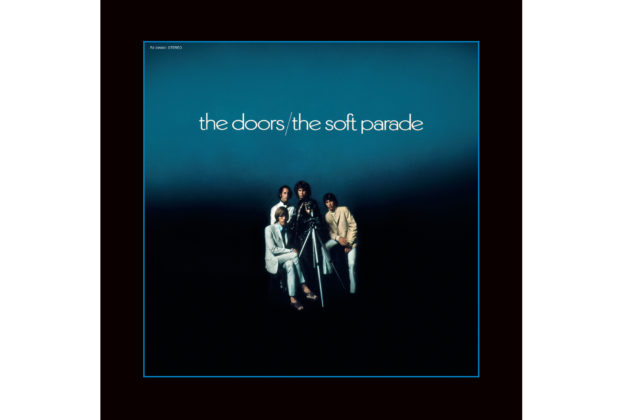
Q: The Soft Parade. Was there a pre-production meeting where everyone voted to include the use of strings and horns on the album?
A: We had made three albums with the same formation and at some point or another when you make albums you want to do an album with expanded sound. So you want to have some horns and strings. My God, everybody did it. And we were gonna do it too. I want some strings. I want some jazz arrangements. I want some classical arrangements. And everyone said yes. Great idea. And a record label that said it was fine. What was great about the record label was that Jac Holzman said, ‘Boys, do whatever You want. Just don’t use the seven illegal words.’ George Carlin’s seven forbidden words. Other than that, anything goes. Whatever you want to do. And Paul Rothchild encouraged it.
Q: You used the Elektra Studios as well.
A: We have left Sunset Sound. The first two there and the Third at TT& G. on Sunset and Highland in Hollywood. We then went into Elektra’s new place. Fabulous. It was all wooden. Brand new state of the art facility. A great recording studio and they had a great funky organ in there. Gnarly organ.
Q: George Harrison dropped by one of your Soft Parade sessions. He was visiting the Elektra studios. He mentioned all the musicians at your date reminded him of The Beatles’ Sgt. Peppers because of the orchestra booked.
A: Yes. A Beatle in the room. A very charming guy. Very low key. And I’m surprised John Densmore didn’t become good friends with him.
Q: And, once again, the Morrison vocals are potent, distinctive and his voice more confident than ever.
A: He’s no longer a blues singer. He’s added Frank Sinatra crooning to his voice and did an absolutely brilliant job. Terrific. Girls loved it. ‘Touch Me’ a number one song.
Q: You also had individual writing credits for the first time on the album sleeve.
A: That’s a great story. Because of ‘Touch Me.’ The song was initially called ‘Hit Me,’ and Jim is gonna say hit me. It’s ‘Hit Me’ like in poker. And Jim said, ‘No it’s not like poker. It’s like someone is gonna walk up to me and are gonna hit me. You gotta change the line.’ ‘To what?’ ‘Touch Me.’ Beautiful. And along with that ballad part he sings in ‘Tell All The People’ the line with ‘Get your guns…Follow me down.’
“Morrison, a military boy said, ‘I am not going to say that.’ And Robby replied, ‘that’s the way I wrote it and you can’t change it.’ Robby was going to stand up to Jim at that point. And Jim said, ‘I am not going to do it.’
“And Robby said, ‘well that’s the song.’ And Jim said, ‘We’re gonna have to say that you wrote this song.’ And Robby said, ‘OK. Fine with me.’ And that lasted for one or two more albums.
Q: Guitarist Robby Krieger was another kind of songwriter. He penned a lot of the popular radio hits and chart singles. “Love Me Two Times,” “Spanish Caravan,” the lyrics to “Tell All The People,” “Touch Me,” “Runnin’ Blue,” “Love Her Madly,” and co-wrote “Peace Frog” and “Light My Fire” with Morrison.
A: Robby was a different sort of lyric writer. You know, Robby might be the secret weapon of the Doors, we get this great guitar player who plays bottleneck, and all of a sudden he comes in and plays ‘Light My Fire,’ the first song he ever co-wrote with Jim. And then Robby wrote ‘Love Me, Two Times,’ ‘Love Her Madly.’ ‘Touch Me.’ Lots of Doors’ hit singles. Another guy with a high IQ.
Q: On The Soft Parade you had Harvey Brooks as well as Doug Lubahn on bass, saxophonist Curtis Amy and George Bohanan the trombonist.
A: Wasn’t that great. Curtis Amy, who was married to Merry Clayton. Curtis was a big nationally known jazz horn player who lived in Los Angeles. He takes he solo on ‘Touch Me.’ It might have been the first time a real jazz saxophone solo went to number one on pop charts. And, we brought the strings and horn players to some shows and TV appearances. It was a great deal of fun for me to bring them on stage.
“It didn’t work for a lot of the critics and teenagers. ‘We’re not coming to see you guys expand.’ We want to see ‘Light My Fire.’ Four Doors. The sexy lead singer. You play the songs. No horns. No strings. No jazz soloing.’ Well, you’re gonna get it anyway. Like, at the Forum show you get Jerry Lee Lewis, Lonnie Mack, Sweetwater and a Chinese Pipa player, too.
Q: And by The Soft Parade Jim Morrison started to indulge and really drink.
A: Jimbo came out. They call it the demon rum. There’s a demon in the bottle. And there’s a demon in that white powder, too. A demon on the blade. You know what those things do? They open the trap door of the subconscious and allow some creature to come out. And the alcohol for Jim, a genetic pre-disposition famial pre-disposition to alcohol, something came out, man. Some kind of combination. He went from being the poet to a shooter. Shooter Morrison. I was flabbergasted.
“We started experimenting in the studio. I wouldn’t allow anything to get out of the recording studio without my approval. If I didn’t think it was right it did not go on a record. Nothing happened without my OK. We did some composite vocals. You do what you have to do. If Jim sings one line great. Fine. Then let’s get the next line. Let’s get the words, man. Whatever it takes to get the best possible performance. While you can see that Jim Morrison is undergoing a transformation. Right before our very eyes. And I hoped that this transformation was short lived. But it wasn’t. ‘This can’t last. This is not Jim.’
‘The Soft Parade’ song is an unusual piece of music. It’s a suite, you know. A suite of tunes all put together. Which is what it was.
Q: You heard and recorded Jim Morrison’s lyrics to “When The Music’s Over,” late 1967. This is a timeline pre-Earth Day that began in 1970. Those lyrics are detailing ecological concerns and environmental chaos. Psychological territory away from ‘The End’ song. You and the band are the new soundtrack to global warming and the continual destruction of our planet. It’s akin to poet Gary Snyder and his writings and prose on nature.
A: Sure, absolutely man. But don’t forget that’s late 1967, and the potheads were aware. That’s what was so great about marijuana opening the doors of perception along of course with LSD. Marijuana makes you aware that you are on a planet.
It’s God’s good green earth and you’ve got to take care of God’s good clean earth. The pot heads were the first mass ecological movement. And I hope they continue on and continue it into future because it’s our obligation to save the planet.
Q: In 1963, you were in the U.S. Army stationed at a Southeast Asia military base in Korat, Thailand. It was there where you tried marijuana for the first time.
A: The first time I smoked pot was back in Thailand. When I was in the Army we lived in these little quanset huts. These little shacks. There was an air base that we were connected with. You would have little house boys from the nearby village in Korat who would shine your shoes, take care of your clothes for you, help clean the barracks. You would pay them a couple a bucks a months and they were more than happy. One day, I asked one of the boys, maybe age 12 or 13, ‘Can you get me ganja?’ And the kid just froze for a second. ‘You smoke ganja?’ ‘Yes. I would like some ganja.’
“What happened was that earlier I had gotten a joint from one of my black brothers. So I said, ‘I will trade you cigarettes for marijuana.’ I exchanged a carton of American cigarettes that cost me around two dollars on the PX base and he brought me some Thai sticks stuffed into a can of Saltine crackers. To him that was like the greatest deal he could have ever imagined. The pot cost him nothing, he cut it off at the bottom of a stalk and put into a foot long can with a lid on it. I swear. You open the can and there is this folded over stalk of marijuana. Now he would normally buy one of those cartons from one of the GI’s for four dollars. I got it for him at two dollars. And he would take that thing and sell it and make like eight to ten dollars on a carton.
“It was a Saturday night. Nothing to do, so we decided to smoke this stuff. I had a couple of hits and came on. The first trip was when I realized what the word stoned was. I could not move. I sat there and looked into outer space stoned out of my mind. It wasn’t a giggling thing. It was a profound awakening. ‘Oh my God.’ And every five minutes I would have to stick my tongue back into my mouth. Little by little. Sort of choking and realizing my tongue was all the way out of my mouth and I had to push it back in. I was sitting there like a moron, stoned and just in a complete state of absolute joy. Not giggly or silly. Just amazed at the profundity of being alive on planet earth. This went on for four hours while we drank some Cokes and ate pound cake from a nearby snack stand.
Q: And your UCLA college friend Jim Morrison excelled in the art of rolling a joint with one hand. He admitted to you, “Ray, it’s one of my God-given talents.”
A: Morrison could roll a joint in a single sheet of paper like a thin cigarette with one hand. Cowboys could roll with one hand. Watch a cowboy movie and you see these guys pouring out tobacco out of a little pouch. You lick it, you hold it in one hand and you kind of roll it up with one hand. How you do it I have no idea. I could not do it with four hands let alone one. I needed a pipe.
Q: It seems The Doors smoked pot and indulged in some THC for spiritual, meditative and medicinal reasons.
A: The purpose of smoking the green intoxicant is enhanced experience. Usually an aural one. That’s what you would have.
Q: Once again, some warnings about the environment are inherent in the lyrics. ‘Not To Touch The Earth.”
A: Sure. Yes. Ecology was very, very big. We were all trying to save the planet. The sun was the energy. The supreme energy.
“The establishment, as we called it, the squares, as they were called in the fifties, the establishment as they were called in the sixties, were trying to stop drug use, the smoking of marijuana, were trying to stop any kind of organic fertilizer. The word organic to them meant hippie, radical pot heads and people who wanted to leave behind the organized religions and start some new tribal religion based on American Indian folklore. That’s indeed what we were. We called ourselves the new tribe. By the third album, Waiting For The Sun, Paul Rothchild was becoming a real Laurel Canyon connoisseur of veteran potent stuff that was being crossbred by the Northern California growers. All those guys up in Humbolt County.
For recording sessions, Rothchild had two types of marijuana: Work dope and also playback dope, which was a little stronger for listening later. One of the benefits of being a known rock ‘n’ roll band.
Q: You have seen some changes in legislation and law enforcement around marijuana over the last couple of decades.
A: I didn’t grow up with reefer madness and paranoia. I was a musician. I initially knew it from guys who were jazz musicians and smoked it. Then, all of a sudden, it makes its appearance in the world of the Sixties, you know. ‘Holy cow! It’s like everyone is smoking a joint now. It’s like no big deal at all. A common occurrence. It’s God’s good green earth that grows on God’s good clean planet. And it’s a mild intoxicant. A slight hallucinagenic. It’s not LSD or peyote or mushrooms. It’s got a little bit of consciousness expansion. And I think it’s virtually harmless. And it makes for a much more tranquil benign society. Without people being at each other’s throats as they are with alcohol. Marijuana is just a relaxant that enhances reality. Now what on earth is wrong with that? Why is it illegal? I have no idea why it is illegal. To this day I still don’t know. I’m all in favor of a de-criminalization.
I mean, I’d legalize it. But I think you can’t go that far all at once. You just decriminalize it. And the pot clubs I think are terrific. A great idea. Medical marijuana is a great idea. I’m all for it.
Q: I always viewed Jim Morrison as a poet.
A: I knew Jim was a great poet. There’s no doubt about that. See that’s why we put the band together in the first place. It was going to be poetry together with rock ‘n’ roll. Not like poetry and jazz. Or like it, it was poetry and jazz from the ‘50s, except we were doing poetry and rock ‘n’ roll. And our version of rock ‘n’ roll was whatever you could bring to the table. Robby bring your Flamenco guitar, Robby bring that bottle neck guitar, bring that sitar tuning. John bring your marching drums and your snares and your four on the floor. Ray bring your classical training and your blues training and your jazz training. Jim bring your Southern gothic poetry, your Arthur Rimbaud poetry. It all works in rock ‘n’ roll. So Jim was a magnificent poet. I loved his poetry. The fact that he was doing ecological poetry. ‘What have they done to the earth?’
Q: Again, like in the entire Doors’ studio journey, Rothchild and Botnick on The Soft Parade took the whole trip into a new sonic world.
A: Absolutely. We knew each other. We were friends. We would hang out together. We would get high together and go to each other’s houses and hang out.
Q: You know, as a kid, I would see some of the Doors in Los Angeles eating at Norm’s Restaurant on La Cienega Blvd. right next to the Elektra Studios. It was near our Fairfax High School. Even then I sort of knew you guys were recording and didn’t bother you at a table or the counter. My Aquarius mother Hilda said something like, ‘Let them eat they’re on the clock.’ I didn’t quite know then what she meant. At the time she was working for The Monkees and Raybert Productions at Columbia Pictures movie studio.
A: Absolutely. It was work. We didn’t fool around. I was not able to duck out of Sunset Sound, or TT&G or later at Electra to see bands or local jazz at Shelley’s Manne-Hole. No! We were working. We’re recording. The clock is ticking. This is your job. Your job starts at 2:00 p.m. in the afternoon and goes to 11:00 at night, 12 or one o’clock in the morning. You go home. You got to bed. You get up the next day. Maybe at 11:00 a.m. have a leisurely breakfast, take care of a couple of things and go back to the recording studio. Because guess what, Harvey, the recording studio is the only place you wanted to be. I didn’t want to see anybody. I didn’t want to go to a film or a jazz club. I wanted to make records. Right then and right there. With Jim Morrison, Robby Krieger, John Densmore, Paul Rothchild, Bruce Botnick and Doug Lubahn. Great bass player.
Q: Though several bassists auditioned for the group, none could match the bass lines you provided by your left hand employing a Fender Rhodes keyboard bass instrument. Left hand bass, and your right hand you were not doing chords but comping on the organ or piano.
I always felt that was one of the main attractions about the sound of the Doors and the dynamic of the Doors sonically. And not having another physical fifth person on stage as bassist as you held down two instruments…although you had a bass player on some recording dates.
A: First of all, the left hand created that hypnotic Doors’ sound. For instance, during the ‘Light My Fire’ solo section, it’s an A-minor triad to a b-minor triad that just repeats like (John) Coltrane’s ‘My Favorite Things.’ The same sorta modal chord structure that Coltrane used in ‘My Favorite Things.’ Left-handed I’m playing the same thing over and over. The right hand is just playing filigrees, comping behind Robby Krieger, punctuating with chords, punctuating with single notes playing with Robby Krieger. When I’m soloing I’m playing anything I want to play. And that bass line just keeps on going. It never varies and it never stops. Over and over like tribal drumming or Howlin’ Wolf playing one of his songs without any chord changes. On and on and on. The same pattern. Now, if I were to have added a live bass player to play that the guy after about 2 or 3 minutes playing the same two triad…I’ve had guys say to me, ‘I can’t do this Ray…’
“The same three notes over and over. And off he goes, man. So I think the secret to the Doors hypnotic sound comes out of the left hand keyboard bass. Meanwhile the right-hand thinks its Johann Sebastian Bach.
“A fifth person, another physical element on stage, would have made it not a diamond. It would have taken away the diamond with Morrison at the point. As we faced the audience Morrison is at the point, (John) Densmore is at the point, behind Robby and I, who are point left and point right, a four-sided diamond, the purity of the diamond shape rather than some kind of pentagram star thing. And a fifth element would have confused it. Another guy playing would have made a more confusing bottom.