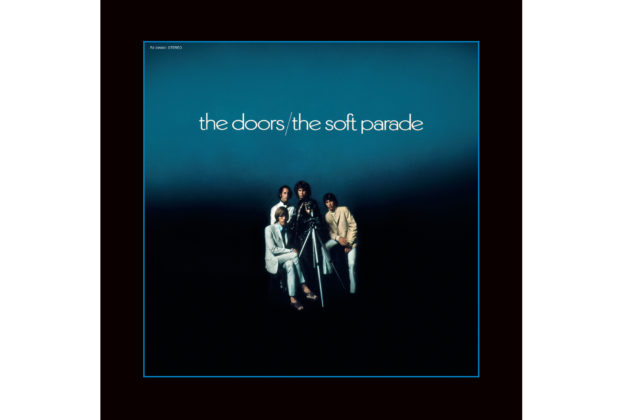
Harvey Kubernik and Robby Krieger Interview (2008)
Q: Tell me about the pre-production process of The Soft Parade album.
A: When we started The Soft Parade it was after the Beatles’ Sergeant Peppers.
The Soft Parade was recorded in West Hollywood at Elektra Sound Records on La Cienega Blvd produced by Paul Rothchild who brought in arranger Paul Harris to do the string and horn overdubs on The Soft Parade.
“I never liked the idea myself of strings and horns. It was an experiment. But once we decided to do it we did it. In fact we knew going in that the arrangements were made for the songs were actually tailored to have strings and horns. I would work with Paul Harris ‘cause I knew very little about orchestration. I would give him ideas for a horn line here and there and hope for the best. But he really did most of the work.
Q: Let’s discuss Rothchild who had produced albums by The Paul Butterfield Blues Band and Love.
A: Paul Rothchild was great. He was just what we needed. A very strong personality and real smart which Jim looked up to. And he knew a lot about recording, you know, which we knew nothing about. There are very few guys that Jim would look up to actually. And the same with us. He would make us do 50 takes. Bruce Botnick our engineer for all the albums and the producer of L.A. Woman is a little bit overlooked. He is a perfectionist. So is Paul. Bruce is the guy who actually turned the knobs and you can’t argue with the sound he got. He was very young but had produced the Supremes and a lot of stuff.
“It was a blast to have Curtis Amy in the studio. That was the most fun part. You got to meet all these great musicians and hang out. They were our heroes. Like on ‘Touch Me,’ Curtis took the solo. That was the first time that happened. It served the song. That was another example of egos not getting in the way for the sake of the song. Leroy Vinegar was on our Waiting For The Sun album. In fact he played on ‘Spanish Caravan,’ which was pretty silly ‘cause it wasn’t his type of forte. The only reason we wanted a stand up bassist was that it was right for the sound and Leroy was a good reader, and it was a written part.
Probably any guy could have done it. Doug Lubahn and Harvey Brooks were the bass players on The Soft Parade. Leroy was a bit taken back when he saw what we wanted to do. ‘This isn’t really my thing.’ ‘Come on, Leroy, you can do it.’ (laughs). On stage we didn’t have a bass player just the three musicians. Ray covered it. There were a couple of other groups who did that, the Seeds and Lonnie Mack. I loved Lonnie. He played on ‘Roadhouse Blues.’
Q: How was the material on The Soft Parade developed and constructed?
A: I came in with some songs and it was not like I had not done that before like ‘Love Me, Two Times.’ It was more like coming up with stuff on my own. Jim was getting more and more hard to work with as far as songwriting goes. It wasn’t the Jim who was writing ‘Your Lost Little Girl.’
Q: Let’s discuss the songs on the disc. “Tell All The People.”
A: I had never written anything political and I heard this song by Lead Belly called ‘Fannin Street’ about a street in New Orleans. And he had this line in there, ‘Follow me down.’ I really liked that line.
Q: Then the hit single “Touch Me.”
A: It was originally called ‘Hit Me, Babe’ and Jim thought people might take it literally on that. (laughs). Jim and I had a telepathic relationship. It was a perfect combo. That’s how you make a great group. You have three, four or five guys who come together and have that perfect intuitive relationship and stuff comes out.
“When we did the first Doors’ album Jim was totally un-experienced in the studio as far as recording his vocals. He had a year with his voice playing live every night. He had never done anything in the studio. And I think by the time ‘The Soft Machine’ came around his voice had matured a lot as far as low notes and range. Stuff like that. I don’t think he could have sung ‘Touch Me’ nearly as good if that was on our first album.
Q: “Do It.”
A: It started off with a lick that I had and we needed words for it. And I didn’t have anything. And so we would go to Jim’s poetry book. A lot of times that’s what happened. Like with ‘Peace Frog.’
Q: “Runnin’ Blue.”
A: That was different. It was a crazy little song that I had and when I sang it to the guys they really liked how I sang it. ‘You sound a little like Bob Dylan. Maybe you should sing that song. And then Jim added the part about Otis Redding. That’s an example on how Jim would make my songs better. We had an ethic that we wanted to make the song better. Jim was amazing in that way. Possibly the least ego-bound songwriter I have ever worked with, no question. As far as, ‘Hey…That’s my line…’ It wasn’t like that at all. He was always open to discussion and for things I told him to sing. He wasn’t really a musician but usually what would happen is that he would come up with something better.
Q: “Wishful Sinful.”
A: It’s definitely one of my favorites on the album. The orchestration is really good. I love the chords and stuff I came up with on that song. I wish I knew how I did it. (laughs).
Q: “Wild Child.”
A: It’s one of my favorites because it’s live. That one didn’t need strings or horns. The title song ‘The Soft Parade’ was quite a work. It was actually three songs in one.
"One night we went out for dinner at a Mexican restaurant after a date at Elektra and these singers were at the bar doing a song called ‘Push Push.’ And we really dug that. We were all getting drunker and drunker. And we were done with recording and we went back to the studio and then recorded ‘Push Push’ ourselves. It came out on the Doors’ Perception box. Looking back at it, that was pretty cool.
“We didn’t tour the The Soft Parade album. We only did it twice. It was another step for the Doors to try something different. The reason I didn’t like it was that I felt we were kind of doing the album for somebody else. But I definitely like how it came out, you know. A couple of years later we tried re-mixing some stuff without the strings and horns but it didn’t quite work. We had actually tailored the arrangements to horns and strings and to put that out again would be a lot of work, or alter the arrangements. "