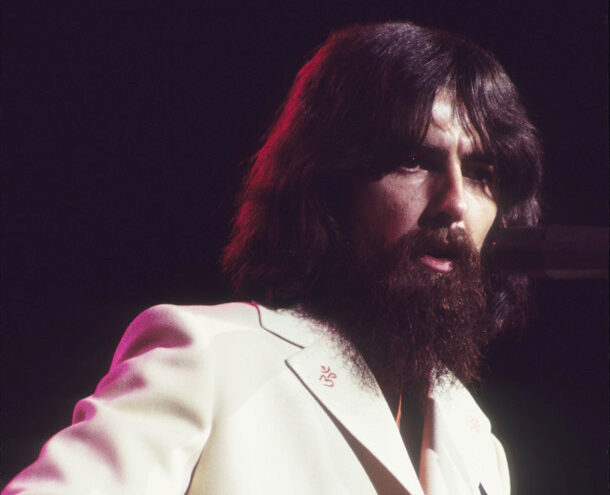
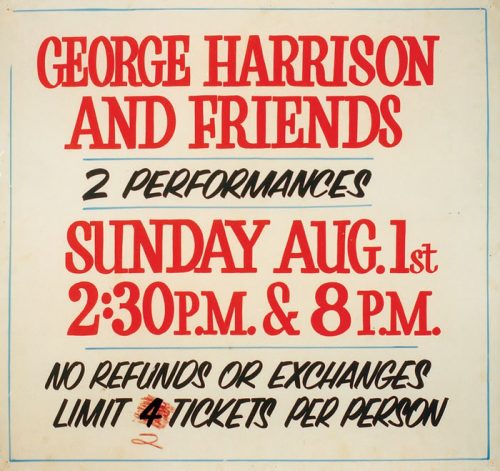
August 1 marks 55 years since Harrison and his friend Ravi Shankar, along with several other top music stars, including Bob Dylan, Eric Clapton, Ringo Starr, Leon Russell, and Billy Preston, shared the stage at Madison Square Garden for two history-making concerts to alert the world to the plight of the Bangladeshi people, victims of simultaneous floods, famine and civil war.
The legendary Concert for Bangladesh and its award-winning double album and feature film releases have since inspired other major, entertainment-led charitable initiatives, including Bob Geldof’s LIVE AID and LIVE8, Willie Nelson’s Farm Aid, and Hope For Haiti Now.
It was in Los Angeles earlier that summer of ’71 when Harrison was alerted to the scale of suffering his friend and sitar teacher Shankar was feeling about the struggle for independence from the ten million East Pakistanis refugees who fled over the border from West Pakistan to neighboring India to escape mass starvation, hunger, and death. Nearly three million people were killed. The dilemma and crisis was deepened when the 1970 Bhola cyclone and floods hit the region. At that moment, very little monies and help were made available from foreign governments.
Harrison then organized two relief of refugees charity concerts while composing, recording and releasing a studio single, “Bangladesh,” that was available just before the heralded affair.
At the performances, Harrison and his karmic pals offered stellar renditions of “Wah-Wah,” “Here Comes The Sun,” “Something,” “While My Guitar Gently Weeps,” “My Sweet Lord, “Just Like A Woman.” “Blowin’ In The Wind” and “A Hard Rain’s A-Gonna Fall.”
Production Coordination was Jon Taplin, Steve Lieber and Allan Steckler. Staging and lighting courtesy of Chip Monck Enterprises and Bruce De Forrest.
The two concerts on 1 August 1971 were successful, garnering U.S. venue proceeds for $243,418.50 donated to UNICEF while also raising awareness and visibility for the organization around the world.
The shows were recorded by Phil Spector and engineer Gary Kellgren with the music produced by Spector and George Harrison.
Saul Swimmer directed the Harrison-led movie who had served as co-producer of the Neil Aspinall and Mal Evans-produced Beatles documentary “Let It Be” in 1970.
“The Concert for Bangladesh” (originally titled “The Concert for Bangladesh”) initially was a live triple album commercially released in retail outlets just before Christmas in 1971 in the U.S. and after New Year’s Day 1972 in the U.K.
It immediately became a bestseller, landing at #2 for several weeks in the U.S. charts and becoming George Harrison’s second #1 U.K. album.
The multi-disc set won the Grammy Award for Album of the Year of 1972 for music producers Harrison and Phil Spector.
Allegedly, an additional 15 million was also earned from the “Concert for Bangladesh” album and film profits by the early-mid-70s. However, those funds reportedly were held in an Internal Revenue Service escrow account for years owing to the concert organizers having not applied for tax-exempt status.
Eventually, millions of dollars were given to UNICEF, which distributed milk, blankets and clothing to refugees.
George Harrison set up his own charity foundation, The George Harrison Fund For UNICEF, after he became frustrated with red tape and bureaucracies that had slowed down the process of spreading monies intended for recipients.
The George Harrison Fund for UNICEF is a joint undertaking between the Harrison family and the U.S. Fund for UNICEF to support UNICEF programs that provide lifesaving assistance to children, including health, education, nutrition and emergency relief. In the tradition established by George Harrison and Ravi Shankar, The George Harrison Fund for UNICEF continues to support UNICEF programs in Bangladesh while expanding its influence to include other countries where children are in need.
Apple Corps/Capitol in autumn 2005 released “The Concert for Bangladesh-George Harrison and Friends” on DVD and CD to celebrate the 35th anniversary of this collaborative event.
In October of 2005, the 2-DVD package was issued by Apple Corps/Rhino and the expanded 2-CD set by Apple Corps/Capitol. The DVD includes the original 99-minute film restored and remixed in 5.1, as well as 72 minutes of extras.
There is also previously unseen footage: “If Not For You,” with George and Bob Dylan from rehearsals, “Come On In My Kitchen” featuring George, Eric Clapton and Leon Russell at the sound check and a Bob Dylan performance from the afternoon show of “Love Minus Zero/No Limit,” not included in the original film.
The extras feature a 45-minute documentary, “The Concert For Bangladesh Revisited with George Harrison and friends,” about the background to the event with exclusive interviews and contributions from Sir Bob Geldof, and United Nations Secretary-General Kofi Annan, who stated, “George and his friends were pioneers.”
In the well-received documentary, Leon Russell reflected, “It was just one high level of experience from beginning to end.” While Eric Clapton readily admitted, “This will always be remembered as a time that we could be proud of being musicians. We just weren’t thinking of ourselves for five minutes.” Added Ringo Starr, “The beauty of the event came across and the audience was so great.”
The album of the concert has been remixed and repackaged, and contains an additional track of Bob Dylan performing “Love Minus Zero/No Limit.”
The Concert for Bangladesh was one of the first benefit concerts, along with the earlier 1967 Lou Adler and John Phillips- produced Monterey International Pop Festival non-profit venture, that brought together an extraordinary assemblage of major artists collaborating for a common humanitarian cause – setting the precedent that music could be used to serve a higher cause.
The Concert for Bangladesh has been the inspiration and forerunner to the major global fundraising events of recent years proceeding Live Aid by 14 years.
All artists’ royalties from the sales of the DVD and the CD edition continue to go to UNICEF.
George Harrison and master sitar musician Ravi Shankar met in early summer of 1971 in Los Angeles, California, where they birthed the idea for The Concert For Bangladesh.
“I told George and George wanted to help me,” Shankar explained to me in his San Diego, California area home in a 1997 interview published in “HITS” Magazine. “The film ‘Raga’ was ready and it needed some finishing in which George helped. It was released, I believe, in 1972.
“There are many other people who could do what George does, but they don’t have that depth. He’s so unusual,” said Shankar. “What has clicked between him and me, what he gets from me, and what I get from him, that love and that respect and understanding from music and everything, is really the most important thing. It’s not the money, or he helping me to record, that’s not the main thing. But it’s the very special bond between both of us.”
Shankar lived in Los Angeles in 1971. “I had a house on Highland Ave. A beautiful Spanish villa and at that time. George was in town, and at that time I was planning to do a benefit concert for Bangladesh, because I was very hurt that this whole thing was going on. To help this refugee problem, I wanted to raise some money. Everybody, every Indian, was thinking about doing that. And then, when I thought about it, I knew I could do more than any other Indian musician. Still, how much can you send? $20,000? $25,000, at the most?
“At this time of turmoil I was having, George was there,” reinforced Ravi in our “HITS” conversation. “He came to meet me and I was sitting. He saw me. From 1966, whenever he came to town, we would meet. At that time, he was staying in L.A. for a couple of weeks. I told him what I was planning. You know, it’s like a drop in the ocean. At the same time, I never wanted to take advantage of him. I did not want to say, ‘Would you help me?’ But, somehow, it came very naturally. He was so sympathetic. ‘Well…let’s do something.’ And you know that made me feel so happy. George is a very rare person…it is something so special. What he did, he immediately started phoning and booking things up. He phoned and got Madison Square Garden.
“Later, he contacted Bob Dylan, Eric Clapton, Billy Preston and a few of his friends. Somehow, it was done. Within three weeks or so, we gave a performance and it was sold out. So, they had to schedule a matinee. As you know, the first half was me. I called my guru’s son Ali Akbar Khan who plays the sarod. We were the first part. I composed the first lines for the items played as we always do and we improvised. And then intermission. There was no clapping when we were tuning, which is seen in the film and the people were so well-behaved. A lot of matches. It went beautifully.”
Shankar, in 1997, was amazed at the throng who hailed George Harrison and friends.
“It was a young audience, especially because I had this existing audience already, who were mature listeners and who had come to Carnegie Hall. This audience was the same type of audience as the Monterey Pop Festival, but they were very attentive and there was no problem at all. After our segment, I went to see the second half. Their program was very complimentary, because they chose the numbers that were very soulful in the sense that they weren’t hard rock. ‘My Sweet Lord,’ ‘That’s The Way God Planned It.’ Bob Dylan had his harmonica and did ballads. George sang ‘Here Comes The Sun,’ and the song he composed ‘Bangladesh.’ There was harmony and it wasn’t so different. It went off beautifully. The soundtrack won a Grammy (for Best Album of 1972).”
“Really, it was Ravi Shankar’s idea,” answered Harrison in a press conference in July 1971. “He wanted to do something like this and was telling me about his concern and asking me if I had any suggestions. Then after an hour he talked me into being on the show. It was a question really of phoning the friends that I knew and seeing who was available to turn up. I spent one month, the month of June and half of July just telephoning people.”
In the mid ‘70s when I was a weekly music reporter for “Melody Maker,” Harrison personally fixed me up to attend a Ravi Shankar recital and earlier sound check at The Roxy Theater in West Hollywood when George was proudly showcasing his special Dark Horse Records/A&M label artist.
In an interview arranged for me in 1997 and published in “HITS,” Harrison recollected about his initial meeting with Ravi Shankar in 1966 at a dinner party for the North London Asian Music Circle.
“His music was the reason I wanted to meet him. I liked it immediately, it intrigued me. I don’t know why I was so into it — I heard it, I liked it, and I had a gut feeling that I would meet him. Eventually a man from the Asian Music Circle in London arranged a meeting between Ravi and myself. Our meeting has made all the difference in my life.”
Harrison had first heard the sitar on the set of The Beatles’ movie “Help!” Later that same year, he would record with the instrument on John Lennon’s “Norwegian Wood (This Bird Has Flown).” Subsequently, Harrison integrated the sitar into his own composition “Love You To” for the Beatles’ “Revolver” album. He fused sitar and Indian influences on his selection “Within You Without You,” on the influential “Sgt.Pepper’s Lonely Hearts Club Band” album and also on “The Inner Light,” the obscure B-side to the “Lady Madonna” single.
Harrison further commented about his own sitar playing.
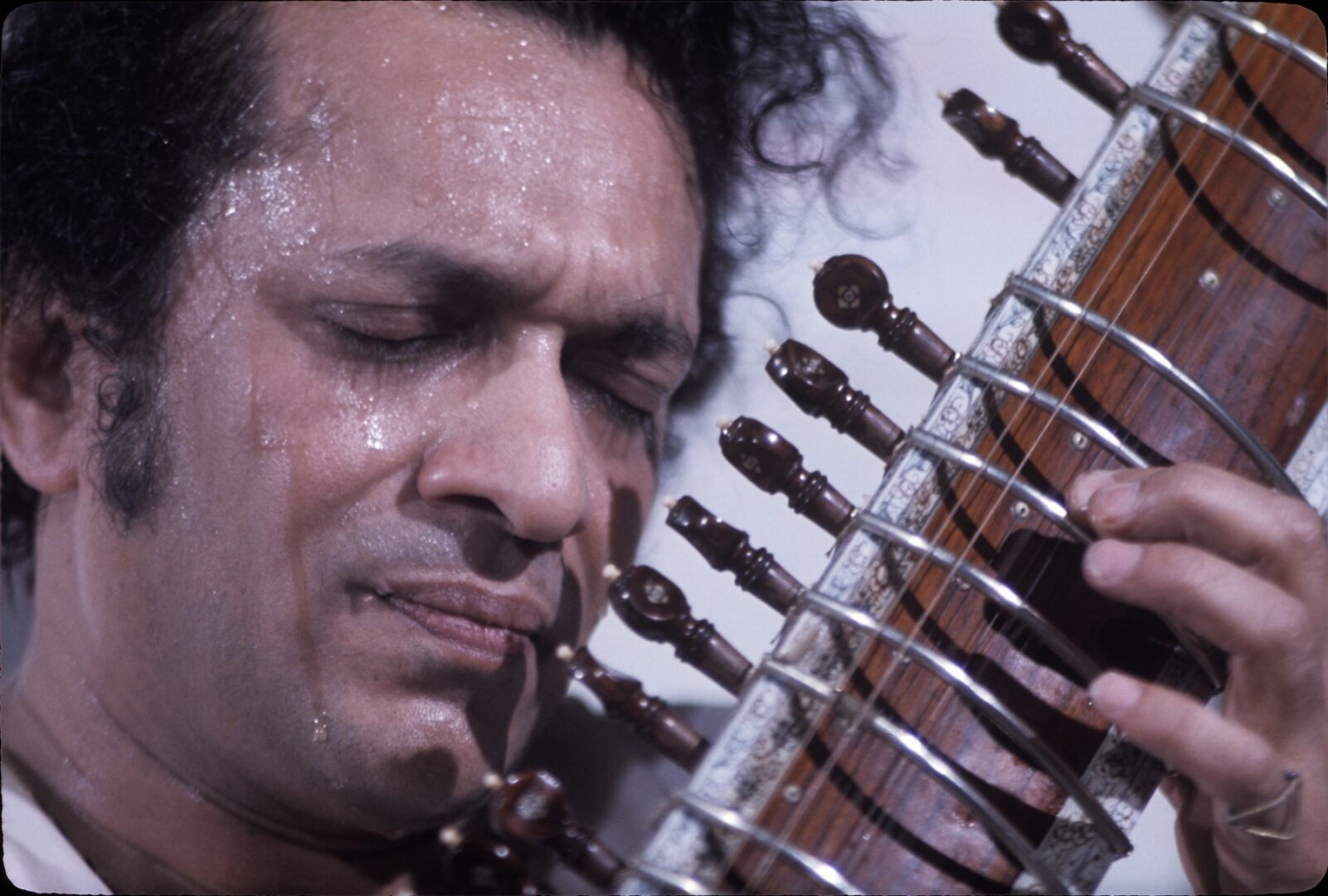
“I’m not a very good one, I’m afraid. The sitar is an instrument I’ve loved for a long time. For three or four years I practiced on it every day. But it’s a very difficult instrument, and one that takes a toll on you physically. It even takes a year to just learn how to properly hold it. But I enjoyed playing it, even the punishing side of it, because it disciplined me so much, which was something I hadn’t really experienced to a great extent before.”
Harrison went on to describe his earliest attempt at playing the sitar with the Beatles, “Very rudimentary. I didn’t know how to tune it properly, and it was a very cheap sitar to begin with. So ‘Norwegian Wood’ was very much an early experiment. By the time we recorded ‘Love You To’ I had made some strides.”
Harrison put his sitar experiments with the Beatles in perspective,
“That was the environment in the band, everybody was very open to bringing in new ideas. We were listening to all sorts of things, Stockhausen, avante-garde music, whatever, and most of it made its way onto our records.”
In a 2002 “Goldmine” Magazine interview I conducted with drummer/percussionist Jim Keltner, he reminisced about participating in The Concert for Bangladesh and his then 30-year recording relationship and friendship with Harrison and record producer, Phil Spector.
I talked to Jim Keltner one evening over dinner at his home in Los Angeles.
Keltner worked on the Spector-produced John Lennon “Imagine” album, “Happy Xmas (War Is Over)” and John’s “Rock and Roll” LP. Jim also appears on George Harrison’s “Living In A Material World.”
“I was staying at Eric Clapton’s and the phone rang early one morning I picked it up since I was the only one awake. It was Phil Spector. He asked if I wanted to come down and play. So I said ‘sure.’ I borrowed a drum set from Colin Allen who was in a band, Stone The Crows. We became good friends and he helped me out a lot in those days. The first song we did that night was ‘Jealous Guy.’ George (Harrison) was there as well. We did ‘Don’t Want To Be A Soldier’ next. Playing on ‘Jealous Guy’ was one of those moments when you feel you are in a dream, especially later during playback in a room with John, Yoko, George, Phil Spector, Klaus Voorman and Nicky Hopkins all listening.”
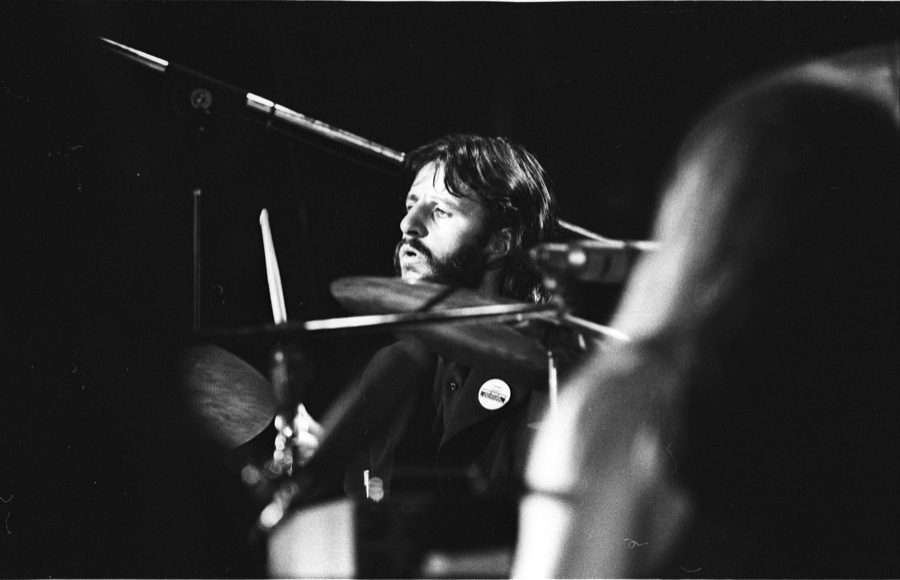
For the two Bangladesh shows at Madison Square Garden, Keltner is double drumming with Starr.
Ringo Starr was asked by George to play and accepted on the condition “but only if Keltner will do it with me.”
Starr hadn’t played in front of an audience in a while, either. Keltner was asked to participate and he replied, “of course, but I want to stay out of his way.”
The drum duo had to work out some things at sound check, including the decision for Keltner not to employ his hi hat cymbal much and emulate Levon Helm of the Band. Levon had a technique Keltner had had seen where he’d pull the hand off the hi hat for the two and four, so that it didn’t come down with the backbeat at the same time. And that enabled Keltner in getting out of Ringo’s way on that fabled bandstand.
“Ringo was a little on edge,” volunteered Jim. “He didn’t fancy playing alone and was kinda unsure about his playing. Which is amazing if you think about it. One of rock’s all-time great drummers. All you have to do is listen to the Beatles records, of course, especially, the ‘Live at the BBC.’ Rock and roll drumming doesn’t get any better than that. Earl Palmer, Hal Blaine, Gary Chester, Fred Below, David ‘Panama’ Francis, great early rock and R&B drummers, and Ringo fit right in there with those guys. Listen to the ‘BBC’ tapes and you’ll hear what I’m saying. Playing on Bangladesh was a really big deal for me. I made sure to stay completely out of Ringo’s way and just played the bare minimum.
After the earthquake in February of 1971 in Los Angeles, I told my wife, ‘Get the kids together and get on over here.’ We were there at a flat in Chelsea for a couple of months. During that time, George introduced me to Ringo and I played maracas on the single he produced for Ringo Starr at Trident Studio, ‘It Don’t Come easy.’”
“I remember loving the sound of the Garden. I heard Phil’s voice over the speakers, but never really saw him at the actual show, except during sound check. He was in the Record Plant (recording) truck.
“Phil had his hands full and did a remarkable job if you really think about it. Horns, multiple singers, double drums, lots of guitars. That was his forte, so he wasn’t intimidated by two drummers and 14 background singers. On Bangladesh, George was very lucky to have had Phil on that set,” reinforced Jim.
In my book “This Is Rebel Music,” Keltner proclaimed, “George was absolutely focused and fantastic as a leader. Of course he had Leon (Russell) in his band. And Leon helped with the arranging and all. I remember that everything seemed to be fine at the sound check and that I didn’t have too many concerns. When we started playing with the audience in the room it really did come alive. George seemed very powerful that night.”
Delaney & Bonnie’s 1969 debut LP, “Accept No Substitute,” made a big impression on both George Harrison and Eric Clapton. David Anderle had witnessed this white soul outfit gigging in West L.A. and brought them to Elektra Records to supervise their memorable album produced by Delaney Bramlett. Billy Mundi and Jeff Simmons, during their Frank Zappa and Mothers of Invention employ, auditioned for the band as well as Duane Allman. George Harrison had tried to sign Delaney & Bonnie to Apple Records in the U.K.
“Leon is all over that,” reiterates Keltner. “His piano playing on the ‘The Ghetto’ is the greatest. No one else can do that. When I got to know John (Lennon) he told me he liked the Delaney & Bonnie and Friends ‘Accept No Substitute’ album,’ recalled Keltner.
In our 2002 dinner table talk, Keltner further regaled about Delaney & Bonnie and the Concert for Bangladesh. “Leon Russell made it great to be there. I had played with Leon on quite a lot of stuff: Gary Lewis and The Playboys, Delaney & Bonnie and Friends, Joe Cocker and Mad Dogs and Englishmen. Leon played on a lot of Phil’s great records.”
The late bass player Carl Radle played on the Leon Russell portion of Bangladesh.
“Carl was one of my closest friends,” lamented Keltner. “James Jamerson, Paul McCartney and Carl Radle- I always thought were the guvs. Carl was the first bass player I started playing rock and roll with. The good fortune and luck of that?
“Bangladesh was a great little reunion. They loved playing with Ringo and me. Klaus Voorman was the principal bass player on Bangladesh. Phil loved the way Klaus played. He had a great way of stretching the time. Klaus is one of the greatest bass players I’ve ever played with. His playing was always just exactly right for the song. He didn’t have that much in the way of chops but he made up for that with his great musical sense.”
Guitarist Jesse Ed Davis is also seen and heard during Bangla desh. Davis worked with Keltner and Spector on the concerts, as well as Lennon’s “Rock and Roll” album. “Jesse Ed was the only guitar player who ever made me cry,” revealed Jim.
Henry Diltz, a photographer and musician, is a founding member of The Modern Folk Quartet.
A Diltz-snapped photo of George Harrison graces the cover of the 2005 “Concert For Bangladesh” CD/DVD package
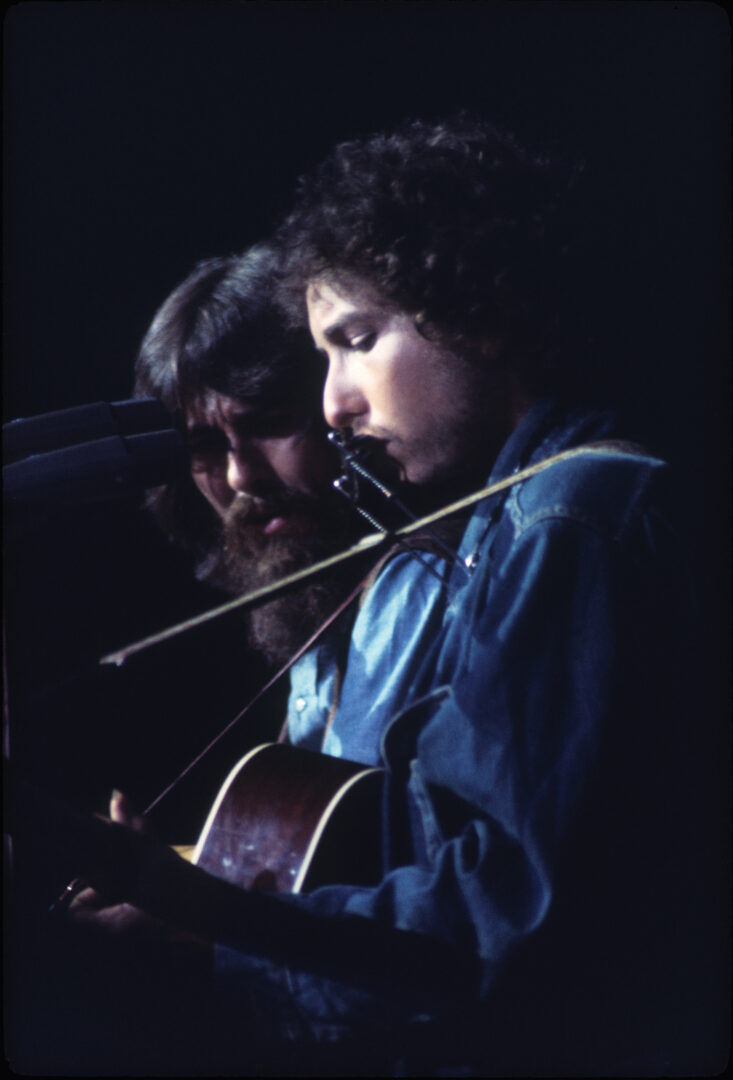
“The high point at the Bangladesh concert was when Dylan came out and played with George. And I took pictures. I was in the wings and took pictures from the side. I waited for that moment because I didn’t want to get kicked out until the best possible moment and then Dylan and George at the microphone from the side of the stage. Barry Feinstein or someone out front was shooting. And if I would have showed my face out there with my camera I would have been kicked out immediately. Alan Pariser who helped plan Monterey Pop did additional photography. They did two shows and I somehow got to the front of the stage. One roll of color and one roll of black and white with my Nikon. Walked through and found an empty seat.”
“My pictures sat around and never got seen or used for any “Bangladesh” album packages, videos, or DVD’s until 5 years ago when the 35th anniversary occurred,” Diltz admits.
“My friend Rona Elliot knew George’s wife Olivia. Somehow she mentioned to Olivia that, ‘Henry Diltz has some photos.’ ‘Oh, I’d love to see them.’ So she came by my studio and we pulled out my little box of slides and she said, ‘My God. These are beautiful and better than the stuff we got.’
“So she picked one out, George in his white shirt and coat, and his hair blended into the black and I never used it for anything. ‘Can we use it?’ ‘Certainly.’ And they very carefully made the background orange around his hair so it looks a lot better than the actual naked slide looked. So they made that into the cover of the 35th anniversary DVD. That picture of George and a couple of photos of Dylan and Harrison in black and white.
In spring of 1971 just before the concert for Bangladesh was conceived, Jim Keltner had done some recording sessions with Bob Dylan.
“In March of ’71 I did a couple of songs with Leon (Russell), Carl Radle, and Jesse Ed Davis for Bob Dylan. (“Watching The River Flow” and “When I Paint My Masterpiece”).
“When George introduced Bob, (at Bangladesh) I stood backstage, and Dylan walked on. Jean jacket, kind of quiet, the way Bob always is. Standing in the back in the dark, it was great to see Leon have the guts to get up there with the bass and perform with him on ‘Just Like A Woman.’”
Pattie Boyd, former “Vogue” model, George Harrison’s wife, inspiration for “Something” and Eric Clapton’s “Layla,” had witnessed her husband organizing the Bangladesh talent in the Nichols Canyon house they rented in Southern California for the summer of 1971.
“Pisces Apple Lady” Chris O’Dell also helped Pisces George contact a few of the musicians for the event.
“The first line of thinking from George was ‘Ravi has asked me to do something for him,’” remembered O’Dell in July 2011. “That’s about friendship. That was more important than where it was gonna go. Even in the lyric to the song ‘Miss O’Dell,’ George had mentioned ‘the rice (that never made it) to Bombay.’ George had told me about that situation earlier that summer. George was learning a lot from Ravi as time went by. So the idea of a concert didn’t come up right off the bat. It came up later. Then it was, ’would you help me?’
“ And it was little things. Don Nix came into town. George didn’t know him. We all went to Catalina Island together. I knew him from Leon. From that came the background singers.
“I don’t think we had any idea of what it could be. I mean, it was fairly apparent that if you put a Beatle on stage, with a successful album behind him, ‘All Things Must Pass,’ that it would probably draw people especially. John & Yoko did their things, but George hadn’t, and you make an assumption that with George involved it’s gonna draw people.
“George said, ‘I can’t believe this is all coming together.’ The whole thing just grew right before our eyes.”
Chris O’Dell also remembers Harrison’s own mission in securing Bob Dylan for the gathering.
“That was part of the territory with him for a long time. And, you know, honestly, if George had an idol musically, that was it. So I think just having that piece there. George looked up to Bob in a way that there was that kind of esteem. And then the asking him to do something like that, and not wanting to let him down. George was really frightened by all this.”
It was well documented that George and Pattie had concerns about Bob Dylan showing up at the Bangladesh booking. Although she was immediately relieved when Dylan arrived at the rehearsal.
Chris O’Dell and Pattie Boyd were subsequently backstage for all the action and caught the second show in second row center-stage seats.
” Sensational. It was amazing. Really wonderful. So exciting,” Pattie told journalist Michael Simmons in July 2011 at Boyd’s photo show on Catalina Island. “So exciting George pulled it off. I remember when Dylan was onstage, everybody said ‘Oh my God, he’s not going to get off!'” Boyd, wasn’t criticizing Bob for playing too long, but was simply inferring that despite the fact that no one was sure he’d show up, once he did Dylan had a blast performing.
In a 1971 radio interview on Los Angeles AM radio station KDAY, Spector previewed selections from his first generation “Bangladesh” master tape acetate.
Phil and the DJ aired Bob Dylan’s “A Hard Rain’s A-Gonna Fall” from the concert as well as Dylan’s non-released “Love Minus Zero/No Limit,” left off the package due to vinyl space limitations of the period.
In May 2011, Steve Van Zandt sent me an email from Lillehammer, Norway.
“The anti-apartheid Sun City project (single, album, video, documentary, book, teaching guide) was a high point and a rare clear-cut victory from the ten years I spent immersed in the dark, murky, frustrating labyrinth of international liberation politics.
“It came in the middle of my five politically themed solo albums and had it’s roots, like all the charity and consciousness-raising multi-artist events that would follow, in the Concert for Bangladesh.
“One could go back seven years further to the work of Bob Dylan for the reason my generation had any political or social awareness at all. He would single-handedly bring the more personal, socially, and politically relevant lyrics previously confined to Country Blues, Country, and Folk music to the Pop and Rock idiom. The fact that he probably did so to impress his girlfriend Suze at the time, rather than some grand megalomanical scheme to become the spokesperson of his generation, just makes him all the more human and likable and is probably the reason he’s still around and still great.
“And it’s not a coincidence that he’s the one artist on both Bangladesh and Sun City 15 years later.
“But it was the Concert for Bangladesh that would be the beginning of all the multi-artist events bringing awareness to a cause and/or raising money.
“It would take the energy and focus of a Beatle, George Harrison, to bring the extraordinary necessary life force to get the event organized and executed so quickly and with such high quality.
“The unfortunate financial complications that followed was the one thing that couldn’t be foreseen by noble naïve artists trying to do the right thing in an emergency situation. The despicable, mindless, emotionless bureaucracy they would run into would later instruct all of us who followed.
“But that aside, it was a wonderful event and we all owe George our gratitude. All of us who have ever had the desire to use-and justify-our celebrity to do some good, as well as the tens of millions who have benefited from these events, all have him to thank. Him, and the generous heart of the legendary master musician Ravi Shankar who came to his friend with the desire to bring aid and attention to a terrible, tragic situation.
“As far as history is concerned, we shouldn’t take for granted the fact that these charity and awareness events exist, and that the Rock world has done more than any other industry to help people in need. This was not some inevitable act of destiny or even a predictable evolution of what turned out to be a 25-year successful run of the music business.
“The idea had to start somewhere.
“The source is the Concert for Bangladesh.”
All photos by Henry Diltz, Courtesy of Gary Strobl at the Diltz Archive
Ad courtesy of Ron Furmanek