

 MC: I understand that you’re a fan of Fender and Gibson guitars. What are some of your favorite models and why?
Branco: My main guitar is the Fender Bullet. It’s a very cheap guitar—I bought it for about two hundred dollars. I think it sounds better than an expensive, custom shop model. The pickguard is made of metal and it creates a unique resonance in the wood, which is also kind of cheap; it’s not cherry wood. This combination is unique; it kind of resonates in your bones and this is very hard to find in a guitar. In a very good guitar shop, they may have one guitar that resonates with your body. I really love this one.
Some of my favorite guitar players are Sterling Morrison from Velvet Underground and of course I love Bob Dylan. He’s a very underrated player; very skilled but he hides it. If you listen to his early stuff, it’s very well played. The more I grew up, the more I realized that he was an authentic player. And I like his attitude.
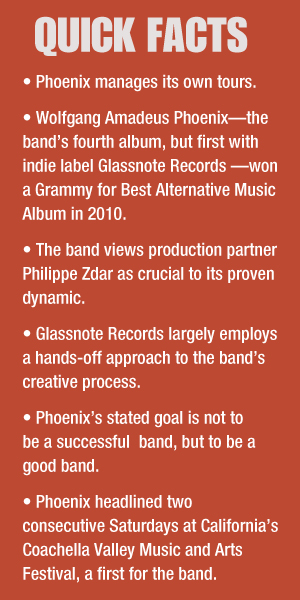
MC: After your contract with EMI ended just before Wolfgang Amadeus Phoenix, you chose to sign with Glassnote Records. How did the band arrive at that decision?
Branco: When we finished Wolfgang Amadeus Phoenix, we were looking for a partner. [Label head and founder] Daniel Glass heard the new record and his reaction was great. The day after he listened to it, he flew to Europe. When we met him, we knew that he understood what we were trying to do. And Glassnote was also an independent label, which we really liked, so the decision was quite easy. We’d talked with other labels, but no one had the same level of enthusiasm or passion that he did. And I liked his old-school way of thinking. He was our partner. When we made a decision, we just talked with him eye-to-eye.
What I don’t like about the modern world and big companies is that there’s a lot of tiering and no one is really in charge. There are dozens of people and they don’t know what they’re doing. I think that’s why the music world is not as good as it used to be. The decisions are diluted and there’s not one captain who can make a quick choice. That’s why [Apple co-founder] Steve Jobs had a great company: because he was a leader; he was a captain.
MC: Do you own your masters or does Glassnote?
Branco: We own our masters and our publishing. We own everything. From the very beginning, it was a means of control. What we like is freedom in doing this job and that’s how it should be. Daniel Glass was happy to do it. We needed a partnership with the label and we got it. There was no hesitation.
MC: Is the label involved in the band’s creative process?
Branco: For the music, there’s no involvement; the ideas are from the four of us. One of the great things about Glassnote is that it’s led by intelligent people who are convinced that we know what we’re doing, so they give us plenty of freedom. There’s no decision that we don’t take. But we’re also very open to ideas once the music is finished; we’re open to the label’s input. After almost two years [while recording Bankrupt!], we showed them what we’d done and hopefully they liked it. The relationship between the band and the label is very strong now.
MC: How much tour support does Glassnote offer?
Branco: We own our touring company so we are pretty self-sufficient. I don’t know if Glassnote is involved in tour support. They could be, but even when we started the promotion of Wolfgang Amadeus Phoenix in 2009, we were already touring the US on a level that was self-sufficient. We produce and support our own tours.
MC: V2 Records will release Bankrupt! outside of the United States. What’s the relationship between Glassnote and V2?
Branco: There’s some confusion about that and I don’t know where it comes from. V2 was involved with the European release of Wolfgang Amadeus Phoenix. Now Glassnote has a partnership with Loyauté, the band-owned worldwide label that handles European releases.
 MC: What’s it like to headline Coachella two weekends in a row? Is there any special preparation that you go through? What’s it like doing two large back-to-back shows?
Branco: For us, Coachella is very important. It’s almost a mystical moment. We could compare it to the Olympics. The first time we played Coachella, we did the worst tour of our lives. That was a long time ago. The last time we played it, it was one of our favorites. In terms of our preparation, we thought about it for a long time. It’s now a two-week thing and we don’t really know how to deal with it. It’s exciting to see how different it can be. This is the first time we’ve done [back-to-back weekend shows] so we don’t know exactly what to expect. It’s kind of terrifying, but when you’re frightened to death you’re also excited. Those moments are the best––when you know that you can fall and there are no safety nets. That’s what we’re feeling right now.
MC: Are American audiences or fans different from European ones?
Branco: No, not really. There are a lot of commonalities between people around the world. But even in the United States, there seem to be regional differences. For example, Southern California is different from Chicago. The main thing is that all audiences react to the same things at about the same moments during a concert. People share emotion, and that’s real.
MC: Do you like being on the road?
Branco: We love it. It took quite a long time to find the right crew, the right people and the right way of touring. It demands a lot of energy to make it interesting and not just a repetition of the same day over and over again. But now we’re kind of good at it, we know how to handle it and so touring for us is great, especially after we’ve spent two years in the studio. We’re happy to travel the world.
MC: Is being in a successful band different from what you thought it would be?
Branco: For us, being a little bit successful is not that different from being very successful. Our lives haven’t changed that much, except we have the opportunity to play a lot more. I thought there would be so much pressure, but actually it’s not that complicated. We just have decisions that need to be made, but it’s pretty easy to do what we have to do. The only thing that we like about success is the creative power we have. [Or] at least we have it now. It might not last forever. But now we know that we can experiment and do things the way that we want to do them. We also have access to all these creative tools.
Contact jen@pressherepublicity.com