Web: margotsinclair.com
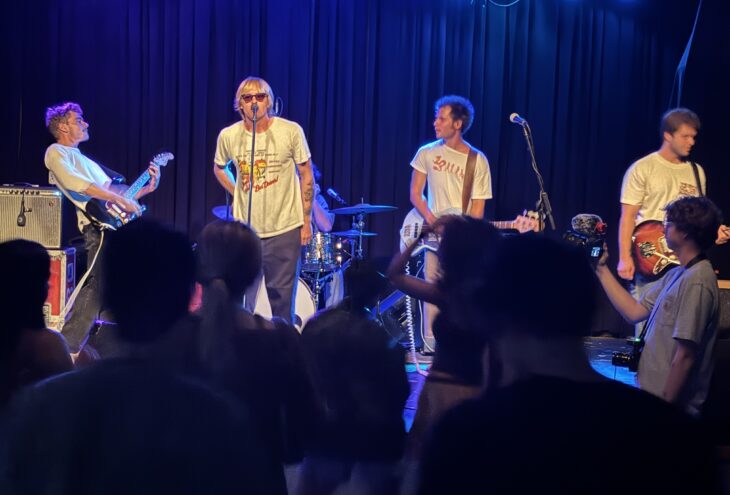
Players: Kyle Mix, vocals; Luke Sutherland, guitar; Carson Baer, guitar; Owen Rice, bass guitar, background vocals; Donovan Hess, drums, background vocals
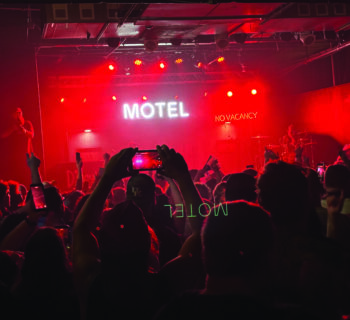
A totally unexpected quartet of Orange County escapees—perhaps slightly bewildered to find themselves this far east—takes the stage and, within seconds, traps the room in an opening crescendo. The “wow” factor is immediately off the chain. Mutinous electrons ricochet off the walls, rafters and bar, coalescing into soaring minor chords, barre-chord power surges and enormous slabs of guitar before somehow resolving back into the major.
Meet Margot Sinclair. Their first three songs are a gut punch to the inner ear. Imagine some of the country-rock brilliance of Sweetheart of the Rodeo, the early Byrds when Roger McGuinn’s Rickenbacker was practically weaponized, and a dose of Henry Rollins-era Black Flag being fired through the same electrical grid.
After exploding through “POV,” “Boat” and “Napalm,” Margot Sinclair locks into a groove train that simply refuses to let go. “Jealousy,” “Excuses” and “Jester” become absolute heaters—big, muscular songs propelled by a band that already understands something many young groups spend years figuring out: how to move as one organism without everybody fighting for the same square inch of sonic real estate.
These guys are dialed in from the first note, and frankly, they seem way too good to be from this part of the galaxy. As the set gathers kinetic propulsion, the thin crowd begins moving closer, bodies collecting around the stage as if somebody quietly turned on a giant musical electromagnet.
The four-piece rock machine bounces, swerves and rides the ramjet hard into “Ween,” “Free” and “Watching,” a closing three-song rattlesnake that leaves the room smoldering and the walls suspiciously sticky with groove juice.
There is unusual cohesion in this quartet. They ride each sound wave to its crest, then hand off verses, intros, rhythmic accents and melodic ideas with impressive smoothness. Nothing feels accidental, yet nothing feels overly rehearsed. There’s muscle here, but also restraint—and that combination is considerably harder to manufacture than sheer volume.
Sutherland’s guitar work is especially notable. Not overbearing, not underwhelming—just the right amount, at the right moment, saying exactly what the song needs said. Having already been through the live-performance grinder at rooms like The Troubadour in Los Angeles and Rickshaw Stop in San Francisco, Margot Sinclair has clearly had time to sharpen the machinery.
Carson Baer and Rice kick this musical golf ball straight through the Garden Hose of Groove, supplying compression, clarity and dynamic punch while keeping the whole contraption moving forward. Then there’s Kyle Mix, with enough vocal range, presence and raw power to suggest that this band has considerably larger stages ahead of it.
If there’s a crack in the veneer—and you have to look pretty hard to find one—it’s this: once Margot Sinclair reaches full bore, they are so strong, so relentless and occasionally so overwhelming that your head and ears start begging for a little dynamic daylight. Give us a whisper. A crack in the door. Twenty seconds to locate our internal organs before firing up the engines again. But that will come. Margot Sinclair has a future so bright it hurts your eyes.