Web: diggygraves.com
Players: Mr. X, keys, synths, programming; Mr. Y, bass, electric guitar; Mr. Z, drums, percussion
The business of death—the unknown, the macabre, and the celebration of both—has become Diggy Graves’ raison d’être. Onstage, that morbidity isn’t a gimmick so much as a vocabulary: horror-movie imagery, goth iconography, trap-weighted rhythms and pop instincts all feeding the same strange machine.
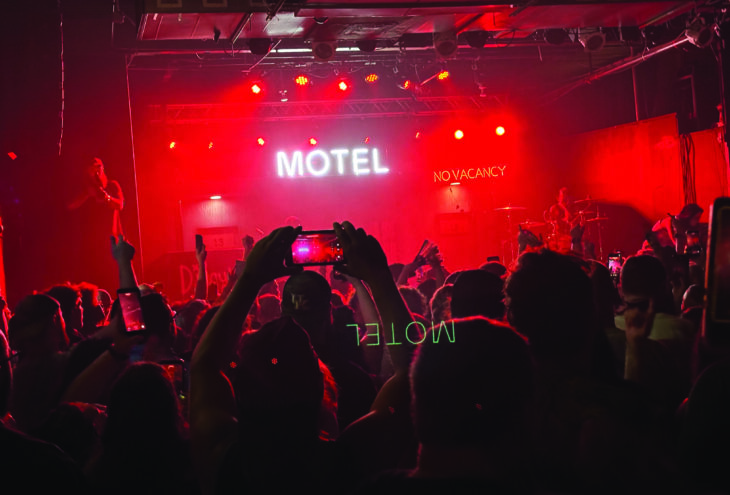
At Cat’s Cradle, the stage was stripped to the essentials, built around the MOTEL tour’s enormous red neon sign. No clutter, no unnecessary production tricks. Just the sign, the darkness and a room full of people waiting to see what crawled out of it.
Then Diggy appeared in his white hockey mask. He hit “Motel Blues” and the room detonated. Bodies surged toward the stage, the beat hit with physical force, and suddenly the motel wasn’t a prop anymore—it was the entire world of the show.
“The Grim Weeper” followed, then “Cyanide,” each track tightening the screws before the set took a darker turn with “Dear Dracula.” The imagery could easily have tipped into camp, but Diggy understood the crucial difference between merely wearing a horror aesthetic and actually performing inside one. The songs moved with purpose, driven by bass-heavy grooves, programmed percussion and hooks that gave the darkness something to dance to.
And the audio was excellent. That matters more than it sounds. At a show built around rhythm, diction and character, muddy vocals would have killed the illusion. Instead, Diggy’s voice came through cleanly and distinctly. He could spit, sing, bark or lean into a phrase without disappearing beneath the low end. Every word landed.
That clarity is part of what makes Diggy interesting. Whatever genre pigeonhole you try to stick him in—hip-hop, pop-rap, goth rap, alternative, whatever—he keeps slipping through the hole. The music is too melodic for one box, too rhythmically aggressive for another, too theatrical to sit comfortably anywhere for long.
The songs themselves are loaded with personality. “The Exorcism of Diggy Graves.” “Hollow.” “Boot Scootin’ Diggy.” “Red Vinyard.” “Tac Town Two Step.” Even before the music fully registers, the titles establish an alternate universe. Each one is an invitation, an audio name tag, a little signpost telling you where to hang your attention.
There’s something inherently slippery about that kind of theatrical anonymity. It can feel inauthentic, particularly when the persona becomes bigger than the person underneath it. But perhaps that tension is the point. The mask isn’t necessarily concealing the artist; it may be giving him permission to exaggerate everything.
The crowd was packed, energetic and remarkably well behaved. No sense of menace, despite an aesthetic built almost entirely from it. People came to lose themselves in the music, not in each other.
And that might be the most revealing thing about a Diggy Graves show. For all the skulls, ghosts, exorcisms, motel rooms and graveyard imagery, the actual experience is communal. The darkness becomes a party. The mask becomes a mascot. The morbidity becomes rhythm.
Diggy Graves has built himself a little universe where death is the theme, but the groove is the life force.