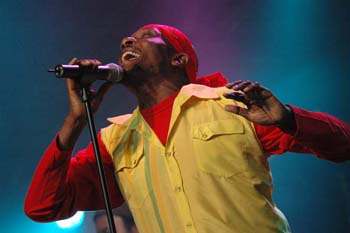
The Jamaican singer, actor, songwriter Jimmy Cliff who starred in the influential 1972 reggae film The Harder They Come has died. He was 81.
At the time of his physical passing, Cliff had received the Order of Merit, the highest honour that the Jamaican government granted for achievements in the arts and sciences.
His wife Latifa Chambers posted a message on Instagram that reads: “It’s with profound sadness that I share that my husband, Jimmy Cliff, has crossed over due to a seizure followed by pneumonia. I am thankful for his family, friends, fellow artists and coworkers who have shared his journey with him. To all his fans around the world, please know that your support was his strength throughout his whole career … Jimmy, my darling, may you rest in peace. I will follow your wishes.”
Her message was also signed by their children, Lilty and Aken.
In 1969, radio airplay of Jimmy Cliff’s “Wonderful World, Beautiful People” and “The Israelites” from Desmond Dekker & the Aces, along with “Hold Me Tight,” a 1968 hit single by Johnny Nash, and Millie Small’s earlier hit “My Boy Lollypop” in 1964, exposed ska and reggae rhythms and sounds from Jamaica in Southern California and Stateside.
Nash’s “I Can See Clearly Now” in 1972 reached number one on the US Billboard and Cash Box charts. Island Records’ Chris Blackwell, label owner and A&R man, had signed a handful of reggae artists to bring the messages from Jamaica to a global audience through distribution deals for Island, and associated imprints like Mango, with major labels including Columbia and Capitol.
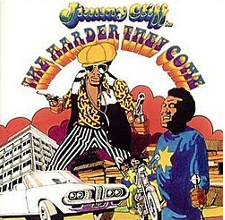
In June of that year, the Jamaican film, The Harder They Come (1972)—a crime drama directed by Perry Henzell, co-written by Trevor D. Rhone, and starring Jimmy Cliff—premiered in Jamaica. It tells the story of Ivanhoe “Ivan” Martin (Cliff), a young singer who arrives in Kingston, Jamaica, desperate and eager to become a star in that country. He falls in love with a woman and quickly signs a record deal with a powerful music mogul, and soon learns that the record game is rigged. Angered and confident, Ivan becomes increasingly defiant and finds himself in a personal and social battle that threatens not only his life but the very fabric of Jamaican society.
In the August 21, 2019, edition of The New York Times, J. Hoberman praised The Harder They Come in a story sub-headlined “A Pop Classic That Has Hardly Faded”: “Powered by one of the most infectious scores in the history of cinema, it’s a pop classic—the movie that brought reggae to America. The film arrived on the international scene in the wake of Shaft (1971) and Superfly (1972), with a hero akin to the righteous outlaws in films like the Brazilian director Glauber Rocha’s Antonio das Mortes (1969), Melvin Van Peebles’ Sweet Sweetback’s Baadasssss Song (1971), and numerous Italian westerns.”
In November 1972, I attended the Hollywood premiere of The Harder They Come at Grauman’s Chinese Theatre, where it screened as part of Filmex, the Los Angeles International Film Exposition. The place was packed and the audience loved it. Shortly thereafter, I learned that visionary producer and director Roger Corman had secured domestic distribution via his company, New World Pictures.
The musical climate of the US was altered by the local premiere run of The Harder They Come at the Nuart Theater in West Los Angeles on December 26-31, 1972. The film debuted in London at the Gaumont cinema on September 1, 1972.
Author and consultant Roger Steffens has written seven acclaimed books about the Wailers, Bob Marley, and the history of reggae. His most recent volume is So Much Things to Say: The Oral History of Bob Marley (2017). Los Angeles-based Steffens was also a national promotions director for reggae and African music at Island Records and handled reggae promotion for Elektra Records in the early 1980s.
Seeing The Harder They Come the first time was a life-altering experience for Steffens, a Vietnam War veteran, photographer, actor, and voiceover artist he explained in a 2004 interview that we conducted.
“Back in early summer 1973, an Australian gonzo journalist named Michael Thomas wrote an extraordinary article in Rolling Stone outlining the history of Jamaican music from the ska and rocksteady eras into the emerging internationalization of reggae, particularly through the success of The Harder They Come.
“It featured some of the major Jamaican stars of the moment, including the movie’s leads, Jimmy Cliff and Toots and the Maytals. The mesmerizing tale was based on the true story of a ’40s gunman named Rhygin (‘raging’) who killed cops and became a folk hero. The film became a lynchpin of a newly popular trend of midnight movies from coast to coast. In Boston, it played in Harvard Square for eight years, and when Jimmy was playing in that city, he was known to enter the theater unannounced and jump on stage pretending to hold six guns, mimicking a scene in which he is photographed in his gun-totin’ bad boy pose, in a photo studio, much to the audience’s astonishment.
“The day after I read the article, I saw the movie in a tiny northside theatre in Berkeley, holding about forty seats. When the midnight chalice-smoking scene came on screen, everyone in the theater lit up, and there was so much smoke in the room you couldn’t see the screen! On the way home, I bought the soundtrack, which led me to seek out recordings by each of its contributors.”
Earlier this century I witnessed a marvelous show by Jimmy Cliff at The Key Club in West Hollywood.
In 1976 Cliff’s In Concert live album, culled from concerts in Massachusetts and New York, was produced by Andrew Loog Oldham, the record producer and manager of the Rolling Stones during 1963-1967.
During 1986, Cliff, along with Don Covay, Bobby Womack, Tom Waits, and Patti Scialfa contributed backing vocals to the Rolling Stones Dirty Work album.
On his River tour, Bruce Springsteen included Cliff’s Trapped, and in 1985, Jimmy contributed to “Sun City,” a protest song written by Steven Van Zandt and recorded by Artists United Against Apartheid for a charity album that conveyed a message of opposition to the then existing South African policy of apartheid.
Bob Dylan once touted Cliff’s “Vietnam,” “as the best protest song he ever heard.”
Cliff earned two Grammy Awards during his career along with seven nominations. He won in 1985 for best reggae recording for Cliff Hanger. It was followed by Rebirth, the best reggae album of 2013.
In 2021, the Library of Congress deemed The Harder They Come soundtrack “culturally, or aesthetically significant” and was selected for preservation in the National Recording Registry.
Cliff was inducted by Wyclef Jean into The Rock and Roll Hall of Fame in 2010.
Photo, by Bryan Ledgard, licensed under the Creative Commons Attribution 2.0 Generic license.