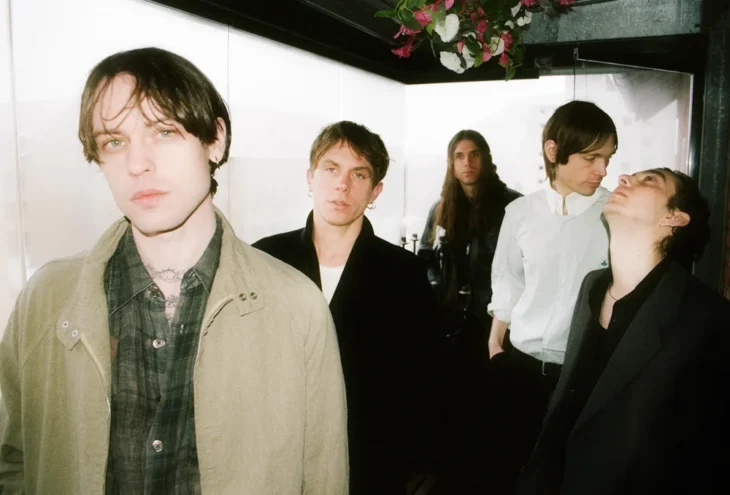
The Members: Elias Bender Rønnenfelt, vocals, guitars; Johan Suurballe Wieth, guitars; Casper Morilla, guitars; Jakob Tvilling Pless, bass; Dan Kjær Nielsen, drums
Producers: Iceage
Mixing: Nis Bysted
Engineering: Nis Bysted and Jens Benz
Mastering: Emil Thomsen
Studio: Silence Studio. Sweden
The Origin: With an unyielding drive to defy creative expectations—both internal and external—Copenhagen’s Iceage has treated sonic evolution as an essential part of their artistic identity. Throughout their trajectory, from the frantic noise-punk of 2011’s New Brigade to the grand art-rock arrangements of 2018’s Beyondless and the expansive soundscapes of 2021’s Seek Shelter, the band has continually showcased a unique capacity for absorbing new influences. Across every era, they have delivered their abrasive sonic structures and bleeding-heart declarations with an unfiltered, no-holds-barred intensity. No matter which musical style sits in the forefront—whether sweeping arrangements, stripped-down rock, or moody, Manchester-inspired grooves—Iceage’s undeniable, unvarnished punk presence is consistently heard as an undercurrent, a pseudo-low-end frequency, a vital sonic baseline of their own.
This constant evolution, powered by that steadfast subwoofer sonic essence, acts as a subconscious, self-determined vendetta to stay true to themselves. By treating new musical inspirations as creative tools to expand their sound rather than depart from it, the core of their dark-art punk spirit remains unbroken — always ready to be tapped into, and always winning out against the threat of standing still.
This undercurrent lives inside the physical language of Iceage’s music. Elias Bender Rønnenfelt’s unmistakable vocal presence—aching, commanding, and deeply human—carries a sense of bruised, wounded beauty that ascends and locks into brilliant, austere rhythms and intense, dissonant punk chords. This collision of sounds holds the danger and unpredictability of punk’s earliest provocations, framing that fierce energy through their own distinct songwriting and lyrics that look through a dark, poetic lens. That same tension defines Rønnenfelt’s writing, where alienation, existential dread, and inner turmoil transform into vivid fragments of emotional reality, making them feel strangely beautiful. This combination leaves the listener with strikingly surreal, cinematic images of internal chaos and shattered elegance within the mind.
It is this uncompromising intensity that earned the validation of proto-punk pioneers like Iggy Pop and Richard Hell — architects of swaggering vocals and analog lo-fi grit — who recognized a familiar, lawless signal capable of cutting through conventional popular soundscapes generally designed for easy listening consumption.
With their sixth album, 2026’s For Love of Grace & the Hereafter, Iceage returns to that exact same search. They subconsciously preserve a pure punk undertow while naturally seeking new motivations and finding in-the-moment soundscapes. Below, drummer Dan Kjær Nielsen and bassist Jakob Tvilling Pless offer insight into Iceage’s latest sonic quest, detailing how a deliberate retreat to Sweden’s remote Silence Studio allowed them to tune into the quietude so often needed for deep-seated artistic focus.
Stepping back into the same physical space that delivered 2014’s breakout classic, Plowing Into the Field of Love, the band managed to loop their past into their present. The studio’s isolation and wonderfully wild environment acted as a creative reset, unlocking a uniquely bright headspace — one that remains, at its core, bound to the bloodline of their dark-art punk essence.
The Production: For artists consumed by the all-encompassing gravity of their sound, the studio environment often guides the underlying frequency of the album. This profound attention to studio vibe and its surrounding landscape was particularly vital for Iceage’s recording process during For Love of Grace & the Hereafter. “As we were talking back and forth, it became clear that we were looking for the same kind of experience we’d had in Silence Studio [for Plowing Into the Field of Love],” drummer Dan Kjær Nielsen shares. Rather than blindly chasing a new location for the sounds they instinctively pursued, they trusted a shared, subconscious intuition and resolved "simply to return" to a place of proven solace.
This decision to isolate themselves deep in the woodlands near the Swedish-Norwegian border provided a much-needed psychological peace of mind. "We were searching for a place where we could focus around the clock, where the room itself sounds good and would work well to capture our energy,” explains Nielsen. Ultimately, surrendering to the remote forest served as the ultimate catalyst for their creativity, proving to be the “ideal setting for staying within the fairly isolated process, with few distractions and reminders of the rest of the world."
Mirroring the internal sensory focus of the music, Nielsen found inspiration by immersing himself in the stark environment of the studio grounds. "I personally did a lot of walking in the frozen woods," the drummer notes, "making sure to get slightly lost once in a while and keeping my internal sense of direction sharp, a sense I feel in my playing too." Removed from outside noise, the band found the space to truly listen—not only to the songs themselves, but to the subtle shifts, instincts, and unexpected moments that reveal exactly where a track wants to go.
Bassist Jakob Tvilling Pless emphasizes that finding the right recording atmosphere is essential to capturing the sounds that feel right in the moment. "While the core of Iceage and the friendship between us has always been constant, all of us are very curious people and therefore always stumble upon new inspirations, which makes it hard not to have a natural progression happen," he explains. For Iceage, repeating past sonic formulas to a ‘t’ equals a creative dead-end. "It also wouldn’t be very interesting for us nor anyone who listens to our albums if we had tracked a new album that sounded like a previous one. It’s been a long time since we recorded Seek Shelter and a lot of stuff has happened in the world and in our lives since then." This prolonged absence only intensified their studio chemistry, as he adds, "I do feel like there was a big thirst for making new music and heightened focus this time— in general a good level of excitement and I believe that shows on the recordings."
This instinctive, vibe-driven approach, however, did not mean entering the studio unprepared. Unlike previous eras where Iceage’s ideas may have developed more spontaneously, the band arrived in Sweden with a literal "wish to whip up a storm," carrying songs that were already deeply embedded in their collective muscle memory.
Nielsen clarifies this shift in their workflow: “This time it’s kind of been the other way around, where we’d practiced (most of) the songs quite a bit till we were happy with them, in the way they worked when played live in the rehearsal space and then translated them [to tape].” This meticulous preparation allowed them to preserve the live energy that ignites when they play together in the same room. As Nielsen eloquently explains, "There are of course spontaneous outbursts and last-minute decisions made in the studio, but the songs had strong skeletons before being dragged to the woods to be caught on record.”
Because the structures were so established, the final shapes remained completely open to spontaneous discovery. Iceage was searching for the sparks where something small ignites a song to life. "I don’t think we went into the studio with a very specific idea of a specific 'sound' in mind," Pless reflects, emphasizing that the focus remained on capturing raw energy. "More so, we just wanted to really nail the songs and know how to play them exceptionally well when we started recording." By partnering with trusted co-producers Nis Bysted and Jens Benz, who already knew the band's audio dynamics, they avoided wasting time on tedious tweaking and gear dialing.
Being liberated from the console allowed for pure, unadulterated studio magic. Pless recalls such a moment while tracking overdubs for "The Weak": “Elias casually walked into the recording room and just put down, perhaps, the only double flute solo in history." It was a magnificent, unprompted flash of intuition. "And did it in one take like it was nothing," Pless laughs. "We were all in the control room holding our breaths, fully enchanted, while he was doing his magic. There are those moments when you know something is just right.”
Following sudden inspiration so freely proves that after a lifetime of navigating the underground together, Iceage’s greatest production tool—and their ultimate guidepost for where to go next musically—remains this invisible, telepathic connection between its members. "As cliché as it might sound, we all love music, and this has been a way of life for us since our early teens," Pless says. "Something magical happens when you’ve been playing together for so long. Even at times when we haven’t rehearsed or played together for months, we still interlock immediately when we start playing... You become one moving unit, and you no longer need words to communicate. For me that’s a damn liberating feeling, and there’s nothing like it."
In the end, For Love of Grace & the Hereafter treats recording as the live capture of a breathing musical entity. “I like to think of the band as one organism that shapes and molds the music that it creates," Nielsen concludes, "so that regardless of the material and dynamics within it, there’s a clear mark of how and by whom it’s been played."
For Iceage, the ultimate form of punk exists in the absolute refusal to become predictable — retaining the rare ability to return to the same room, with the same people, and still discover a lawless signal they have never heard before. From the back of the mix to the forefront of their evolution, it is their strong proto-noise-punk essence, that vital low-end frequency that remains throughout their changes. The band’s vendetta remains entirely internal, a fight to keep the core untouched while refusing to stand still.
Photo Credit: Alva de Febvre