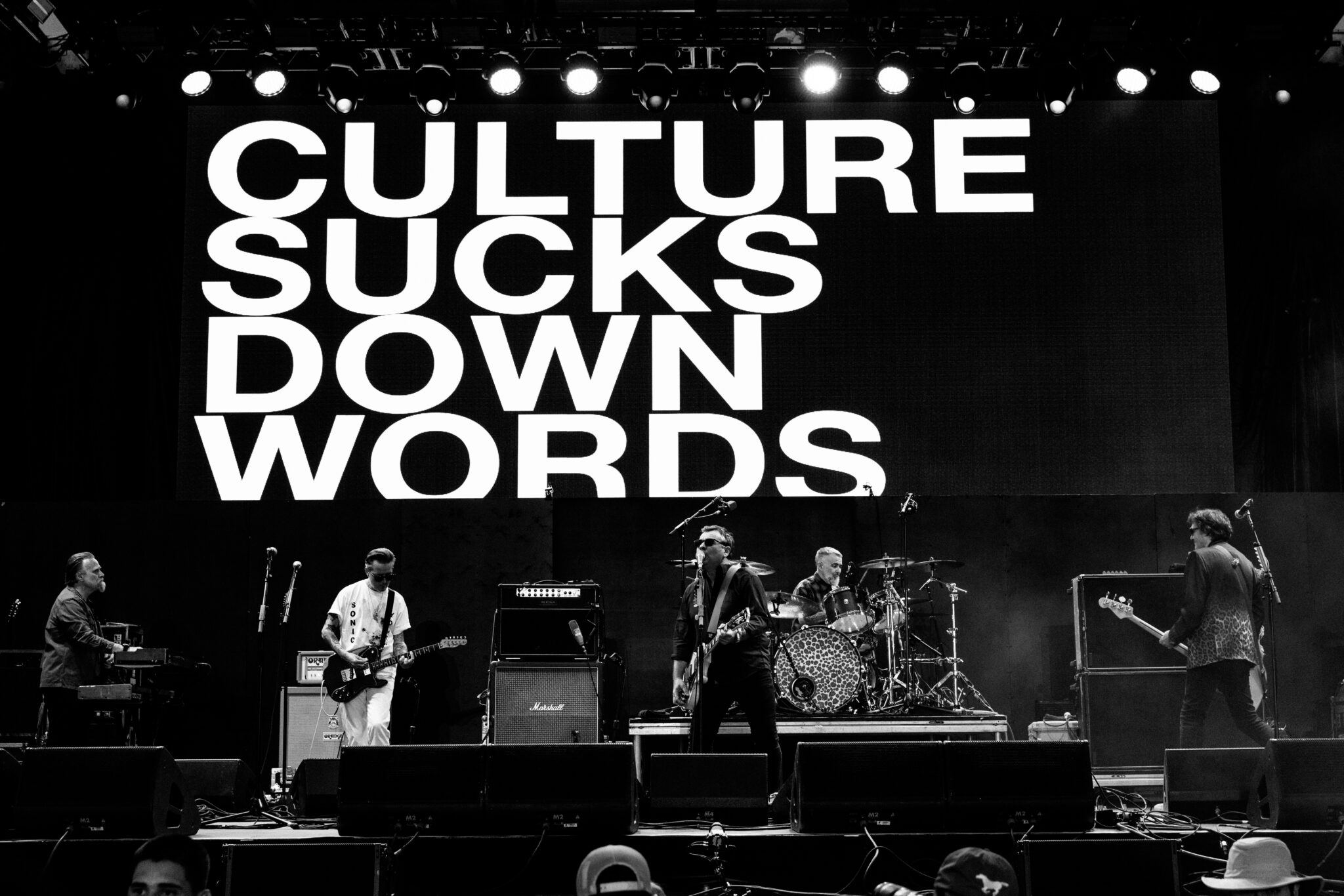
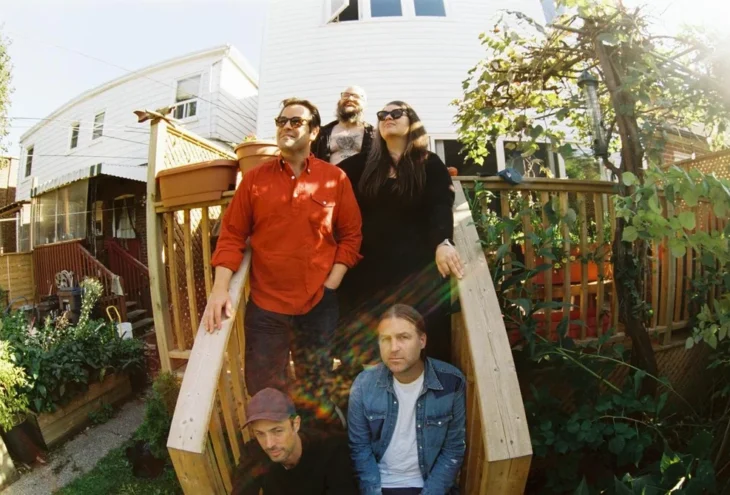
The Band: Fucked Up
The Members: Mike Haliechuk, guitar, lyrics, story, vocals; Jonah Falco, drums, guitar, vocals; Damian Abraham, vocals; Sandy Miranda, bass; Josh Zucker, guitar.
Written & Produced by: Fucked Up
Lyrics & story by: Mike Haliechuk
Mixed & Recorded by: Alex Gamble
Mastered by: Arthur Rizk
Full Credits & Liner Notes: For the complete list of recording studios, additional engineering, guests, and liner notes, visit Fucked Up’s Bandcamp page: Fucked Up
The Origin: Overloading the punk scene circuitry with a string of 7-inch hardcore incantations, Fucked Up gradually revealed an underlying capacity for hearing a hidden world of interconnected melodies and harmonic subtleties humming underneath the din of distortion, feedback, and static — phantom frequencies. Soon, their uncanny ability to intersperse sweeping open-string chords with a sweetening of strings became part of their exploratory palette, effortlessly setting those symphonic soundscapes alongside heavy roving basslines, relentless rhythms and unearthly vocals. That magnetic balance of rich melodic consonance written alongside atonal dissonance was ultimately set within traditional punk cuts, standalone sonic tone poems, and classically arranged multi-movement rock-based operatic suites.
This heightened sensitivity — an ability to tune into the inner ear’s faintest tonal echoes — in turn sharpened their eye for detecting life’s discordant realities and hidden harmonies. Placing those internal struggles beside eternal philosophical questions of the fate of fates and mortal woes found in classical texts, epic poems, and grand operatic symphonies, Fucked Up transposed those timeless anxieties into a limitless, self-referential continuum of sound and thought across their vast interconnected catalog. This interplay gave rise to recursive parallelisms linking their music and lyrics in a symbiotic fashion.
Shifting in scales of time through a telescoping, near-omniscient perspective, Fucked Up have effortlessly strung together a matrix of thematic reprises and character callbacks between ancient pasts, a splintered present, and a looming future. Examples appear throughout their archive, but most notably on their Polaris Music Prize-winning The Chemistry of Common Life, which is framed by a pastoral woodwind passage that debuts on the opening “Son The Father,” and resurfaces as a distorted rock reprise on the closing title track.
On David Comes to Life, they push their classical scoring even further by transposing Rashomon-style character arcs across an eighteen-track tragedy. That operatic instinct eventually spilled over into stolen-voice, stylized Italian arias on “Voce Rubata” and a metallurgical punk-classical crossover, Metallurgy, with Toronto’s Tapestry Opera.
After baiting the public with those celebrated full-length epics and even resurrecting David Comes to Life’s protagonist years later on Dose Your Dreams, Fucked Up gradually unveiled a monumental revelation — a vast second score, a companion overture composed in parallel and ticking alongside in time since 2006: the Zodiac Series.
This hidden cycle began with Year of the Dog, scattering amid label pressings over two decades — including Year of the Ox and Year of the Horse — before reaching the Grass Can Move Stones trilogy (Goat, Monkey, and Rooster). Its symphonic movements of contrapuntal sounds and themes are laced through their mind-numbingly large catalog, inviting the attentive to trace the recurring refrains, mythological archetypes, and timeless human struggles across turning wheels within wheels of years, casting an anamorphic reflection of modern times.
As Fucked Up’s resident librettist and hardcore-punk polyphonic rhapsode, Mike Haliechuk — alongside co-conspirator and drummer Jonah Falco — deploys symphonic sweep and operatic pacing as a cipher for their own mythic, hyper-detailed universe, drawing loosely on Wu Cheng’en’s Journey to the West to intertwine allegorical themes around the band’s own longform odyssey. With a cinematic, eidetic mind’s eye, Haliechuk has spent nearly twenty years scoring character arcs and cross-pollinated motifs into a panorama.
Now Haliechuk and company — aided by an amazing array of guests including Thurston Moore, Keith Morris, and Debsey Wykes among many others — bring this twelve-sign rotation of zodiacal archetypes and existential fables to a dénouement with Year of the Rooster, the closing movement in the three-part Grass Can Move Stones series (Year of the Goat, Year of the Monkey, and Year of the Rooster). This monumental, labyrinthine opus comes complete with old-school operatic liner notes and hidden epilogues.
The Production: For all the mythic, multi-layered scale of the Zodiac universe, Mike Haliechuk approaches its construction with a pragmatic, punk-minded fearlessness, scoring and linking complex movements in real time. It is an extemporaneous modus operandi that became standard practice for the band. He explains:
“Most of the core writing in the band now is done by me and Jonah. He lives in England, so we aren't around each other or together as a band enough to sit down and write out songs in a conventional way. He moved there in 2015 or something, so our records since then have mostly just been him and me writing together while we're recording and everyone else will add parts to the completed shells.”
Haliechuk applied that exact method when it came to tackling the grand Zodiac trilogy, a multi-year undertaking that required them to zoom out and treat all three albums as a single continuous piece.
“We wrote Goat/Monkey/Rooster all together as an evolving single piece, starting in 2019. Every few months he'd be in Toronto, and we'd book a week or two somewhere and just write. I don't like writing music if it isn't being recorded; it feels like a waste of time in our process.”
For a project of this magnitude, the execution also remains remarkably direct: “We don't do pre-writing, we don't demo with the Zodiac stuff — we just write and record them incrementally at the same time.”
While Haliechuk and Falco laid the structural rebar of the tracks side by side in Toronto, filling out the massive vocal roster required a dispersed studio setup:
“Jonah handled most of the guest vocalists - he'd either have people come into the studio in London or they'd record themselves at home. There are 30-50 guests on these records - it would take too long and be too expensive to have everyone come into the bigger places we were recording in.”
Much like casting an opera by vocal timbre, working remotely let Haliechuk invent new characters as the story grew, set their dramatic tone, and match each role with the voice it needed:
“The characters were evolving over the years, so it would have been hard to plan all that out in advance even if we wanted to. I'd write in a new character, give them some lyrics, set their tone, and then we'd go through lists of people we knew or liked, and send out the music and they'd send it back. We got to work with a range from friends to heroes.”
Working bar by bar, Haliechuk orchestrated their through-composed arrangements in real time — growing massive movements on the spot and expanding them in four-measure increments alongside narrative cross-referencing:
“The arrangements would come from the writing—over a 12-hour recording day, I can go into the booth and do guitar writing for like an hour to 90 minutes, maybe twice a day. So, I'd come up with a riff that would connect to the previous part we'd been working on, and just build the arrangements like that, each part stemming from the previous bit.”
Haliechuk explains further:
“So, I'd do four bars of a riff, call it a verse or a pre-verse or something, and then grow a new riff from there, and do that until I'd end up with like a 10-minute chunk of connected music. Then I'd do my own layering right then—harmonies or other bed parts.”
Once those arrangements were composed, turning them into finished songs required approaching the trilogy as a meticulous Gesamtkunstwerk — a total work of art — built on the alignment of sound, mood, and unfolding plot:
“We'd take a look at that, and I'd have to cross-reference the sound of the music with what was happening in the story and the lyrics, and have all the component parts meet each other. We'd make notes of what was happening in the story, what mood the music was setting—and months later I'd fill in the music with words.”
From there, the compositions entered a circuitous, years-long handoff across separate studios:
“Then, years later, Sandy would add bass at her parts, and meanwhile Damian was at his own studio at his own place, doing a few hours of vocals every few weeks. It took seven years to write the music and two years to write the lyrics, so there was a lot of waiting around.”
Keeping the music and narrative tethered together from day one for this round of the Zodiac was a response to composing Year of the Horse, where dramatic plot arcs and character leitmotifs had to be reverse-engineered onto pre-existing tracks:
“With HORSE, we had most of the music done before I was considering the lyrics or story, so I was often just fitting the story into stuff we'd written years ago. With these three, I wanted the music and lyrics to fit together more tonally, so there was a lot of cross-referencing going on while we were tracking, and each animal or character has their own sound motif, so we had to keep track of all those too.”
With so many ever-changing character and symphonic motifs, guest vocalists, and multi-year sessions in play, the trilogy needed a unified sonic thread to orient the listener. Much like an operatic basso continuo—the unbroken harmonic floor that allows vocalists and orchestras to leap across wild dramatic shifts without losing their footing—Haliechuk and Falco engineered an unexpected sonic experiment, tuning sampled vocal tones into an omnipresent foundation:
“Most of the instrumentation on these records is pretty straightforward, but the one thing that was new for us that kind of ties the entire thing together is a vocal sample we loaded into a MIDI to play it like an instrument,” says Haliechuk. “On the first day of tracking, we recorded Jonah doing a series of 'oohs' and 'aahs,' and we loaded them into a MIDI keyboard so we could use them as drones across every pitch — and that sound is like the rebar of the album. It's almost every minute of the music in the background to help orient you and set the tone we wanted for the sound.”
Falco’s MIDI-based harmonic hum is what keeps the trilogy oriented as it ricochets across Fucked Up’s own internal compositional motifs as well as decades of influential music. The cycle moves from Year of the Goat’s cinematic overtures into Year of the Monkey, where subtle echoes of Pink Floyd’s “Money” surface in the undertow, while later the warped, oscillating screech that closes Radiohead’s “Karma Police” cuts in like a string stinger. By Year of the Rooster, heavier music strikes with thrash metal speed and Reign in Blood-era screams that are akin to the blood-curdling roar at the end of Deftones’ “Gore.”
Reining in such dense, genre-rich, whiplashing arrangements into a cohesive whole required a streamlined slant, prompting Fucked Up to entrust the final mix to a unifying ear:
“Alex did all that. This is almost five hours of music, so we just kind of agreed that he'd do the mixing and EQ-ing on his own. We'd send him notes after he had some finished drafts.”
He adds, “If we had all been around for mixing, everyone would have just been pulling their hair out for hours, and it would have taken ages to get anything done. It was important that we try to streamline things due to the volume of music we were trying to finish here.”
Balancing towering operatic grandeur against hardcore fury, Grass Can Move Stones stands as a massive artistic feat, revealing a hidden world where abstract, existentialist storylines, melodic motifs, and discordant chords collide in strange yet lovely, jarring harmony. As this Zodiac trifecta of symphonic punk rounds out, Fucked Up sign off with a classic twist — a libretto postscript hinting that the cycle is far from over: “Fucked Up will return in the Year of the Dog.”
Photo Credit: Jake Ballah