MC: Can we geek out for a minute and talk about the groundbreaking E=MC2 album, which was the first electronic live-to-digital release?
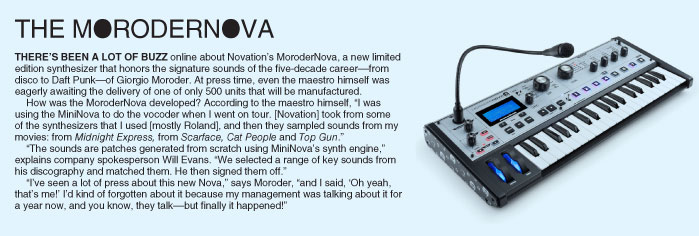
Moroder: Let’s say it was direct-to-digital in the sense that I think all instrumental stuff was direct, but the voices were not because I overdubbed my voice. First of all, I’d heard of that digital two-track machine from Dr. Stockham of Soundstream in Salt Lake City. I always wanted to be at the front of what was happening in technology, so I thought that it would be great to record the whole thing live-to-digital. It was an enormous job. I had several people playing live, I had some computers playing basslines and stuff, I had Fender Rhodes players fully automated and preprogrammed—unfortunately what happened is that I was so concentrated on the technology that I kind of forgot a little bit of the music side of it.
But it was great, it worked quite well and wasn’t that where I sang the credits through the vocoder? Somebody reminded me a few months ago and I listened again, and it’s really funny. “Tea and coffee by Laurie Howard.”
MC: C.K. Lendt’s book KISS and Sell mentions that you were in talks with the band to possibly produce their 1979 album, Dynasty, and when I interviewed Gene Simmons for Music Connection in 2002, he claimed you borrowed the melody from that album’s single “I Was Made For Loving You” when you did “Call Me” with Blondie. What do you make of Gene’s recollection?
Moroder: You know what? I don’t remember at all. I know that KISS was at Casablanca and I was at Casablanca, but no. I probably heard it [“I Was Made For Loving You”], and it has some similarities, but there are always similarities. I don’t really believe [the story about me producing KISS], because KISS were so pissed at us––at me and Donna—because they were the rock gods and we were those stupid, well, not stupid, but we were “those disco guys.” I never heard that they asked me to produce a song or an album, and I don’t remember ever talking to them.
MC: After watching Dave Grohl’s Sonic Highways documentary series, I’m sure people would want to know more about your Musicland Studio in Munich, where you recorded “Love To Love You Baby” hits. And also, what about Larrabee Studios in Los Angeles?
Moroder: Musicland was my studio in Munich, and we had The Rolling Stones recording there, we had the last album for Led Zeppelin, but then when I moved to the States I was becoming less and less interested in it so I sold it to Mack, my engineer, who took care of it. And he did a lot of recordings with Queen and with Freddie Mercury, but then he moved to the States, too. So unfortunately that studio doesn’t exist anymore.
Larrabee was the studio that I had in North Hollywood on Lankershim [where Moroder worked with Sparks on their No. 1 in Heaven album], but I also remember working in the Larrabee studio on Larrabee St. in West Hollywood.
MC: One last question... It’s been 30 years since your last record; how do you feel now that Déjà vu is finally being released to the world?
Moroder: All I can say is that I’m very happy with the results. For now, I have great reviews––not too many people have listened to the whole album, but I’m really surprised how good the reviews are––and if I look at iTunes, the preorders are great and the preorders have five stars, for which I’m also very happy.
MC: Great to talk with you again, Giorgio.
Moroder: Okay...so I guess I’ll talk to you in about 10 years? [Music Connection’s Daniel Siwek last spoke with Moroder for the magazine’s first issue of 2001.]
For more information, visit facebook.com/giorgiomoroderofficial.
By Daniel Siwek