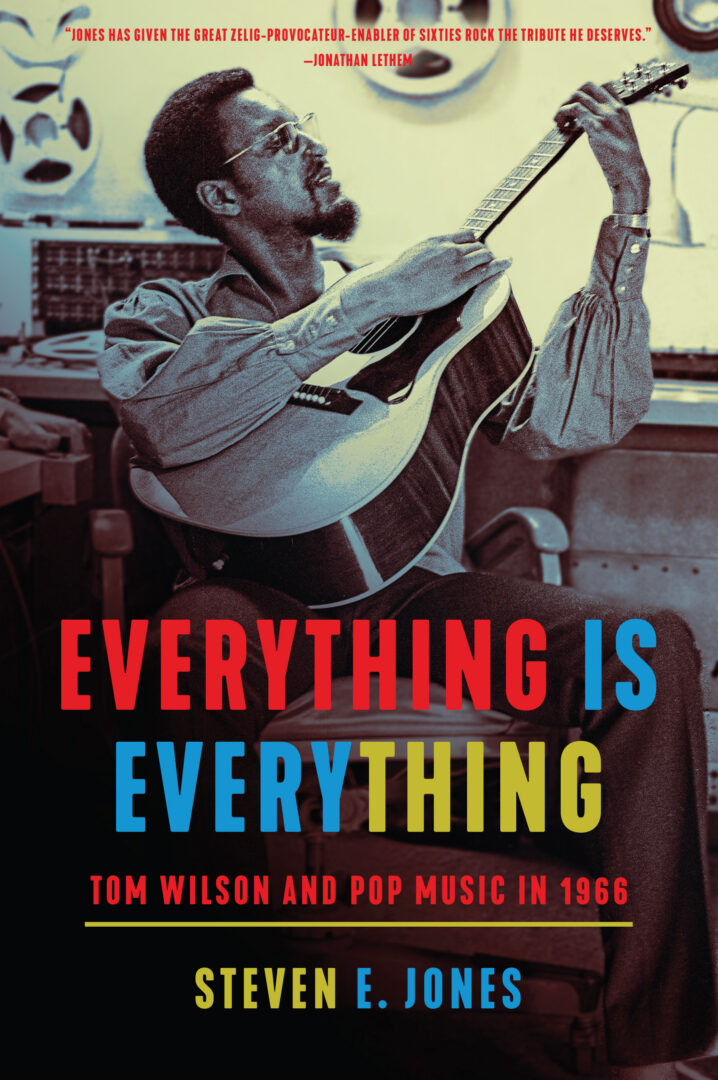
Everything is Everything: Tom Wilson and Pop Music in 1966 by Steven E.Jones (Stanford University Press, 240 pages, $20.00, September 29, 2026) sets out to decode a transformative year in popular culture. It’s the year go-go dancing met the electric blues, bubblegum pop met underground rock, free jazz met psychedelia, and they all morphed into one another like fluid blobs in a liquid light show.
Diversifying radio formats, especially the emergence of “underground” FM stations, greeted a unique efflorescence of boundary-breaking artists, records, and songs, at once showcasing and encouraging fervent experimentation. In Everything is Everything, Jones tracks the confluences of that miraculous year by following the profoundly influential record producer, Tom Wilson, and the groundbreaking work he stewarded.
It would be hard to find a figure more solidly at the junction of the currents traversing America in 1966. A Black man working in almost exclusively white studio settings, Wilson played a vital role in an astonishing array of landmark records: in just this one year, Wilson produced albums from Frank Zappa & the Mothers of Invention, The Velvet Underground, Hugh Masekela, Eric Burdon and the Animals, Sun Ra, and more. Any one of these would be a standout on most producers’ resumes. Taken together, they testify to a unique career, and invite a new appraisal of a pivotal moment in American pop culture.
As Jones reveals in this energetic account, Wilson’s embrace of myriad musical genres was a response to the times, as was his engagement with the music industry as a whole and with the low and high in pop culture. It was all part of making pop music in what he called “an era of complex mixed media” when—in his catchphrase—“everything is everything.”
Dying young in 1978, without leaving behind a significant archive of interviews or writings, Wilson has often been unjustly overlooked. Everything is Everything provides a testimonial that is long overdue, celebrating him as an avatar of the most important trend in pop music in 1966: an exploding eclecticism, accompanied by a sometimes-desperate search for authenticity.
Steven E. Jones was DeBartolo Chair in Liberal Arts and Professor of English and Digital Humanities, University of South Florida, and is the author of many books, including Cell Tower (2020) and Roberto Busa and the Emergence of Humanities Computing (2016).
Advance Praise for Everything is Everything:
“Two books rolled into one: an exploration of Tom Wilson, understudied maverick and industry mainstay, and of 1966 in pop music via the array of groups he produced. This works because of the intricacy, thoughtfulness, intelligence, and prodigious research that animate these pages.”
—Eric Lott, author of Black Mirror: The Cultural Contradictions of American Racism
“A kaleidoscopic portrait of a chaotic and creative year in popular music history organized around one of the most neglected and influential producers of the era, Everything is Everything is everything and more.”
—Loren Glass, author of Carole King’s Tapestry
Record producer Thomas Blanchard Wilson Jr. (March 25, 1931 – September 6, 1978) deserves an induction into the Rock and Roll Hall of Fame just for his studio excursions with Cecil Taylor, Sun Ra, Eddie Harris, Hugh Masekela, Bob Dylan, Simon & Garfunkel, the Mothers of Invention, Blues Project, Velvet Underground, along with Eric Burdon and the Animals.
Marshall Crenshaw has been producing a documentary on Wilson.
In the mid-seventies, I was around Tom Wilson a couple of times when he was scouting talent at Doug Weston’s Troubadour club in West Hollywood and doing work for Motown Records. I think he was living in Pacific Palisades at the time and had a son at Palisades High School.
Wilson was a friend of Robert Marchese, the club’s manager, who met Wilson in 1965. Wilson told Robert a funny story one night about glimpsing Jimi Hendrix, Mitch Mitchell and Noel Redding walking on 42nd Street in New York in 1968. The loudly dressed Jimi was wearing a feathered hat when Tom hailed him at a crosswalk. Jimi immediately inquired, “How did you know it was me?”
Since 2004, I have thanked Tom Wilson in a couple of dozen of my books. His 1965-1967 studio endeavors made a big impression on me, particularly his production on Bob Dylan’s “Like A Rolling Stone,” and Mothers of Invention’s Freak Out!
In 2001, I interviewed songwriter/multi-instrumentalist and record producer Al Kooper and asked him about Tom Wilson. Kooper had penned a couple of tunes that Wilson produced on the Mad Lads and Freda Payne before he played the organ on the Wilson and Dylan “Like A Rolling Stone” collaboration.
“Tom Wilson. Wonderful guy. Tom earlier worked for Savoy Records. He was a very bright guy. He was a very high-class guy. Now he was definitely a Black man, and he was a very well-educated Black man. He graduated [cum laude] from Harvard University.
“He was a soulful and funny guy. And that’s him laughing on Bob Dylan’s ‘115th Dream,’ where it breaks down. That’s his laugh. That fit of laughing. That’s not Dylan. That’s Tom Wilson laughing. He was like, ‘What’s happening, man?’ That kind of guy.
“I used to cop Dylan acetates out of his office at Columbia Records. I was a bad boy. Tom was sort of a spectator sport producer. He didn’t do all that much. He’d put you in the studio and get the job done. He didn’t interfere in anything. At least when I worked with him.
“On that “Like A Rolling Stone” date, my organ follows the Dylan vocal. I did that because I was waiting to see what chord they were going to do. There was no music or lead sheet, or anything. I was just playing by ear, and I didn’t want to be the one making a mistake because I was doin’ like a rebel run there.
“But you knew Tom was bright and he talked about very erudite things, and he really saved my life that day on that Dylan ‘Like A Rolling Stone’ session. Because he could have…I went to him and said, ‘Man, let me play the organ.’ They had just moved Paul Griffin from the organ to the piano.
“And I went over to Tom Wilson, and I was invited just to watch, you know, and I said, ‘Man, why don’t you let me play the organ? I got a great part for this.’ Which was bull shit. I had nothing. And he said, ‘Man…You’re not an organ player…’ And then they came to him and said, ‘Phone call for you, Tom.’ And he just went and got the phone. And I went into the studio and sat down at the organ. He didn’t say no. He just said I wasn’t an organ player. OK.
“On the Highway 61 Revisited interactive CD put out a few years ago, they have the multiple takes of ‘Like A Rolling Stone,’ and on there you can hear Tom Wilson, ‘OK. This is take 7. Hey! What are you doing in there?’
“Then you hear me laughing, and that was the moment he could have just thrown me out and rightfully so. And you know what? He didn’t. And that was it. That was the beginning of my career. Right then and there. That studio dialog is documented.
“Wilson is the guy who invited me to the session first of all, which is really nice. You didn’t get invited to Bob Dylan sessions, you know, especially if you were a nobody like I was. And there it was. There was the chance he had to toss me, and it would have reflected on him because he had invited me to the session.
“Tom brought the musicians into the session, including drummer Bobby Gregg and pianist Paul Griffin, who is also on Dylan’s Bringing It All Back Home. Paul was a biginfluence on me as well! Paul came from the Baptist church.
“The best thing I can say about Paul Griffin is take five minutes out of your busy day and get a time where you have nothing to bother you at all. Find a real nice stereo system and sit back and put on ‘One Of Us Must Know (Sooner or Later)’ from Blonde on Blonde. And just listen to the piano…And tell me if you can find on a rock ‘n’ roll record anybody playing better than that. And I would really like to hear what your decision is.
“To me it is the greatest piano achievement in the history of rock ‘n’ roll. I don’t hear anything but him playing the piano when I hear that record. But I’m thrilled that I’m playing organ, but I’m embarrassed. And I think that Dylan should be embarrassed too. ‘Cause Paul just steals that fuckin’ record. It’s the most incredible piano playing I’ve heard in my life. If you’re a piano player, try playing that note for note. It’s just incredible. Griffin also played on those Chuck Jackson records like “Any Day Now” and worked with Garnet Mimms.”
It was Tom Wilson, then a staff producer at Columbia Records, who suggested to label employees in a 1964 product meeting that a newly signed folk rock duo act, Simon & Garfunkel, should remain Simon & Garfunkel, and not be concerned about limited radio airplay owing to their names.
Their debut album, Wednesday Morning, 3 A.M., sold poorly.
In late 1965, partially owing to the commercial success of Dylan’s “Like A Rolling Stone,” Wilson then overdubbed electric guitars, bass guitar, and drums to the existing acoustic rendition of “The Sound of Silence,” without Simon and Garfunkel’s knowledge, and it reached number one on the Billboard Hot 100 chart.
In December 1965, Guy Webstar took photos of Bob Dylan at his Hollywood press conference, held in the Columbia Records Press Room and arranged by Billy James from the label.
Webstar was no stranger to the world of music and show business. His father, the lyricist and songwriter Paul Francis Webster, earned three Academy Awards for Best Original Song. “Secret Love,” “Love is a Many-Splendored Thing,” with Sammy Fain, and “The Shadow of Your Smile” with Johnny Mandel. His first hit lyric and music from John Jacob Loeb was in 1932 for “Masquerade,” performed by Paul Whiteman.
“I was doing a lot of photography for Columbia Records and told my father I was going to photograph Simon & Garfunkel for an LP cover, and I wanted him to meet them,” Webster reminisced in a 2014 interview with me.
“I brought Simon & Garfunkel by, and my father and Paul Simon hit it off because he learned Simon was a Dickensian scholar. So was my dad. He had a Dickens collection. Then Paul Simon said, ‘Hey, you want to hear our new song?’ And he pulled out his guitar in the living room, in Beverly Hills, and my dad was sitting there, who is not a rock and roller, and he listened to ‘Sounds of Silence’ for the first time. ‘Oh my God, you guys. What a brilliant song.’
“I took Paul and Art up to a dirt road in Franklin Canyon and shot the cover of Sounds of Silence for Columbia Records. The name Garfunkel got me. I never forgot it. I heard “Sounds of Silence” five or six times before I shot the cover. And I wanted that thing where they’re walking down the road, a little English with the scarves behind them, with Art’s hair.”
In 1959, guitarist Elliot Ingber was in the Gamblers with bassist Larry Taylor, guitarist Derry Weaver, and keyboardist Bruce Johnston. Nik Venet produced the Gamblers’ “Moon Dawg” and “LSD-25” in 1959 for World Pacific Records. Ingber also gigged with drummer Sandy Nelson and guitarist Don Peake.
After his 1966 stint with Frank Zappa and the Mothers of Invention on Freak Out!, Elliot co-founded Fraternity of Man, produced by Tom Wilson. Ingber and Lawrence “Stash” Wagner co-wrote "Don't Bogart Me,” renamed "Don't Bogart That Joint," on the soundtrack to Easy Rider. Elliot later recorded with The Factory, Little Feat, and Shakey Jake Harris. In 1972, he was heard in Captain Beefheart’s Magic Band, employing the stage name Winged Eel Fingerling, for 1972’s The Spotlight Kid.
"I first met Tom Wilson while being a guest of my brother Elliot Ingber, as he participated in the recording of the first Mothers of Invention album,” guitarist/songwriter and producer Ira Ingber emailed me in August 2026.
Ira is now recording and playing in two Southern California-based bands with guitarist Steve Bartek, BarIng All, and jackiO.
Ingber visited TTG and observed the groundbreaking recording sessions of Freak Out!
“It was early in 1966, and the studio was TTG on the corner of Highland Ave. and Sunset Blvd. in Hollywood. Tom Wilson was sitting behind the recording console with the recording engineer, who I believe was Val Valentin. I recall Tom being very welcoming to me. He was impeccably dressed, and equally well-groomed. Urbane, thoroughly professional, and clearly very much in charge was he. I was seeing what a ‘real’ music producer did and how he did it, first hand. He possessed, among other things, the first portable telephone I had ever seen. It was a rotary phone in a briefcase. This guy needed to make important phone calls immediately, I thought.
“I attended several sessions. All the members of the band knew me, and Frank was especially kind to me. He had generously lent me a Fender Twin Reverb amp, as well as a Rickenbacker 12-string guitar for an extended period. Tom also actively engaged in conversation with me, a 16-year-old kid!
“In 1969, also at TTG, I ended up playing bass on several Fraternity of Man songs for their second and final album, Get It On. The Hagstrom 8-string bass I played belonged to Frank Zappa. He had lent/given it to my brother years earlier.
“Tom was producing this second Fraternity of Man album, just as he had done the first one. He attempted to bring some version of order to what was a very chaotic setting. He was supportive and completely encouraging of my own attempts to bring some musical order to the chaos. He didn't look down at this now 19-year-old kid. He treated me as a serious musician who was earnestly performing his parts. I will never forget his smiling countenance, and his confidence-building demeanor."
The Turtles’ Howard Kaylan was also in attendance at the Freak Out! sessions.
“I went to the Freak Out! recording sessions at T.T.G. studios,” Kaylan recalled in an interview we conducted last decade.
“Back in that era in 1966 and ’67, before ‘Happy Together’ hit, and Mark Volman and I were still street people in L.A., working in the same clubs and stuff, there was enough of a camaraderie there. Knowing him, but also through [manager] Herb Cohen and going to the Zappa log cabin in Laurel Canyon.
“I go to the Freak Out! that night. There are two or three rooms that are being used simultaneously, and Frank had tape recorders going in all of them. There are different tracks being played in all of them, and people are doing different things in every room. Frank would put some guys in one room, and some in another. The environment was more Soupy Sales than, say, Spike Jones. He’s creating his own scenarios. He’s making people go up to the mike and either rant in their own language, or getting them to say things. I think I was doing a little bit of both. Then I went into another room, where it seemed to be like an orgy, and that’s where [Tom] Wilson was.
“I knew who he was. I was aware that he was the guy who produced Dylan and many other gems. They were just recording random couples and noises, and people who had not met each other before. Frank would actually direct them physically, almost like he was directing a movie. It was surreal and great. I really wanted to be a part of it. It was so outside of my normal, structured thing. I had no idea, and still don’t know, how much stuff was ever going to be used. Brilliant editing job. Still a masterpiece, in my mind.”
Earlier this century, songwriter/record producer/music publisher Kim Fowley detailed his own encounters with Frank Zappa.
“My impression of Zappa was ‘John Cage-obsessed doo-wop guy with emotional leanings toward East Los Angeles Latin and Black culture, making fun of White people who were superficial and shallow.’ Which, of course, was cool.
“Zappa was another guy in the mid-sixties standing around in Laurel Canyon clothes. Nothing more, nothing less. Somewhere between a beatnik and a farmer.
“The first gig we did was in a venue, a building on Santa Monica Boulevard near the intersection of Crescent Heights. They used to have music there, where people and independent promoters would rent it and four-wall it. Two hundred, three hundred people. The Mothers of Invention went in. I came on for two or three songs. It was raga music, jazz changes, Roland Kirk, R&B, atonal, mantra, rock.
“I knew guitarist Elliot Ingber who was working with Frank before the Freak Out! LP recording sessions from the late 1950s with Don Peake from an Italian restaurant in Los Angeles on Pico Blvd. It was owned by singer Timi Yuro’s mother. A lot of the up-and-coming musicians, songwriters, and producers would eat there. Timi’s mother would give us discount spaghetti dinners.
“Later, at Canter’s Delicatessen, Frank then said, ‘We’re going in the studio to do what we did tonight. I have some stuff for the band that I have learned. We’re gonna turn the street loose in there, and you can come down and make noise if you want.’
“I’m on the track ‘Help, I’m a Rock.’ I walked into the studio with Les McCann and Danny Hutton.
“TTG. Studios was a giant cheeseburger box with high ceilings. Owned by a sound engineer, an Israeli named Ami Hadani, who built studios and worked with Tom Wilson and Zappa on Freak Out! and Absolutely Free. Bill Parr built and designed the T.T.G. board in the big film-scoring room upstairs. He was one of the engineers on the Hollywood Argyles’ ‘Alley-Opp’ that we did at American Recorders. Jimi Hendrix later recorded at TTG, and cut one of my songs, ‘Fluffy Turkeys.’ Tom Wilson did some producing on the Soft Machine at TTG. I earlier produced them in England.
“For Freak Out! we were there all night. We didn’t get paid. We did it because Frank convinced us it was historical and we were on the cusp of something, and we all bought into it. We all wanted to go have breakfast. That was more important. I shared a microphone with Mac Rebennack and Les McCann.
“The Freak Out! album to me was John Cage meets 1920’s France. A Josephine Baker version of art is anything that you can get away with. I thought Frank was gifted. I thought musically he was brilliant.”
During 1967-’68, Wilson, a former college deejay, hosted a radio series The Music Factory, sponsored by the MGM and Verve record labels.
It debuted in New York on WABC-FM in June 1967. He did 25 hour-long syndicated episodes on vinyl records, featuring interviews with engineers, producers, and musicians, often implementing tracks from the MGM and Verve library.
In 1969-1970, Wilson was a partner in The Record Plant recording studio, who were involved in the Jimi Hendrix Band of Gypsys live dates at the Fillmore East venue.
(Harvey Kubernik is the author of 21 books, including 2009’s Canyon Of Dreams: The Magic And The Music Of Laurel Canyon, 2014’s Turn Up The Radio! Rock, Pop and Roll In Los Angeles 1956-1972, 2015's Every Body Knows: Leonard Cohen, 2016's Heart of Gold Neil Young and 2017's 1967: A Complete Rock Music History of the Summer of Love. Sterling/Barnes and Noble in 2018 published Harvey and enneth Kubernik’s The Story Of The Band: From Big Pink To he Last Waltz. In 2021 they collaborated on Jimi Hendrix: Voodoo Child for Sterling/Barnes and Noble.
Otherworld Cottage Industries in 2020 published Harvey’s Docs That Rock, Music That Matters. His Screen Gems: (Pop Music Documentaries and Rock ‘n’ Roll TV Scenes) was published in February 2026 by BearManor Media. Kubernik is researching a multi-voice narrative study on the Beatles scheduled for a UK publisher with a planned fall 2027 publication date.
Harvey spoke at the special hearings in 2006 initiated by the Library of Congress held in Hollywood, California, discussing archiving practices and audiotape preservation.
In 2017, he appeared at the Rock & Roll Hall of Fame in Cleveland, Ohio, in its Distinguished Speakers Series and as a panelist discussing the forty-fifth anniversary of The Last Waltz at the Grammy Museum in Los Angeles in 2023. Kubernik attended the 1976 event.
Harvey was interviewed with Iggy Pop, the Beach Boys’ Bruce Johnston, Love’s Johnny Echols, the Bangles' Susanna Hoffs, Victoria and Debbi Peterson, and members of the Seeds for director/producer Neil Norman’s documentary The Seeds: Pushin' Too Hard. In winter 2026, GNP Crescendo plans a release on DVD/Blu-ray). Author Miss Pamela Des Barres narrates.)