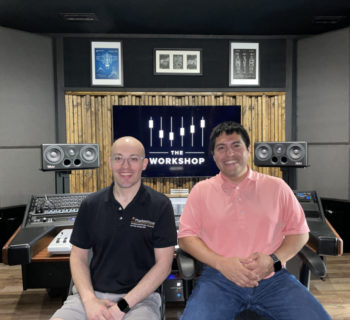
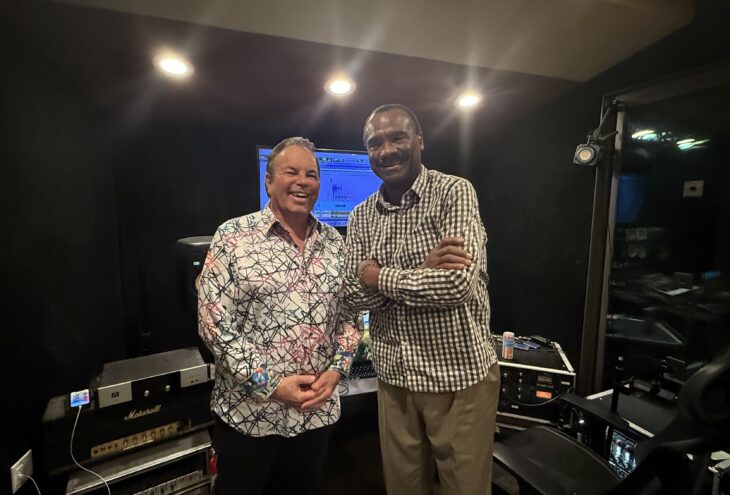
Pictured: David Chatfield and Ronnie Laws
Harmony Records owner David Chatfield is a veteran record producer, recording studio owner, and production company executive.
In the summer of 2026, Chatfield and Harmony have a slew of recordings planned and several just released. In addition, the multi-instrumentalist and lawyer has some very viable observations about the 2026 record business, the producer as a remixer, streaming, and the physical product world. I’ve previously worked with David on several projects.
In late May, we discussed Harmony’s June and July releases and the vision he’s established for his growing artist roster, which currently includes Ronnie Laws (feat. Stevie Wonder), Jose Feliciano, Julian Shah-Tayler, Steel Breeze, Sumthing Strange, UnZepped, the Storm, and the late Michael Japp.
“In late June comes the Easy to Love album by Julian Shah-Tayler,” mentioned Chatfield. “My hand-picked best of Julian’s songs designed to attract worldwide mainstream music fans to my re-imagined and re-worked vision of his music to expand Julian’s success in ‘new wave,’ and ‘goth.’ There’s an Easy to Love playlist on Spotify and a Julian Shah-Tayler playlist.
As Chatfield released his remixes, Julian’s fans began to request more. Places like the Spotify New-Wave Podcast were drawn to Julian’s music and have ranked him high in their annual top 5 new wave artists (which include all of the legacy artists) over the past several years. Julian and his music have also received critical success.
“The music tracks were written and done by Julian. I reimagined the songs, revised the arrangements, enhanced each with additional instrumentation, percussion, remixing, and remastering all by me.
“The album and its packaging are designed as an art piece to allow Julian’s fans to be able to peer into Julian’s variety of work. These are some of my favorite songs by Julian, re-arranged and reimagined in my unique way. I am mesmerized by Julian's layering of sounds. Each of these songs was meticulously hand-picked by me, with Julian's approval. I remixed (in my proprietary way) and mastered (in my unique way) every song, including ‘Easy,’ and ‘Secret,’ that were originally produced by Robert Margouleff. ‘Easy’ was not previously released, so technically my remix is part of the original mix. The music tracks were written by Julian.
“I took [engineer/producer/synthesizer pioneer] Robert Margouleff’s mix, and I added beats to it, and re-did the whole song. I released it as a single in May 2026, and it is currently doing very well internationally.
“When I first created Harmony Records and Sound Image Records (now a subsidiary label), I met Margouleff in the eighties after his groundbreaking collaborations with Stevie Wonder in his ‘classic period’ and the hit album by DEVO,Freedom Of Choice/Whip It.”
Chatfield is actively involved with jazz saxophonist Ronnie Laws.
“In late May and June. 2026 I went into the studio with flutist and saxophonist Hubert Laws (Quincy Jones, George Benson, Herbie Hancock, Paul McCartney, Aretha Franklin, Stevie Wonder, among others) and guitarist Ray Fuller (Whitney Houston, Anita Baker, Luther Vandross, Natalie Cole, Quincy Jones, among others), and Alexis Lombre to complete the Laws family instrumental cover ofStevie Wonder’srecording ‘Ribbon in the Sky.’”
Harmony issued two earlier versions of Laws’ “Ribbon” featuring Stevie Wonder in March 2026, which is doing well globally.
“Stevie Wonder,” added Chatfield, “played harmonica during the initial sessions, and is joined by Howard Hewett (Shalamar), Larry Dunn (Earth, Wind & Fire), and Debra Laws, with Larry Dunn on synthesizer and keyboardist Rob Mullins. The production and engineering on ‘Ribbon in the Sky’ is by co-producer Ronnie Laws, Craig T. Cooper, and mixing engineer Mecca Agoh. I was the co-mixing engineer, digital editing engineer and mastering engineer. This Laws family release should be out in June 2026.”
David is also preparing two Steel Breeze albums, a band from Sacramento. “It’s from the eighties, nineties, and current century,” described David.
“The first one is the hard edge of Steel Breeze, not the pop music group perception some felt they were. The second album is a collection of hits, demos, and unreleased music with a variety of lead singers. I think Ken Goorabian is one of the best songwriters I’ve heard. Spending a decade on the road playing covers and originals, Ken learned how to write a hit song. ‘You Don’t Want Me Anymore’ was a major hit single. It’s Northern California rock. I took my Southern California musical background and mixed it with Northern California music, which Goorabian did, and turned it into what I call the California Sound.
“Because of that, we have charted in more than 50 countries around the world and they went to number one in several. Can you believe that a band that I helped record in the eighties, put out music in the nineties, I can now turn a brand-new audience in this decade on to them? I am very involved in their releases.
“On one song, ‘Where is the Love,’ which is a rock ballad, I played or recorded maybe 15 instruments added to Ken’s work, remixed everything.”
Chatfield is also working with the group Sumthing Strange.
“They bring a dramatic sense of flair and theatricality to their music. I started by remixing their song ‘Where I’m Going.’ I’m now also going to work with the leader of the band, Johnny Santoro, in his solo career. He is writing songs and recording them, and I’m gonna listen, build on hooks or create new hooks, put them into analysis in my brain, play them out, and hopefully they will reach a large audience. Johnny is co-writing with Michael Caruso, who has had a hit and chart success in each of the last 4 or five decades.”
David and Harmony are in production of a tribute album to Michael Japp, who was a Welsh musician and songwriter.
“Japp was in the group Marmalade and then went on to write or co-write songs with Paul Stanley of Kiss and the Babys. Roderick Falconer cut one of his songs for his album New Nation, Kisscovered “Killers,”and the Babys did“Head First.” Japp had a solo album,Dreamer, in 2000. I signed Japp years ago to my production company.
“I continue to work with the band Storm. It is a group with two female singers in a melodic hard rock band context. They have an active underground following and went top 5 on Spotify charts for the first two singles I remixed.”
The Harmony Records catalog also houses fairly recent recordings by Jose Feliciano, which were produced by the label’s head of A&R for Latin and International music, arranger/percussionist Bob Conti.
Earlier this decade, Harmony issued Feliciano’s popular version of the Beatles’ “I Want to Hold Your Hand.”
“It charted in many countries and was added to many playlists around the world. Currently, it’s trending on TikTok in Israel as an anti-war political satire. In my proprietary way, I think I made Jose sound ten years younger in his vocals,” he suggests.
“Jose and Bob Conti also collaborated on a rendition of Elton John’s “Sixty Years On” that I remixed and released worldwide on all streaming services. All of Jose’s music, just like Steal Breezes’ music, has fully filmed music videos produced by Harmony Records in Kyiv, Ukraine, by an acclaimed director and videographer.
“Bob has recorded a couple of dozen sessions by Jose Feliciano that we hope to can be heard and brought to fruition. I’m reviewing the material now.
“There’s also a cover of a standard, ‘My Foolish Heart,’ a standard that was composed by Victor Young, and lyrics from Ned Washington from 1949. Billy Eckstine, Bing Crosby, Roberta Flack, Ralph Towner, and Tony Bennett, with Bill Evans, have covered the tune. It sounds like Jose is playing in a bar in Brazil. Bob worked for many years as a percussionist with Donna Summer.”
In 2025 at the Coachella Valley and Music Arts Festival, Jose and his guitar joined fellow Puerto Rican recording artist Bad Bunny for “La Canción” and “Yonaguni.”
Four years ago, Feliciano was given the first Legend Award at the Billboard Latin Music Awards. In 2021, he was among a dozen recipients of the National Medal of Arts awarded by President Joe Biden.
Chatfield has a deep history in the ever-growing remixing endeavors by engineers and record producers.
“I veered into the remix world many years ago after I got my law degree working with engineer and mixing producer Taavi Mote. I managed him and was with Taavi in many studios working for all the major record labels, and on special mixes for the band U2. We did ‘Desire’ and many assignments for Shalamar. I did a Madonna song with Taavi, ‘Causing a Commotion.’ I was involved in the remixing of the Miami Vice theme with Jan Hammer.
“Streaming and sync licensing are the new radio where people discover the music, with the help of Shazam,” reinforced Chatfield.
“In the movie Top Gun, I represented the film editor as his lawyer. And at the same time, I was with Taavi Mote remixing music for the soundtrack. So, I was working as a lawyer and as a producer at the same time.”
Chatfield offers observations on the remixing universe.
“Because the shape of the final song matters as much as its central elements. In any major musical modeling system, you don't run the model once. You run dozens or hundreds of times, each time with slightly different starting and bridge conditions in order to sample the range of outcomes that the physics of the system will allow, given that the current market suggests that small differences in initial and subsequent conditions are producing large differences in outcome, which means the remix process system is sensitive and uncertain.”
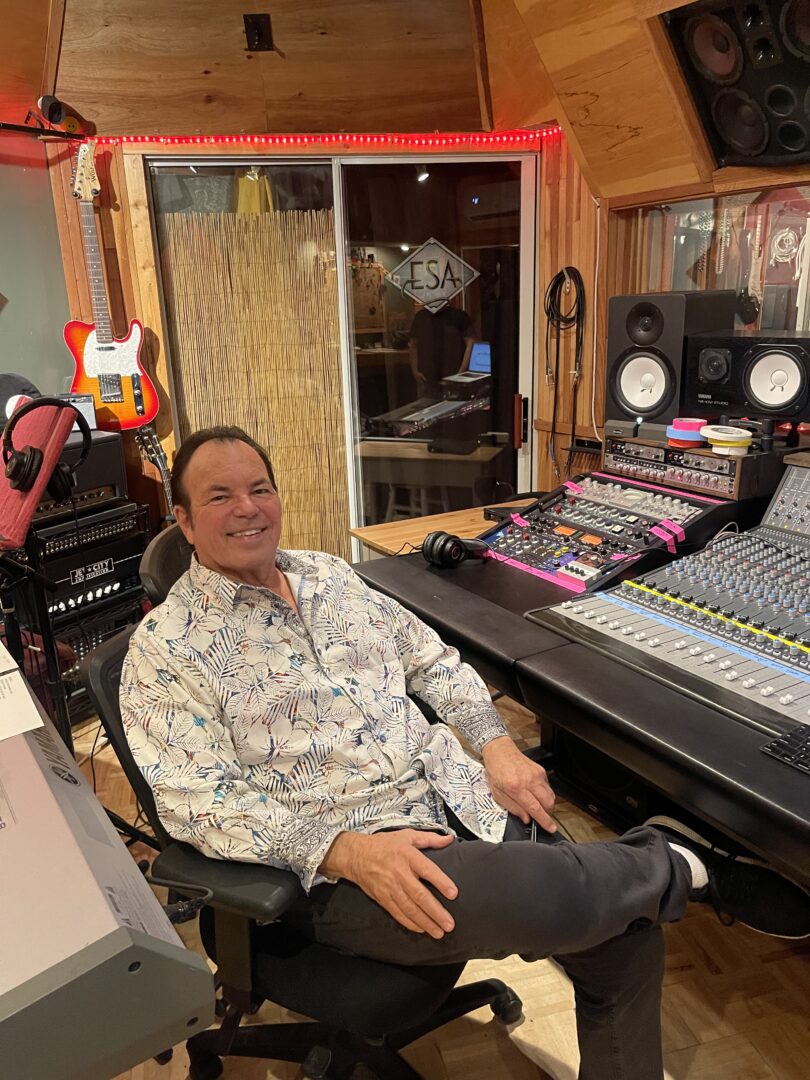
In my visit to Chatfield’s home studio, he discussed equipment that helps inform the sonic aspects in his Harmony Records productions.
“I have 25 guitars, one of them was signed by Crosby, Stills, Nash & Young, a Pearl drum set, and I had a Roland Drum Machine in the eighties. But now I employ a Yamaha Arranger keyboard which is very prominent in movie soundtracks. It contains all authentic samples of instruments from different eras and from all over the world. I have a lot of microphones, including Neumann.
“I don’t record on a grid. If someone sends me something that has been recorded on a grid, I take it off the grid. Because my music makes you feel something. The grid makes it feel like a computer. That’s not what music is.
“I can make things sound live and present. And their voice becomes more clearly apparent. The way it would be when Dolby gave me their surround system before it was out. Why M&K Subwofers gave me their surround sound system and why my clients who were editors and second unit directors in motion pictures would visit me to hear what it sounded like when they started to do it for motion pictures,” he explained. It was the 80s, and I had just sat through classes at the USC film school on film scoring in 70 mm, what a new kind of sound technology.
“I master my own recordings and do not go to mastering labs. I want it to sound like 2026. Not like 1980. Some of the veteran mastering engineers who I like and respect came from the LP, the vinyl world, and they had to be concerned about the technical limitations of the need for space, which isn’t in the CD or MP3 world. I also try to make the record sound as live as possible. The mastering engineers want to make it sound like a recording. I listen in Dolby Atmos, in 5.1, to all the different types of mixes. I love Bruce Botnick’s mixes of the Doors. Because it sounds like when I saw the Doors play.”
Sydney Alston is Chatfield’s director of A&R and management partner, who was formerly with Disc Makers for two decades.
A former professional bassist and singer, Alston’s expertise extends into academia and modern industry solutions, having taught the Music Business Entrepreneurship class at UCLA. Currently Sydney serves as an Account Executive (Artist Relations) at Yondr, where he has worked with recording artists Bruno Mars, Justin Bieber, Jill Scott, and Paul McCartney to execute high-impact, phone-free shows and tours.
“He’s accompanied me to Midem, the international music event, many times. Sydney is an integral part of the success of Harmony Records this decade. Sydney and I worked closely together mixing and remixing the songs that started Harmony’s modern chart-topping successes.
“Being a trained musician who attended the Berkeley School of Music before being snatched away by the music business, Sydney assisted in honing my Digital Recording skills on Pro Tools. This was a digital recording in an analog fashion. I don’t work on a grid. He and I did things that sound and feel musical. This intent to produce authentic musical releases is what causes the music to rise above the other 150-200,000 songs released per day. Sydney also knows my belief in the importance of the song. We both seem to be able to ‘hear’ at hit or take the ‘hooks’ and turn an average song majestic. That is why Sydney is Harmony’s Director of A&R, the way A&R was used to create stars.
“Harmony Records is coming from love and from positivity. And anything that isn’t coming from there doesn’t come from this record company. The label is an artist development factory. We have musicians, business people, and managers, and we do what the old-time record companies did when they found talent. Develop the talent.
“I became a lawyer to be able to help artists understand the rights in contracts and help them have a career. I continue that in Harmony Records. I understand how to make a deal that is fair. I know how to negotiate with the record companies. I know when it’s silly to have a packaging deduction in a contract for streaming. You want to create music that will work and remain contemporary tomorrow. The goal is to always be ahead of the curve.
“I believe that new generations of fans are craving more of a true connection with artists…similar to what we saw in the sixties. Living in the artificial world of social media, they want to have something real to hold on to. They want to read the artist’s backstories, page through album notes and pictures while they listen to the music. The new audiences crave authenticity in a world of artificial everything. New stars will result from this, and merchandise like CDs and vinyl will be the catalyst if the artists and the record companies do their jobs.
“The yearly increases in sales of physical products are not a fad,” underscores Chatfield.
“It’s a trend which may turn into the norm. I am sitting listening to different systems to see how my mixes and records sound on various streaming services. They take my pristine ultra-high definition recordings and turn them into MP3’s. So, I want to listen on vinyl. Unwrap it and read every word on the liner notes and inserts. I want something they and I can put in their hands and treasure, and that they can grow with. In Japan, 60 percent of sales are physical CD products. For any deals I enter, I make provisions for physical product.
“What I learned from record producer, music publisher Kim Fowley, and lawyer Don Passman at the University of Southern California was that the music business was and is an international business. It’s not just the United States. Many hits start somewhere else and come here.
“My degree from USC is in political science because it had the most electives but I spent most of my time there in the film school. I took a class with film historian Arthur Knight, and he had to approve me in advance. He’d invite Jack Nicholson, Hal Ashby, who showed Being There, Dustin Hoffman, and Meryl Streep to speak after they premiered Kramer Versus Kramer on campus. Clint Eastwood came with Jessica Walter and screened Play Misty For Me. I learned a lot about music in soundtracks: You can control how people viewing can feel and see things with music. At USC I took a class from Paul Beaver of Beaver and Kraus, who were synthesizer pioneers.
“I was in the Guild of Music Supervisors,” he reiterates. “There’s way more content out there in competition, and the fees for sync licensing are going down, and the major artists do not want to release their music or catalog for cheap, so there is an increase in the usage of library music. I will say there is a trend in the meetings I’ve attended on music in film and TV, where several supervisors said ‘We want original music. We don’t want your idea of a 1985 song.’
Chatfield has also enjoyed a multi-decade relationship with Music Connection.
“I have a relationship with Eric Betelli and Music Connection magazine that goes back five decades. For many years, my former company, Sound Image, would advertise, and I renewed the relationship back in 2020. I believe in physical magazines and print outlets, and Music Connection is one of the only magazines that actually connects musicians with the audience, and musicians with the companies that make their equipment. And the audience gets to read reviews that are honest and critical.”
Chatfield then revealed one new and bold retail move he is developing and negotiating for label artist Julian Shah-Tayler, which reinforces his love of physical product and trend-setting marketing strategies.
David is currently negotiating with a company manufacturing portable CD players, and is planning to have the unit in a bundle package coupled with Julian’s 2026 Easy to Love for consumers.
David figures that if he gives away the CD player, with a CD purchase and discount coupons for other harmony records, CDs, the consumer might like that. If done right, music can be a real experience for both the listener and the artist.
Contact: Harmonyrecordsmusic.com and Davidblakechatfield.org
(Harvey Kubernik is the author of 21 books, including 2009’s Canyon Of Dreams: The Magic And The Music Of Laurel Canyon, 2014’s Turn Up The Radio! Rock, Pop and Roll In Los Angeles 1956-1972, 2015's Every Body Knows: Leonard Cohen, 2016's Heart of Gold Neil Young and 2017's 1967: A Complete Rock Music History of the Summer of Love. Sterling/Barnes and Noble in 2018 published Harvey and Kenneth Kubernik’s The Story Of The Band: From Big Pink To The Last Waltz. In 2021 they collaborated on Jimi Hendrix: Voodoo Child for Sterling/Barnes and Noble. Otherworld Cottage Industries in 2020 published Harvey’s Docs That Rock, Music That Matters. His Screen Gems: (Pop Music Documentaries and Rock ‘n’ Roll TV Scenes) was published in February 2026 by BearManor Media. Kubernik is researching a multi-voice narrative study on the Beatles for a UK publisher with a planned summer 2027 publication).