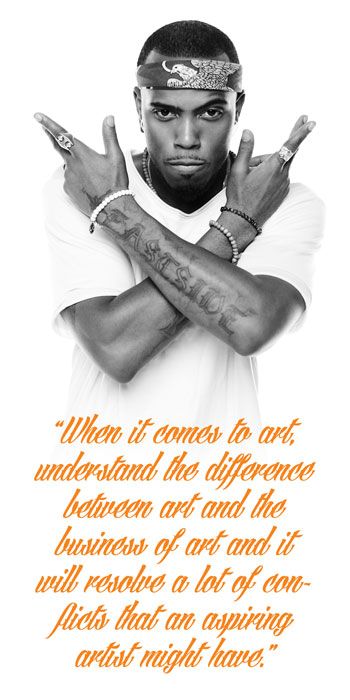
 MC: Your music touches on and draws from so many influences; has there ever been pressure on you to streamline your approach and simplify into one genre?
B.o.B: I feel like consistency is something that’s an enemy of my brand. Every time I get to the sound and think, “This is what I want to sound like,” I get into a different mood. I’m the type of writer who needs to have the freedom to create whatever I want to create. It’s hard for some people to accept that. Some people, when they hear something, label and compartmentalize it, and that’s it—that’s as far as their thought process goes.
MC: And your process extends further?
B.o.B: I’m the type of person who wants to push the envelope. I just let myself go wherever. I understand some people aren’t ready to experience this. It’s like a relationship, a conversation. I don’t see a boundary: Whereas other people might see a closed door, I see a runway.
MC: Are the fans able to keep up?
B.o.B: Honestly, if you look at the discography of my work and how fans have responded to it, it always changes. I was putting out my mixtapes, and when I put out my first album fans were like, “Why you making all of this big pop music, man? I want Bob from the mixtape days.” Then I put out Strange Clouds and they were like, “What are you doing with Taylor Swift and Lil Wayne and Nicki Minaj? I want the old B.o.B from ‘Airplanes’ and ‘Nothing on You.’” Then I put out Underground Luxury and they were like, “We want Strange Clouds.” What do they want? They don’t know what they want. It’s a conversation. People know I’m going to do something different, but I think a lot of people do pay attention to it. But ultimately I want to make a project where all the B.o.B fans can come out of hiding and say, “This is something I can relate to.” It’s a thing that everybody gets in on or can participate in in the social spectrum of music and how it collides with culture.
MC: We caught your performance a couple of Grammy seasons back at the BMI “How I Wrote That Song” panel with Evan Bogart, Busta Rhymes, Luke Laird and Snoop Dogg. What do you remember about that day?
B.o.B: You were there? That’s pretty crazy. I remember talking to Busta Rhymes about how videos have evolved. Videos are so fucking crazy. He said, “Bob, they used to spend a million dollars to make a video; now you try to get it down for a thousand.”
MC: You have mentioned to the press that Psycadelik Thoughtz is a cohesive work, correct?
B.o.B: Definitely. I had a lot of discussions with my team and the label about making sure that this project was one body of work and not a hodgepodge of different B.o.B. moments. Because of the different approaches, I felt like I was in a box but it was like, “Okay, Bob, it’s cool.”
As I talk myself through the projects I have to be patient and work through my own personal preferences and really concentrate on the end result and the product. I compare making music to cooking food in a restaurant. Some restaurants change their menus up every week or so, and some change seasonally and some don’t change at all. This record was like a special menu, so I had to spend time with the particular sound that I was going for.
MC: Tell us about your work habits. When do you like to get busy?
B.o.B: You’ve got to be a vampire and work late into the night. I’m getting to a point where I work better at night. During the day I’d rather live life, do things and be active. At night the city slows down. I can reflect on my thoughts a little better.
MC: Because it is less distracting?
B.o.B: I think it’s the rhythm of consciousness. Have you ever noticed how when it’s daytime––even if you’re in a quiet area, like a country road––it still feels like there’s a lot of shit going on? For some reason, at night everything calms down. When I’m in New York, it never sleeps, so it never feels like its calm. In Atlanta I stay in the country and I want to record at night when nothing’s going on and people aren’t hitting me up because everyone’s asleep. It’s a more creative time.