

MC: Such as?
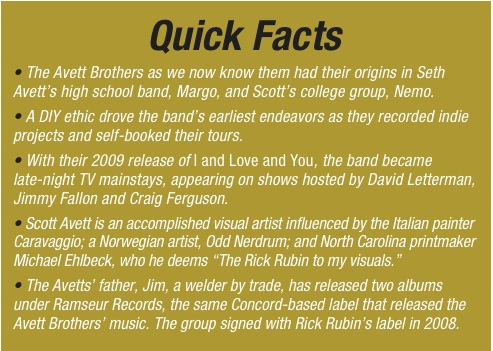
Avett: Before we were working with any major labels we had bestowed all of these deadlines upon ourselves––little deadlines to life and career oriented goals––that I think were causing problems and hindering the arc. Rick was able to put a bubble around us and say, “Make the arc and then present it, but don’t represent it until it’s great.” Nothing goes out the door until it’s ready. We know that. He’s like a fourth partner: Seth, Bob, Rick and I are four guys who are quality control, making sure that whatever we make together is the best it can be not based on deadlines, budgets or trends. Before, Seth and I weren’t identifying that.
MC: In what ways might he assist in this communication?
Avett: Rick can also be a mediator for Seth and me––if we need a third and we disagree, and we need to be told by somebody other than a brother. I respect Rick’s work so much. And the beauty is that he’s become a friend. You can’t anticipate or expect that, working with people in the business you have to keep it business-oriented. Maybe keep them from becoming friends. With Rick it’s been really natural. With pieces of the conversation that aren’t fun, fulfilling or rich, we don’t take time for them. We spend time on the good things.
MC: Is there a specific emotional environment that Rick constructs?
Avett: On the first album he created a challenge, someone to perform for, an audience. We were having a new relationship, so we challenged and pushed ourselves. I was determined to play drums, and I played from eight hours one day, and that was only on two songs. That’s not out of the ordinary, but we only used the track on one.
MC: Each of your albums with Rick has shown a marked progression?
Avett: With every recording and every good art there has got to be some evidence of exploration or something discovered. And when you have a new audience that’s an opportunity to discover something within yourself. You are performing especially for that audience. That happens every night as well, but here is somebody who has produced Red Hot Chili Peppers’ Blood. Sugar, Sex, Magik, that made us react and perform a certain way.
MC: So you won’t reveal strange stories of burning sage, quivering crystals and chanting?
Avett: All of the enchantment and this mystical vibe and “here’s this legend” were out the window, because we were men on the same level working for something great. Mysticism is such a fabricated and abstract thing; it’s way more about admiration and respect.
MC: Speaking of the Peppers, drummer Chad Smith plays on tracks on The Carpenter. It’s always interesting to see a rock drummer who is that versatile, isn’t it?
Avett: A great studio drummer can pull off any style. Chad is not tied to any specific genre; that is obvious in what he listens to and his character. Aside from being an amazing performer in a terrific band––and the energy he plays with onstage––he’s a terrific studio drummer. It’s an energy I understand and grew up with and try to bring to the stage. Seeing that energy from someone who has done it 20 years longer than you have and vibing with it––it’s really uplifting and inspiring––it will make you get down!
MC: What was it like to play with Dylan?
Avett: It was surreal, amazing and a dream come true. And it was a surprising endeavor that when we met for rehearsals out there––maybe Anaheim—it was amazing how quick it went into work mode. “Okay, Bob Dylan is here,” then it switched to we were playing chords, finding keys, seeing what worked and talking to each other. Asking Dylan, “Do you like this seventh chord thing?” And he’d say “Nice,” or “Keep it straight.” In the end Dylan loves to play and so do we.
MC: As SESAC songwriters, you and Mumford & Sons and Dylan all share a common performing rights organization. How did you choose SESAC as your PRO home?
Avett: We know them. They were a small company when we were a smaller company. We didn’t have anyone else coming to the table. Alongside our other early business connects they were very enthusiastic, and very out there for us, very cool and always willing to facilitate and accommodate what we needed––to answer questions. It was later that the other companies came to us. We’re proud to work with them, and we’ve maintained a relatively personal relationship that is interesting in the business. Nashville is a small town with a lot of big fish––SESAC maintains that.