
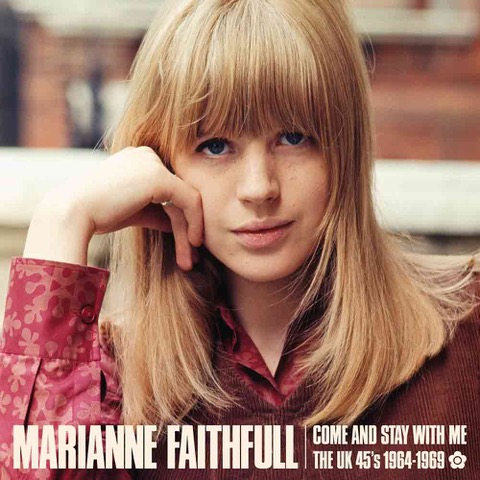
Released in time to mark what would have been Marianne Faithfull’s 80th birthday on December 29, 2026, this exceptionally rare live recording from her 1983 tour of Canada and America captures a powerful performance from Marianne at the height of her early-’80s resurgence following the release of her acclaimed multi-platinum, Grammy-nominated album Broken English.
An announcement from Braithwaite & Katz Communications described the upcoming Faithfull album.
“Taped at the Wax Museum in Washington D.C. on October 2nd 1983, Marianne and her band are on song as they perform a diverse setlist drawn from her 1979 comeback Broken English, follow-up LP Dangerous Acquaintances (1981) and the recently released A Child’s Adventure.
“The concert also features the previously unreleased track ‘Rising’. Transferred from the original analogue tapes and restored and mastered by Andrew Batt, the recording delivers exceptional clarity while preserving the raw intensity of the original performance. Released with the support of the Marianne Faithfull Estate, the limited-edition 180-gram 2-LP set features music across three sides and on side D an etching in Marianne’s handwriting of an excerpt from William Blake’s poem ‘The Tyger’ which she recites in ‘Eye Communication’.
“A true collector’s item, the package also includes a booklet with liner notes by Andrew Batt, featuring new interviews and previously unseen photographs and rare ephemera.”
Singer, songwriter, actress and author Marianne Faithfull passed away on January 30th.
Before she passed this year in January, Marianne completed work on two projects that were to commemorate her 60th anniversary in music; the first was her final EP Burning Moonlight, a collection of four songs inspired by her Decca recordings, the second was her contribution to this series of reissues where she talked in-depth about her Decca recording career for the first time.
On April 4, 2020, a Hollywood Reporter story by Alex Ritman reported the news “McQueen Director to Helm Marianne Faithfull Biopic with Bohemian Rhapsody StarLucy Boynton.”
Ian Bonhôte, who directed the acclaimed Alexander McQueen documentary McQueen, is now slated to direct the biopic Faithfull, starring actress Lucy Boynton, confirmedfor the lead role. Julia Taylor-Stanley (Coriolanus) of Artemis Films and Colin Vaines (Film Stars Don't Die in Liverpool) of Synchronistic Pictures is producing.
According to The Hollywood Reporter, the movie will depict “the star's roller-coaster journey from being discovered as a convent schoolgirl of 17, finding fame as a pop idol, living through hedonistic times and a tumultuous romance with Mick Jagger that inspired some of their greatest songs, to being a homeless drug addict in Soho.”
“I am delighted that my story is finally being made with my dream team of Lucy, Julia and Ian,” said Faithfull in a statement.
Broken English is a 2025 British documentary film written and directed by Iain Forsyth and Jane Pollard. It's an exploration of the life and career of English singer and actress Marianne Faithfull. It debuted at the Berlin Film Festival in 2025 and will be screened in 2026 at the 27th Newport Film Festival on October 15th-22nd.
Marianne’s catalog includes over 20 albums in her career. A 2018 effort on BMG, Negative Capability, hascollaborations with Keith Richards and Nick Cave.
Earlier this century, ABKCO Records issued a collection of Faithfull’s songs of the ‘60s, Marianne Faithfull’s Greatest Hits, spotlighting “As Tears Go By,” “Summer Nights,” “Come Stay with Me,” “This Little Bird,” and “Sister Morphine,” which she co-wrote with Mick Jagger and Keith Richards.
In 2000, I discussed Faithfull with her first record producer, Andrew Loog Oldham, the 1963-1967 record producer and manager of the Rolling Stones, for Discoveries magazine.
“The fact is forgotten that Marianne had, between August of ‘64 and the summer of ’65, four Top Ten hits in the UK. ‘As Tears Go By’ and ‘Come and Stay With Me’ held up.”
“As Tears Go By” is a song penned by Mick Jagger, Keith Richards and Andrew Loog Oldham. It reached a top ten position in the UK singles chart. The Stones then recorded their own version, included on the American pressing of December’s Children (And Everybody’s) in 1965.
Their American record label London issued “As Tears Go By” as a single that landed in the number six spot on the Billboard Hot 100 singles chart. The Rolling Stones subsequently performed the tune on an episode of The Ed Sullivan Show.
In 2016, author and deejay Oldham further elaborated about the 1963-1966 music business in England.
“For one, it was obvious that ‘this thing of ours’ was not going to disappear. We had come in following the Twist, Davy Crockett, Skiffle, and Trad Jazz. Skiffle and Trad Jazz had been very important; they had been the BBC and the Establishment’s last chance to control the key to what music we got to hear.
“There were villains, there was mayhem, action and if we had not had Pirate Radio, I might not have had a hit with Marianne Faithfull's ‘As Tears Go By.’ The BBC would not touch it. They said Marianne could not sing.
“Mind you, that's what they'd said about Mick Jagger a year earlier when the Rolling Stones failed their BBC live audition. They said ‘The singer cannot sing.’ The BBC was the enemy, a limp-wristed arm of the government trying to keep kids on a rationed musical diet of trad jazz and skiffle.”
I interviewed Marianne Faithfull in 1995 when Faithfull: An Autobiography, written with David Dalton, was published. Portions of our conversation were published in my first book This Is Rebel Music: The Harvey Kubernik InnerViews. Marianne Evelyn Gabriel Faithfull was born in Hampstead on December 29, 1946.

It was Faithfull’s friend, Allen Ginsberg, who encouraged me to look Marianne Faithfull up the next time she was in Hollywood. Faithfull had just done a show at The Henry Fonda Theater on Hollywood Blvd., and in the city. “Go talk to her and let her talk to you,” suggested Allen. Her publicist at Island Records arranged for me to visit her on Sunset Blvd. at the famed Chateau Marmont.
I knocked on the door to her hotel room, ironically, right next to the suite where years earlier I had interviewed and hung with Leonard Cohen.
My junior high school pinup girl was now in front of me. She was wearing no makeup, long blonde hair, and shorter in person than I expected, kind of a Juliette Greco meets later-day Gloria Grahame visual. Marianne has big green eyes. She turned out to be a fascinating interview subject. A real yenta. never avoided a question during our time together.
The left-handed Capricorn has a dancer’s body. In fact, twice during the two-hour chat, Marianne leaped off the couch onto the rug and sort of did a move, an interpretation of “the sideways pony” dance that Tina Turner once taught Mick Jagger in the hall way in front of her in 1965 at Colston Hall in Bristol, England.
She explained that her mother Eva, a ballet dancer, taught her to dance as a child. I then mentioned that I briefly danced on Dick Clark’s American Bandstand as a teenager, and many years after that, I had interviewed Tina Turner for the UK music periodical Melody Maker, and Tina gave me a very brief lesson on how to do “The Popcorn” dance.
“Whew…Remind me to give you a kiss and a hug when you leave today and don’t worry if my boobs get in the way,” she warned.
“No problem,” I assured her.
Room service delivered Marlboro Lights. She also ordered a vodka martini for our smokey conversation. I had a mineral water. The label paid. In any conversation, Marianne was confident and elegant.
Q. Throughout all your recording career, you’ve included speech or narrative aspects to your vocal singing style. You never had a ‘Motown’ voice. A.(laughs). It’s something I’ve done all my life. Listen to ‘Jabberwock.’ I’ve always included the spoken word. The talk. To their credit, really, the music business let me do it. Faithfull’s life in 2021, by Cave’s long-standing collaborator Warren Ellis, who produced Faithfull’s 2021 spoken word album She Walks In Beauty. During 1995 I interviewed Marianne Faithfull in 1995 when Faithfull: An Autobiography, written with David Dalton, was published. Portions of our conversation were published in my first book This Is Rebel Music: The Harvey Kubernik InnerViews.
Marianne Evelyn Gabriel Faithfull was born in Hampstead on December 29, 1946.
Room service delivered Marlboro Lights. She also ordered a vodka martini for our smoky conversation. I had a mineral water. The label paid. In any conversation, Marianne is confident and elegant.
Marianne Faithfull 1995 Interview with Harvey Kubernik
Q. Throughout all your recording career, you’ve included speech or narrative aspects to your vocal singing style. You never had a ‘Motown’ voice.
A.(laughs). It’s something I’ve done all my life. Listen to ‘Jabberwock.’ I’ve always included the spoken word. The talk. To their credit, really, the music business let me do it.
Q. How did your autobiography come together? I know you’ve been approached over the years and obviously film adaptations are being offered on this book and your life.
A. It took a long time. I have great recall.
Q. Why did you do the book?
A. I did it for you. (laughs). I did. I felt there was something in the story that was very common to everybody. I do believe that the details and the individuals are different, but the emotions and the sort of core thing are very, very connected to all human experience. Therefore, I felt it was a valid story to tell. And then again, I felt I was very close to some of the greatest people of my time. And I had a lot of help.
I knew it was going to be a really hard thing to do and it took a lot to get me to do it.
Q. Did the photos you considered trigger recall of events?
A. No. I’ve been carrying this around for a long time. And I had remembered the things that were important to me which were always the same. It was always very, very clear that what I was really interested in and always had been interested in was motive and psychic position and why. There were a million things I could not remember, which are not interesting to me.
Like most of the time I don’t remember what people were wearing. I remember what Allen was wearing, because often, Allen would take his clothes off. So, I would know that and understand that. I would see Allen clothed and unclothed. And that’s a very simple situation. And I remember one thing, I think is the White Ball and the black dress. So, it’s only on very clear demarcations like clothed, unclothed, black, white that I really know exactly.
Now Anita (Pallenberg) actually remembers things only through what we were wearing, ‘cause that’s what she’s interested in. I don’t mean that as a put down. But that’s how she remembers things. When I say, “Do you remember such and such a day…?” The way back for Anita is ‘Oh yeah... You were wearing a red velvet …and I was wearing…’” You’d dig her, man.
Q. In your Decca Records period, you covered Bob Dylan’s “Blowin’ In the Wind.” I noticed you were in a hotel room scene in Bob Dylan’s Dont Look Back documentary chronicling his 1965 British tour. Had you never seen a person like Dylan or an American like him in 1965?
A. Never. Never seen. Never in my wildest dreams could have imagined anyone like Bob in 1965. His brain, but I was frightened. I didn’t know they were probably more scared of me. I don’t know. He played me Bringing It All Back Home himself on his own. It was just amazing. I worshipped him anyway. That was where I got very close to Allen (Ginsberg) ‘cause Allen was the only sort of person I could recognize as being somewhat like me.
Q. I really enjoyed the passage in your book when Allen came to London with the Italian poet Giuseppe Ungaretti. They read at Queen Elizabeth Hall. You had spent some time with Ginsberg
A. (smiles). I find them very sexy all those guys. Wonderful. I teased Allen in my book. I adore him. The first time I went to Naropa, Allen was literally by my side like he is. There was a lot of criticism and ‘Who is the woman?’ ‘Why do you (Allen) think she can do this?’ And he didn’t say anything. ‘I just do.’ And then I came back again. We are very good friends. He also represents a lot of things for me that aren’t part of our friendship or our relationship. He is the greatest living American poet. I hooked Allen up with Hal Willner.
Q. There have been some books on Brian Jones and a musical re-evaluation of his many instrumental talents?
A. I use Brian. I have a whole lot of friends on the other side that I call up when I need them. I use Brian, Janis, and now I’ve got Tony Secunda and Denny Cordell. Well, Brian was a genius, but he was a very irritating person. Keith really loved Brian. They were all very much in love with me at that time. Not only me, but I was one of the many women they were in love with. Keith and I are still very close. I’m under his wing, and I know I will always be under his wing.
Q. In the autobiography, you write some of the Rolling Stones’ characters in their songs had emerged from taking LSD.
A. Of course they did. I don’t think acid is relative or relevant anymore. I wouldn’t do it again. But I think that it was important then, and I think it taught us a lot.
I mean, I pushed them away so much. It’s my fault. The door is open completely. I had to push them away, I suppose, to find my own spot. Much too much. Mick, too. ‘Cause I couldn’t stay in that position.
Don’t be too harsh on Mick. (smiles). You’d really like him and he’d support you. He’s a good guy.
Q: As you well know, I’ve always enjoyed discussing records with you and your fondness for the studio endeavors of Phil Spector and Jack Nitzsche.
A: I can tell you that while Andrew Loog Oldham turned me on to Phil Spector and Jack Nitzsche, Bob Crewe and the Four Seasons, the Mamas and the Papas, and a lot of things, the person who really educated me on the Motown level was Mick. I would have never gone that deeply into Motown without Mick. We just played the songs at home constantly. It must have been great fun for him...
There I am at age nineteen, and I've never listened to the Miracles before. 'The Tracks of My Tears...' Mick would run down the bass lines, song constructions on the label, and actually act out the songs in front of me! [Chuckles]. It was really an amazing education. And, of course, when I wanted another type of thing, I'd go and see Keith, and then it was all blues. It all kind of fitted in somehow.
Mick and I wore out the grooves on the records so much we'd have to buy them again. For a long time, it was Vivaldi and Marvin Gaye that were played in the morning. That's how we lived. Which is so wonderful. And I had Mick telling me everything. He knew everything. He knew the names of the session musicians at a snap. So did Jack Nitzsche. Brilliant man. We never could quite get it together to do an album, but at least we have “Sister Morphine."
Q: May I proudly announce to you that I recently did a series of interviews with the Funk Brothers, the surviving Detroit-based Motown session men who are spotlighted in the documentary film, Standing in the Shadows of Motown.
A: I'm dying to see that movie. Oh man...Oh man… Nice to see the players get some attention. I like the idea that Berry Gordy, Jr. still cares that much. He cares about the Motown legacy, and we're not just talking about money. There's something he did there that he cares very much about. It's incredible. Obviously, he knows what he did, but for me, it changed my life. I found the Stax records myself. I was lucky.
Mick knew the Motown records already, but they knocked me for a six. That's why I know about the Four Tops doing 'Walk Away Renee.' I spent years listening to Motown. Smokey Robinson...His voice...The Love I Saw In You Was Just a Mirage.' [Sings the first two lines]. The most beautiful stuff I've ever heard...And to this day I'm sure some Motown songs are in the Stones' live repertoire.
Q: I read decades ago you were raised Catholic, but mutual friends reminded me that my dream shiksa was Jewish. In England you went to a Roman Catholic Boarding School, St. Joseph’s.
A: My dear little Piscean. My mother and my grandmother were Jewish. My mother came from a line of Austro-Hungarian aristocrats. My mother was a doctor’s daughter. She was a Jewess, those great Jews who went out and did it from the Austro-Hungarian Empire. Doctors, writers, sort of like going into Oklahoma. Allen Ginsberg now is my Jewish Mother.”
(Harvey Kubernik is the author of 21 books, including 2009’s Canyon Of Dreams: The Magic And The Music Of Laurel Canyon, 2014’s Turn Up The Radio! Rock, Pop and Roll In Los Angeles 1956-1972, 2015's Every Body Knows: Leonard Cohen, 2016's Heart of Gold Neil Young and 2017's 1967: A Complete Rock Music History of the Summer of Love.
Sterling/Barnes and Noble in 2018 published Harvey and Kenneth Kubernik’s The Story Of The Band: From Big Pink To The Last Waltz. In2021 they wrote Jimi Hendrix: Voodoo Child for Sterling/Barnes and Noble. Otherworld Cottage Industries in 2020 published Harvey’s Docs That Rock, Music That Matters.
His writings are in several book anthologies, most notably The Rolling Stone Book Of The Beats and Drinking With Bukowski. Harvey wrote liner notes to the CD re-releases of Carole King’s Tapestry, The Essential Carole King, Allen Ginsberg’s Kaddish, Elvis Presley The ’68 Comeback Special, The Ramones’ End of the Century and Big Brother & the Holding Company Captured Live at The Monterey International Pop Festival.
During 2006, he spoke at the special hearings initiated by The Library of Congress held in Hollywood, California, discussing archiving practices and audiotape preservation. In 2017, Kubernik appeared at the Rock and Roll Hall of Fame in Cleveland, Ohio, as part of their Distinguished Speakers Series.